
BorgWarner Navigates Global Trade Turbulence Leveraging TurboCell Innovation
BorgWarner’s broad global footprint, recent earnings strength, and TurboCell technology underpin resilient growth amidst complex geopolitical headwinds.
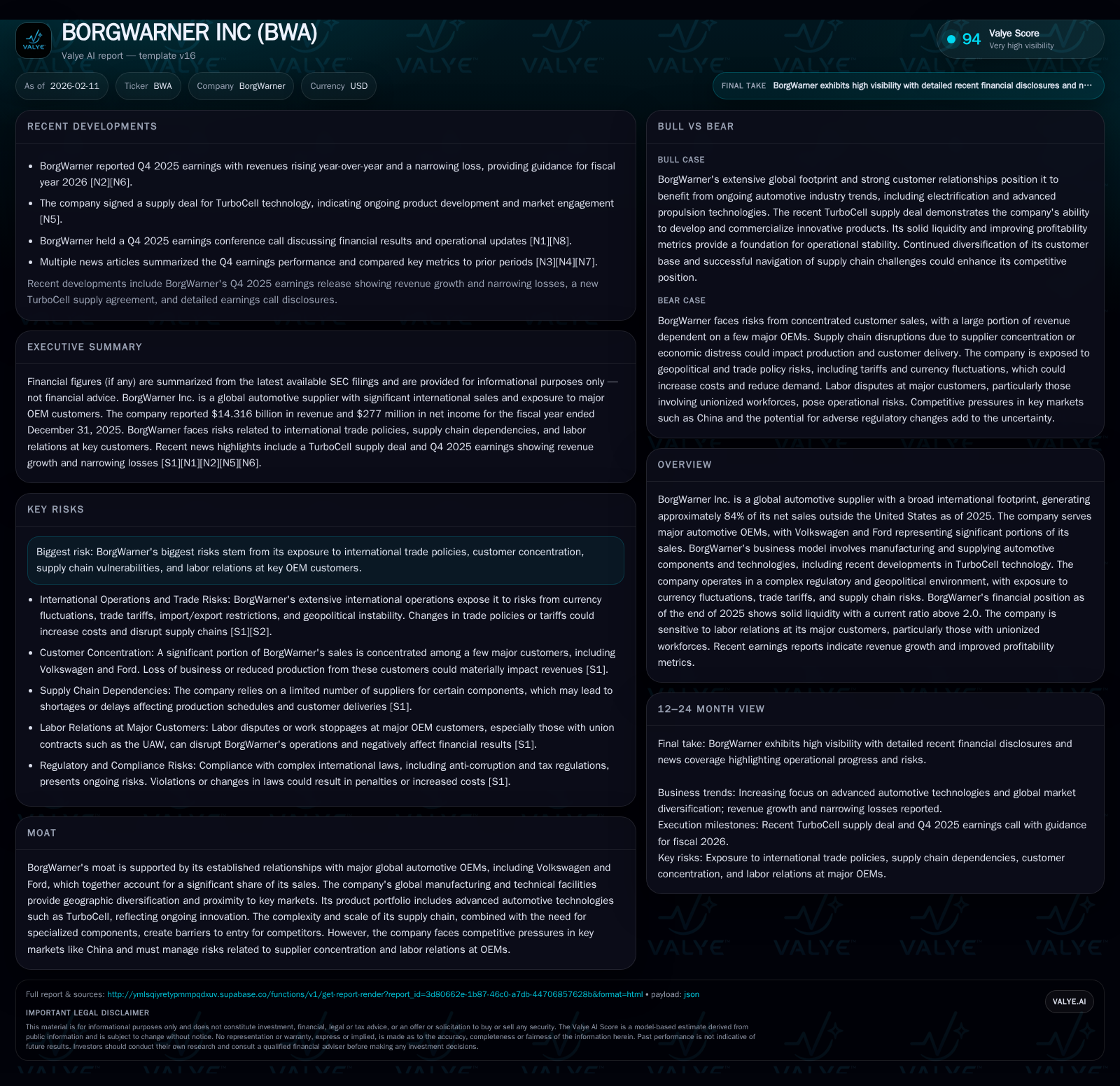
BorgWarner Inc., a pivotal automotive components supplier with roughly 84% of its sales abroad, has demonstrated notable earnings outperformance in Q4 2025, driven by operational execution and strategic innovation. Its pioneering TurboCell technology creates a technological moat that strengthens client ties and barriers to entry. Yet, the company remains exposed to customer concentration risks and volatile global trade policies, including tariffs and retaliatory measures that could squeeze margins. With a strong liquidity profile and improving profitability trends, BorgWarner is poised to balance growth investments against ongoing macro uncertainties in 2026.
Navigating the Global Automotive Supply Chain: BorgWarner’s International Footprint
BorgWarner Inc. stands out as a truly global automotive supplier, with about 84% of its net sales generated outside the United States in 2025 [valye_report_excerpt]. This international orientation reflects both the company’s extensive manufacturing bases and its strategic alignment with major original equipment manufacturers (OEMs) worldwide—most prominently Volkswagen and Ford. These OEM relationships anchor BorgWarner’s revenue stream but also impose sensitivity to global market fluctuations including currency exchange risks and regional regulatory dynamics.
Such geographic diversification brings operational advantages like proximity to key end markets and access to multiple sourcing regions. However, it also exposes BorgWarner to shifting cross-border trade policies that have gained renewed prominence recently under evolving U.S. administration tariff regimes [S1]. The company’s import origins span critical manufacturing hubs including Mexico (55%), Canada (10%), South Korea (10%), Germany (5%), Malaysia (5%), and China (5%) [S2]. Each location introduces unique challenges related to geopolitical tensions or trade barriers.
This sprawling footprint means BorgWarner must adeptly manage complex supply chains amid fluctuating trade environments—a task increasingly demanding given the ongoing restructuring of global automotive production networks. The reliance on large OEMs further accentuates this intricacy since these customers’ production volumes directly affect BorgWarner’s order flow.
Q4 2025 Performance: Beyond Expectations
BorgWarner’s Q4 2025 financial results delivered an encouraging narrative beyond Street expectations. The company reported revenues of approximately $14.3 billion for the full year 2025, growing year-over-year with particular strength in the fourth quarter [F1][N2][N3]. Net losses narrowed significantly during this period, reinforcing improving operational leverage amid still-challenging supply conditions [N14].
Several key metrics outpaced analyst forecasts including revenue beats reported across multiple sources [N1][N4][N5]. This performance reflects effective cost management alongside higher volume shipments tied to recovering global vehicle production levels. Market commentary highlights that tighter execution on supply logistics and streamlined manufacturing contributed materially to improved profitability trends.
In concert with top-line progress, BorgWarner showcased resilience in margin expansion despite inflationary pressures on raw materials exacerbated by tariffs—a testament to disciplined pricing strategies balanced against competitive constraints [N14]. These results offer an early indication of strengthened earnings power heading into FY2026.
TurboCell Technology: Innovation as a Competitive Moat
At the heart of BorgWarner’s durable competitive positioning lies its cutting-edge TurboCell technology platform [valye_report_excerpt][moat]. This advanced automotive component innovation exemplifies the company’s R&D efforts aimed at capturing next-generation propulsion efficiency gains sought by OEMs amidst tightening emissions regulations globally.
Recent announcements around key TurboCell supply agreements substantiate operational progress transforming conceptual technology into commercial scale deliveries [N13]. Such contracts reinforce customer confidence while deterring potential new entrants who may lack similar technical sophistication or scale.
The integration of TurboCell underscores BorgWarner's prioritization of innovation as not merely a product offering but as a strategic moat: providing enhanced differentiation through proprietary design complexity coupled with established manufacturing capabilities straddling multiple regions [moat]. This synergy between technological leadership and expansive production footprint is critical given intensified competition across electrified vehicle components particularly in dominant markets like China.
Customer Concentration and Labor Dynamics: Double-edged Swords
BorgWarner’s heavy reliance on prominent customers such as Volkswagen and Ford introduces concentrated revenue dependencies that carry inherent cyclicality risks [valye_report_excerpt][S1]. Both automakers possess sizeable unionized workforces whose labor negotiations periodically pose disruption threats ranging from production slowdowns to temporary shutdowns affecting component orders.
These labor dynamics can propagate downstream volatility for suppliers like BorgWarner, complicating demand forecasting and inventory management. Additionally, concentrated client portfolios increase exposure to any sudden changes in purchasing patterns resulting from OEM strategic shifts or product cycle delays.
Furthermore, union-related wage inflation pressures within these OEM partnerships may indirectly impact component pricing negotiations or contribute to cost increases that challenge supplier margin preservation [valye_report_excerpt][risks]. Consequently, while deep customer engagement fosters long-term collaboration opportunities, it also necessitates vigilant risk mitigation measures addressing labor relations’ unpredictability.
Trade Policies and Tariffs: Risks in an Uncertain Landscape
One of BorgWarner’s paramount external challenges arises from the evolving landscape of international trade policies characterized by tariff impositions and retaliatory measures enacted since 2024-25 [S2][valye_report_excerpt][risks]. The U.S. government’s introduction of significant tariffs targeting imports from major economic partners including the EU, Mexico, Canada, and China has injected fresh cost pressures into raw material procurement channels essential to BorgWarner’s manufacturing processes.
These tariffs not only inflate input costs directly but also trigger reciprocal tariffs abroad increasing expenses on finished goods sold internationally—Magnifying margin compression risks. Approximately $875 million worth of imports into the U.S. stem from tariff-sensitive countries such as Mexico (55%) and China (5%), laying bare tangible vulnerabilities within procurement frameworks [S2].
Adding complexity are ongoing uncertainties around potential future tariff expansions or modifications to existing trade agreements that could reshape supply chain geographies yet again. Although management references initiatives intended to partially offset these impacts through alternative sourcing or price adjustments, success is not guaranteed given global competition intensity and limited supplier alternatives [S2].
Financial Health: Liquidity and Profitability Under the Microscope
From a balance sheet perspective, BorgWarner exhibits financial stability conducive to navigating short-term volatility while investing for sustained growth [F1][N14][valye_report_excerpt]. Key indicators include a current ratio exceeding 2.0 as of year-end 2025—evidencing ample liquidity buffers relative to near-term obligations.
Coupled with tightened loss containment demonstrated in Q4 earnings releases, profitability metrics reflect incremental margin recovery after periods marked by inflationary cost shocks and production disruptions. Cash flow generation remains sufficient to support R&D outlays such as TurboCell advancements alongside working capital needs tied to global operations expansion.
While cautious about macroeconomic headwinds potentially impacting end-demand elasticity among OEM clients, management signals confidence in maintaining robust financial discipline tailored toward preserving capital flexibility amid persistent market uncertainties [N14].
Comparative Landscape: BorgWarner Among Industry Peers
Situating BorgWarner versus its automotive supplier peers illustrates its relative strength anchored by technology-intensiveness amid competitive pressures faced by Magna, Cummins, Modine, among others [N7][N9][N11][N12]. While many competitors grapple with similar supply chain stresses and geopolitical concerns, BorgWarner’s early adoption of TurboCell technology reflects a differentiation pathway not uniformly matched across its cohort.
Earnings momentum comparisons reveal that although sector-wide challenges temper acceleration potential universally, BorgWarner's successful delivery on both growth targets and innovative contracts sets it apart as better positioned for capturing emerging electrification trends driving future demand transformation footprints.
2026 Outlook and Strategic Guidance: Managing Risks, Pursuing Growth
Looking forward into fiscal year 2026, BorgWarner adopts a measured yet optimistic stance balancing continuous technological leadership with pragmatic risk management protocols addressing tariff impacts and labor sensitivities at key customers [N14][N10][S1]. Management commentary underscores their commitment to fortify operational resilience while expanding TurboCell commercialization efforts designed to entrench competitive advantages deeper within OEM platforms.
The interplay between sustaining R&D investments against an uncertain macro backdrop defines strategic priorities alongside enhancing cost discipline initiatives aiming at margin fortification notwithstanding inflationary headwinds or political trade frictions. This calibrated approach suggests management aims neither to overextend nor underinvest but rather navigate evolving industry contours prudently emphasizing long-term value creation fundamentals.
Disclaimer: This memorandum is prepared solely for informational purposes based on publicly available data as of February 11, 2026. It does not constitute investment advice or recommendations. Investors should conduct their own analysis before making any investment decisions.
Disclaimer: This is research-only, informational analysis and not investment advice. It may include AI-generated interpretation and general industry context. Always verify important details using primary sources.

Comments