
Birks Group Expands Canadian Retail Footprint and Advances E-Commerce Amid Operating Profit Turnaround
Birks Group reports a return to profitability with targeted retail expansion and enhanced omnichannel focus supporting its luxury jewelry leadership in Canada.
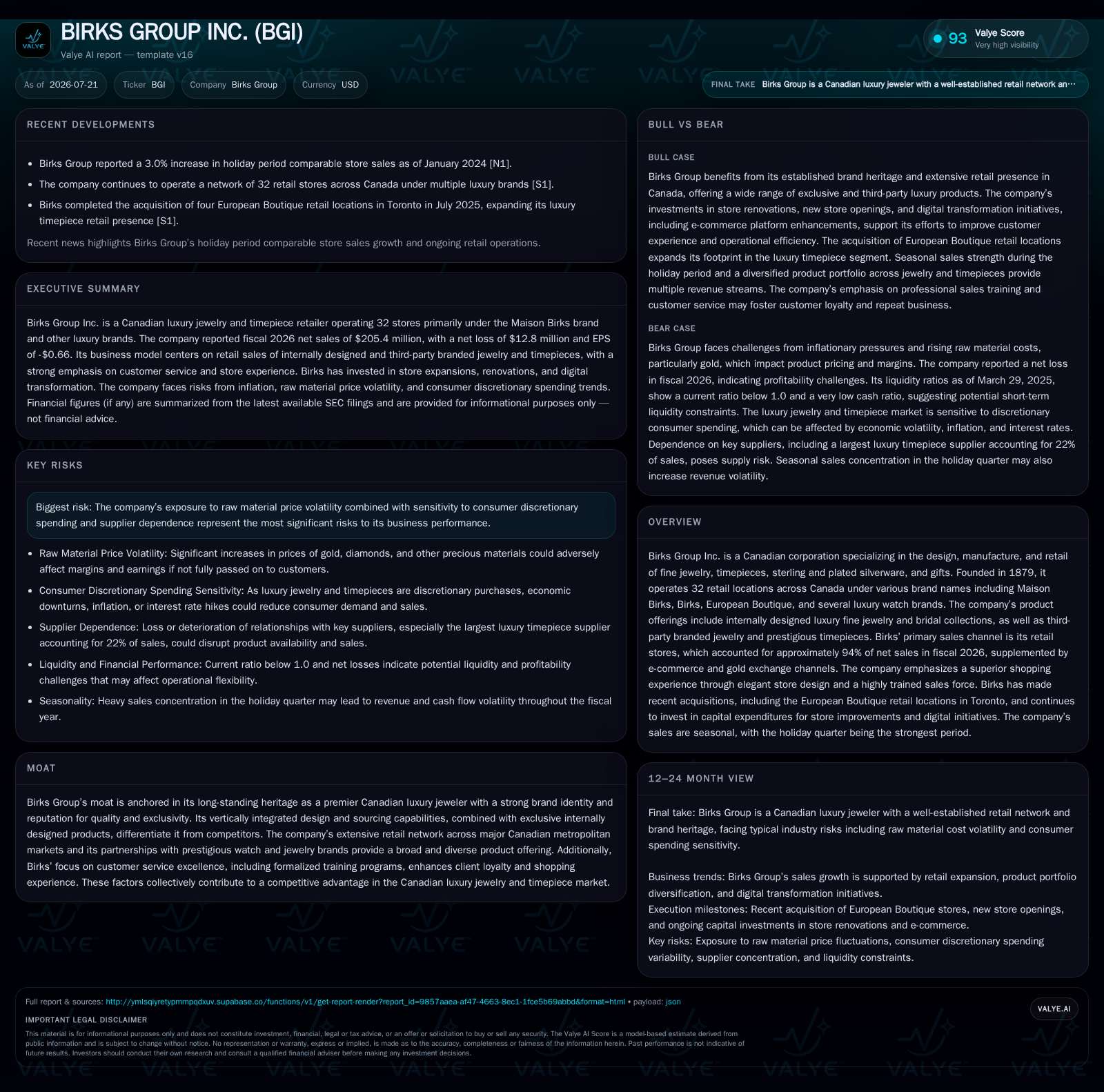
Birks Group Inc., a heritage Canadian luxury jeweler, returned to adjusted operating profitability in fiscal 2026, driven by new store openings and investments in e-commerce platforms. Operating 32 stores nationwide, including recent acquisitions such as European Boutique locations, the company leverages exclusive internally designed fine jewelry and partnerships with prestigious watch brands. Despite industry challenges like raw material price volatility and discretionary spending sensitivity, Birks' vertical integration and customer experience emphasis underpin its competitive moat. Key growth vectors include retail footprint expansion in major urban centers, development of the online channel, and curated branded collections. Liquidity remains tight with a current ratio under one, spotlighting working capital and inventory management as critical near-term focuses.
Recent Operating Update
Birks Group Inc., a cornerstone in Canadian luxury fine jewelry retailing since 1879, reported a notable improvement in fiscal 2026 results ending March 28. After excluding approximately $0.2 million in impairment losses on long-lived assets (compared to $4.6 million last year), the company posted an adjusted operating income margin of 1.6%, a recovery from an adjusted operating loss of -0.5% one year prior [S1]. This turnaround reflects strategic realignment emphasizing profitable store footprint management alongside ramped e-commerce efforts.
The company’s retail segments remain overwhelmingly dominant in revenue composition—about 94% of net sales stem from its physical stores across Canada’s major metropolitan areas [S1]. As of June 30, 2026, Birks operated 32 stores under various banners: Maison Birks flagship outlets; specialty boutiques carrying luxury watch brands such as Patek Philippe and Breitling; plus acquired European Boutique locations in the Greater Toronto Area [S1]. New store openings include one launched in June at Vancouver’s renovated mall and plans for a dedicated mono-brand Birks boutique also in Vancouver later in the year, signaling ongoing geographic expansion focused on affluent urban markets [S1].
The company is also investing in strengthening its e-commerce platform to capture growing online luxury jewelry demand—a segment complementing but still smaller than store sales [S1]. This omnichannel approach addresses shifting consumer shopping behaviors post-pandemic, combining digital discovery with in-store experiences.
Business Model Analysis
Birks operates a vertically integrated business model encompassing the design, manufacture, and retail of high-end fine jewelry, luxury timepieces, sterling silverware, and gift items primarily within Canada. This vertical integration enables tighter control over exclusive product designs and quality standards, critical differentiators in the luxury segment where brand heritage supports premium pricing and customer loyalty.
Revenue is predominantly generated through direct retail sales at brick-and-mortar stores, supplemented by an expanding e-commerce channel [S1]. Monetization centers on proprietary branded jewelry collections benefiting from Birks’ longstanding reputation, alongside licensed partnerships with prestigious watchmakers such as Patek Philippe and Omega, broadening the product mix and customer appeal.
Key operating variables impacting revenue include foot traffic in physical stores—driven by location quality and marketing initiatives—average transaction value influenced by product mix premiumization, conversion rates enhanced through customer service training, and the growth of the online channel supported by digital marketing investments [S1]. Margins benefit from the proprietary nature of much inventory due to internal design capabilities but remain sensitive to raw material cost fluctuations, notably gold and precious stones, as well as competitive pricing pressures during economic downturns.
Inventory turnover is a critical KPI, as excess or obsolete stock necessitates markdowns that erode profitability—an acute risk in discretionary luxury goods. Birks’ ongoing assessment of store productivity leads to closures of underperforming locations balanced against selective openings in premium urban sites.
Industry Structure and Competitive Positioning
The luxury retail jewelry sector is characterized by high barriers to entry, including brand equity requirements, skilled craftsmanship, supplier relationships for precious metals and gemstones, and capital-intensive upscale retail presence. Birks operates primarily within Canada, limiting global scale advantages but leveraging deep national brand heritage dating back over a century.
Peers such as Tiffany & Co., Richemont’s Cartier and Bulgari brands, and Signet Jewelers represent broader multinational or multi-brand models with significant global scale and diversified portfolios. Online pure plays like Blue Nile offer price-focused alternatives targeting digitally native customers but often lack the experiential elements fundamental to high-ticket jewelry sales.
Birks’ competitive moat derives from its vertically integrated product design control combined with a curated store network positioned in affluent urban centers, facilitating personalized client experiences—an advantage difficult for mass-market retailers or online-only sellers to replicate. Brand exclusivity supports premium pricing and gross margins despite raw material cost volatility. Partnerships with prestigious watch brands further elevate the product portfolio, differentiating Birks from smaller local jewelers.
Growth Drivers
Key momentum drivers include:
- Retail Footprint Expansion: Targeted openings in high-profile malls, such as Vancouver’s renovated mall, align with urban wealth concentrations to enhance foot traffic and market penetration [S1]. Concurrent closures of underperforming stores optimize network efficiency.
- E-Commerce Ramp-Up: Investments in digital infrastructure aim to grow the online sales channel, reflecting evolving consumer preferences toward digital discovery combined with showrooming effects supporting offline purchases [S1].
- Exclusive Internally Designed Collections: Continued development of proprietary collections leverages brand heritage and enables stronger margin capture compared to third-party branded product sales.
- Bridal and Gifting Segments: These remain core revenue streams supported by enduring social traditions, providing stable demand amid macroeconomic uncertainties.
- Luxury Watch Partnerships: Expansion of boutiques carrying high-demand timepieces taps into rising global appetite for certified pre-owned watches, maintaining attractive margins.
- Customer Service Investment: Enhanced sales force training improves conversion rates and repeat purchasing behavior, vital for long-term client retention.
Operational improvements in inventory management—balancing availability without excess—will support margin resilience as discretionary spending fluctuates.
Risks and Watchpoints
Several challenges could constrain Birks’ trajectory:
- Raw Material Price Volatility: Fluctuations in gold and diamond prices directly impact cost structures; inability to pass through cost increases could compress margins.
- Discretionary Consumer Spending Sensitivity: Luxury jewelry purchases are cyclical; economic slowdowns or inflationary pressures risk dampening volumes.
- Inventory Obsolescence and Markdown Risk: Overstocked or seasonally outdated items pose write-down hazards compromising profitability.
- Supplier Dependence: Reliance on external watch brands introduces risks if contractual terms change unfavorably or supply chain disruptions occur.
- Retail Location Productivity Pressures: High fixed costs associated with prime real estate require consistent foot traffic; failure to maintain compelling store experiences may trigger closures affecting topline stability.
- Competitive Intensity: Mid-sized players like Birks face pressure from global luxury conglomerates leveraging scale and online disruptors competing on price or convenience.
- Cybersecurity Threats: Growing e-commerce reliance increases exposure to cyber risks; however, governance under the Chief Privacy Officer provides proactive oversight mitigating this concern [S1]
What to Watch Next
Key indicators to monitor include:
- Quarterly same-store sales growth rates, reflecting consumer demand health across physical stores.
- E-commerce channel growth, capturing shifts in omnichannel adoption.
- Launches or refreshes of internally designed branded collections, signaling innovation sustaining exclusivity premiums.
- Expansion plans for new boutiques or renovations that could drive incremental foot traffic.
- Inventory turnover trends, revealing effectiveness of working capital management amid economic headwinds.
- Margin progression, particularly gross profit percentage navigating raw material cost changes.
- Disclosures regarding changes in partnerships with key third-party watch brands impacting sales composition or pricing power.
Financial Profile Discussion
As of March 29, 2025, Birks reported current assets of approximately $126 million against current liabilities near $150 million, resulting in a current ratio of about 0.85, indicating typical luxury retail working capital intensity exacerbated by inventory holdings awaiting sale [F1]. Cash and equivalents stood at approximately $1.5 million, highlighting reliance on operating cash flow generation or external liquidity sources for funding growth initiatives or debt servicing obligations [F1].
Total debt and net debt figures are only available as of March 2021, at $53.7 million and $52.2 million respectively, and thus do not reflect the current leverage position [F1]
The sub-unity current ratio reflects the capital-intensive nature of luxury retail inventory management. Given limited net cash relative to liabilities, even minor disruptions could strain liquidity without external funding or accelerated receivables collection. Monitoring quarterly cash flow statements alongside KPIs such as inventory turnover will provide insight into financial health amid expansion efforts.
This analysis synthesizes recent SEC-filed disclosures up through July 21, 2026 alongside company facts data as of March 29, 2025 without investment advice or explicit valuation opinions. The evolving macroeconomic backdrop, including commodity price volatility and consumer spending patterns, continues shaping Birks Group's operational challenges and opportunities within Canada's concentrated yet competitive luxury jewelry industry landscape.
Disclaimer: This is research-only, informational analysis and not investment advice. It may include AI-generated interpretation and general industry context. Always verify important details using primary sources.

Comments