
KKR Real Estate Finance Trust Advances Leverage and Credit Management in Tightening CRE Markets
KKR Real Estate Finance Trust’s Q2 2026 update shows strategic portfolio vigilance and capital structure refinement amid persistent CRE market headwinds.
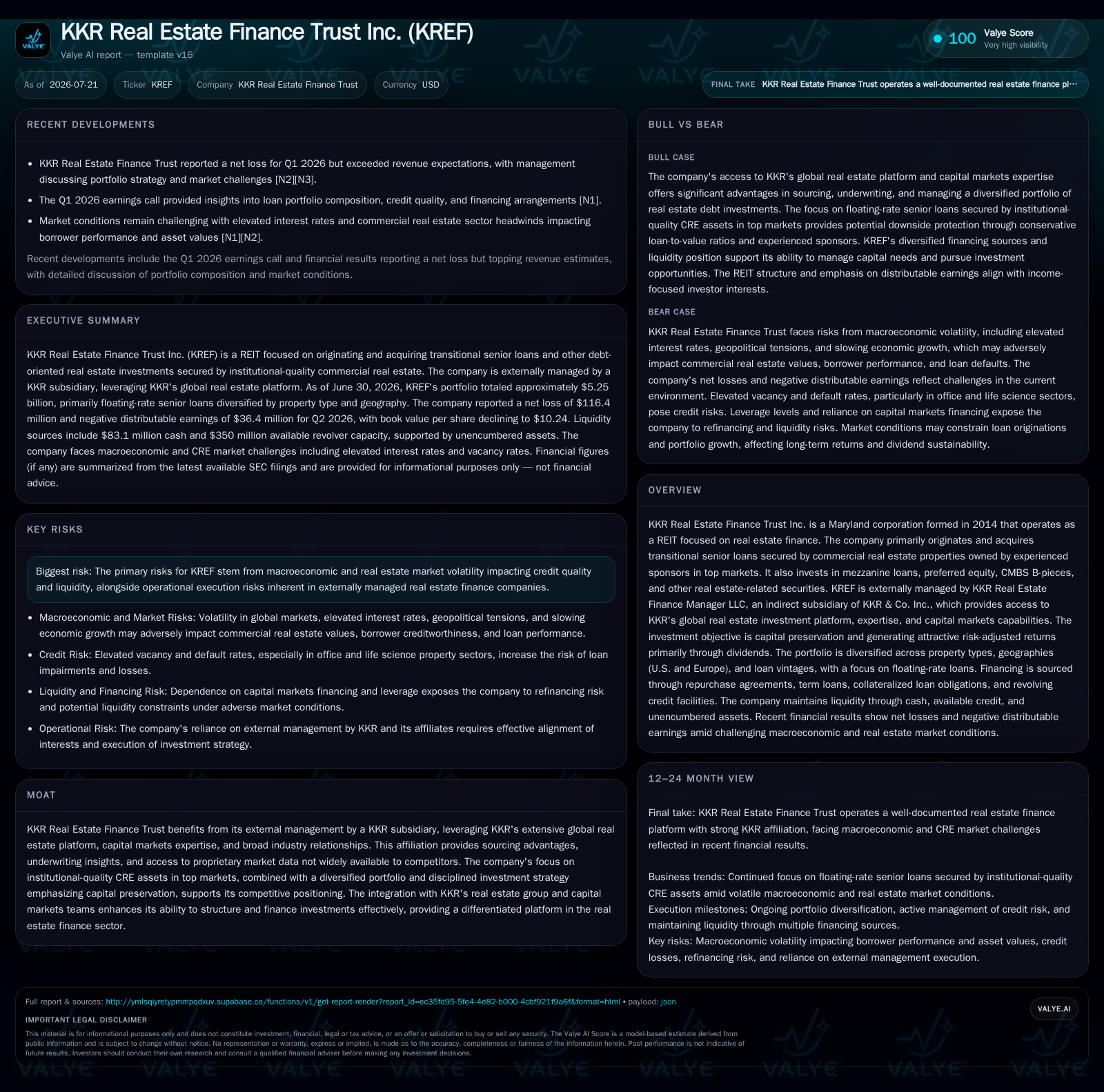
KKR Real Estate Finance Trust (KREF) reported a measured increase in leverage ratios as of Q2 2026, reflecting opportunistic capital deployment in a challenging commercial real estate environment. The externally managed REIT emphasizes capital preservation through diversified senior and mezzanine loan portfolios, supplemented by real estate securities, all underpinned by cautious underwriting and active credit surveillance. Financing strategies rely heavily on non-mark-to-market, match-term borrowings, including expanded secured term loans and collateralized loan obligations, supporting stable liquidity without excessive exposure to market volatility. Nonetheless, macroeconomic uncertainties and sector-specific risks such as increased vacancy rates and elevated credit loss provisions necessitate ongoing risk management vigilance.
Recent Operating Update
KKR Real Estate Finance Trust (KREF) reported a strategic increase in leverage during Q2 2026, with its debt-to-equity ratio rising to 2.6x from 2.1x at year-end 2025 and total leverage increasing to 4.3x from 3.9x, reflecting measured capital deployment amid ongoing commercial real estate (CRE) market challenges [S2]. This leverage expansion aligns with KREF’s focus on opportunistic lending within transitional senior loans secured by institutional-quality CRE assets, primarily in top U.S. and European markets. The portfolio’s emphasis on floating-rate senior loans provides a natural hedge against rising interest rates, while mezzanine loans, preferred equity, and commercial mortgage-backed securities (CMBS) B-piece tranches contribute to portfolio diversification and enhanced risk-adjusted returns [S2], [S1].
The externally managed REIT benefits from KKR Real Estate Finance Manager LLC’s extensive sourcing capabilities and underwriting expertise, leveraging KKR’s global platform and proprietary market intelligence to maintain disciplined portfolio construction and credit risk management [S1], [S2]. This external management model enables real-time market insights and access to a broad pipeline of CRE lending opportunities, supporting KREF’s competitive positioning in a crowded lending environment.
Portfolio surveillance remains rigorous, with quarterly credit quality assessments integrating operational metrics from underlying properties, borrower financial health, and guarantor evaluations. Loan documents grant KREF rights such as budget approvals, tenant lease consents, and enforcement of covenants, facilitating proactive intervention when credit deterioration risks arise. Recent increases in credit loss provisions have been concentrated in office and life sciences sectors, which face elevated vacancy rates and tenant demand softness amid shifting market fundamentals [S18]
Business Model Specifics
KREF operates as a REIT structured holding company, externally managed by KKR Real Estate Finance Manager LLC, generating revenue primarily through net interest income on its loan portfolio and supplemented by origination and asset management fees [S1]. The company’s loan portfolio predominantly consists of senior CRE loans with conservative loan-to-value (LTV) ratios averaging approximately 68% at origination, targeting transitional assets owned by well-capitalized sponsors [S1]. Asset types include office buildings, industrial properties (including life sciences facilities), retail centers, hotels, and multifamily residential projects diversified across major U.S. metros and select European hubs.
Financing strategy centers on non-mark-to-market borrowings, which accounted for approximately 79% of total financing as of June 30, 2026. These financing sources include collateralized loan obligations (CLOs), secured term loans, warehouse facilities, and revolving credit facilities, providing match-term, non-recourse funding that reduces earnings volatility linked to credit market fluctuations [S2], [S4]. The secured term loan facility was upsized to $650 million with a tightened spread of S+2.5% and extended maturity to March 2032, featuring partial amortization that mitigates near-term refinancing risk [S4], [S8].
KREF also invests in subordinate CMBS tranches, which offer incremental yield opportunities above senior loan benchmarks but require active credit monitoring due to higher risk concentrations. The company’s disciplined underwriting and portfolio diversification across property types and geographies support its capital preservation mandate while targeting attractive risk-adjusted returns.
Industry Structure & Competitive Position
Within the Real Estate Finance REIT sector, KREF competes with publicly traded peers such as Apollo Commercial Real Estate Finance, Blackstone Mortgage Trust, and Starwood Property Trust, as well as private real estate debt funds and specialty finance companies [S1]. Competition is intense due to abundant capital inflows into CRE lending and evolving regulatory landscapes that have eased traditional bank lending constraints post-Dodd-Frank reforms
KREF’s competitive advantage derives from its integration with the broader KKR platform, which provides scale in sourcing, underwriting rigor, and access to proprietary market data. This integration supports disciplined loan origination and portfolio management, enabling KREF to navigate competitive pressures while maintaining prudent leverage and credit quality standards. The company’s focus on transitional loans backed by experienced sponsors in premier markets positions it to capitalize on demand for bridge and structured financing solutions amid tightening CRE credit conditions.
Risks & Watchpoints
Key risks include:
Macroeconomic and CRE Market Risks: Persistent headwinds such as slowing economic growth, inflationary pressures, and geopolitical uncertainties adversely affect CRE asset valuations and borrower creditworthiness. Office and life sciences sectors are particularly vulnerable due to elevated vacancy rates and tenant demand shifts, increasing credit loss provisions [S18]
Interest Rate Volatility: While floating-rate loan portfolios benefit from upward rate resets enhancing loan yields, rising funding costs and potential widening of leverage spreads could compress net interest margins, impacting distributable earnings.
Liquidity and Refinancing Risks: Although KREF maintains robust liquidity buffers—including $83 million in cash and over $380 million in undrawn revolver capacity as of Q2 2026—master repurchase agreements with credit mark-to-market provisions pose margin call risks if collateral values decline, potentially reducing borrowing capacity [S16], [S22].
Operational and External Management Risks: Reliance on external management necessitates alignment of incentives and effective oversight to ensure portfolio discipline and risk management during volatile market conditions.
Regulatory and Tax Risks: Changes in REIT qualification rules, tax legislation, or Investment Company Act interpretations could affect distribution policies, operational flexibility, and capital structure strategies.
What to Monitor
Key variables to watch include:
Distributable Earnings vs. Dividends: Monitoring coverage ratios provides insight into dividend sustainability amid evolving credit costs.
Loan Portfolio Yield and LTV Trends: Changes in loan repricing and collateral valuations across property types signal portfolio health and risk-adjusted returns.
Non-Performing Loan Ratios: Particularly in office and life sciences sectors, rising delinquencies may presage increased credit losses.
Leverage Metrics: Movements in debt-to-equity and total leverage ratios indicate shifts between growth-oriented capital deployment and risk mitigation through deleveraging.
Capital Raising Activities: Equity or debt issuances, including ATM programs, inform on growth capital availability and balance sheet flexibility.
CLO Performance: Stability of cash flows from CLO structures underpinning non-mark-to-market financing affects earnings volatility and liquidity.
Regulatory Developments: Manager commentary on tax and regulatory changes impacting REIT operations remains critical.
Financial Profile Discussion
As of June 30, 2026, KREF held approximately $83 million in cash and equivalents, complemented by over $380 million in undrawn revolver capacity and additional borrowing availability through collateral-backed facilities, providing a substantial liquidity buffer to support ongoing operations and opportunistic investments [S18], [S22], [F1]. Total debt stood near $3.03 billion, with net debt approximating $2.95 billion after cash offsets, consistent with the increased debt-to-equity ratio of 2.6x compared to 2.1x at year-end 2025, reflecting prudent leverage expansion aligned with selective portfolio growth [S2], [F1].
The secured term loan facility, refinanced in March 2025 and upsized in September 2025 to $650 million, features a reduced spread of S+2.5% and extends maturity to 2032, with partial amortization reducing near-term refinancing risk [S4], [S8]. The predominance of match-term, non-mark-to-market financing sources, including CLOs, shields earnings from market price volatility common among peers reliant on mark-to-market repurchase agreements subject to margin calls.
Management reports full compliance with all financial covenants, including minimum interest coverage ratios and tangible net worth thresholds near $650 million, alongside maximum indebtedness caps approximating 83% of total assets. Liquidity minimums range from $10 million to $75 million depending on facility terms, underscoring sound balance sheet governance despite elevated credit provisioning pressures primarily in office and life sciences sectors [S6], [S14], [F1].
Overall, KREF’s financial positioning reflects balanced leverage growth aligned with disciplined asset deployment and robust liquidity management, enhancing resilience amid sector-specific credit challenges and competitive market dynamics.
Disclaimer: This analysis is informational and based solely on publicly available filings and data. It does not constitute investment advice or research views.
Disclaimer: This is research-only, informational analysis and not investment advice. It may include AI-generated interpretation and general industry context. Always verify important details using primary sources.

Comments