
BGM Group Advances AI and Biopharmaceutical Integration Amid Capital Restructuring
BGM Group recently executed share consolidation and completed a strategic acquisition while expanding its AI-driven insurance and biopharmaceutical services.
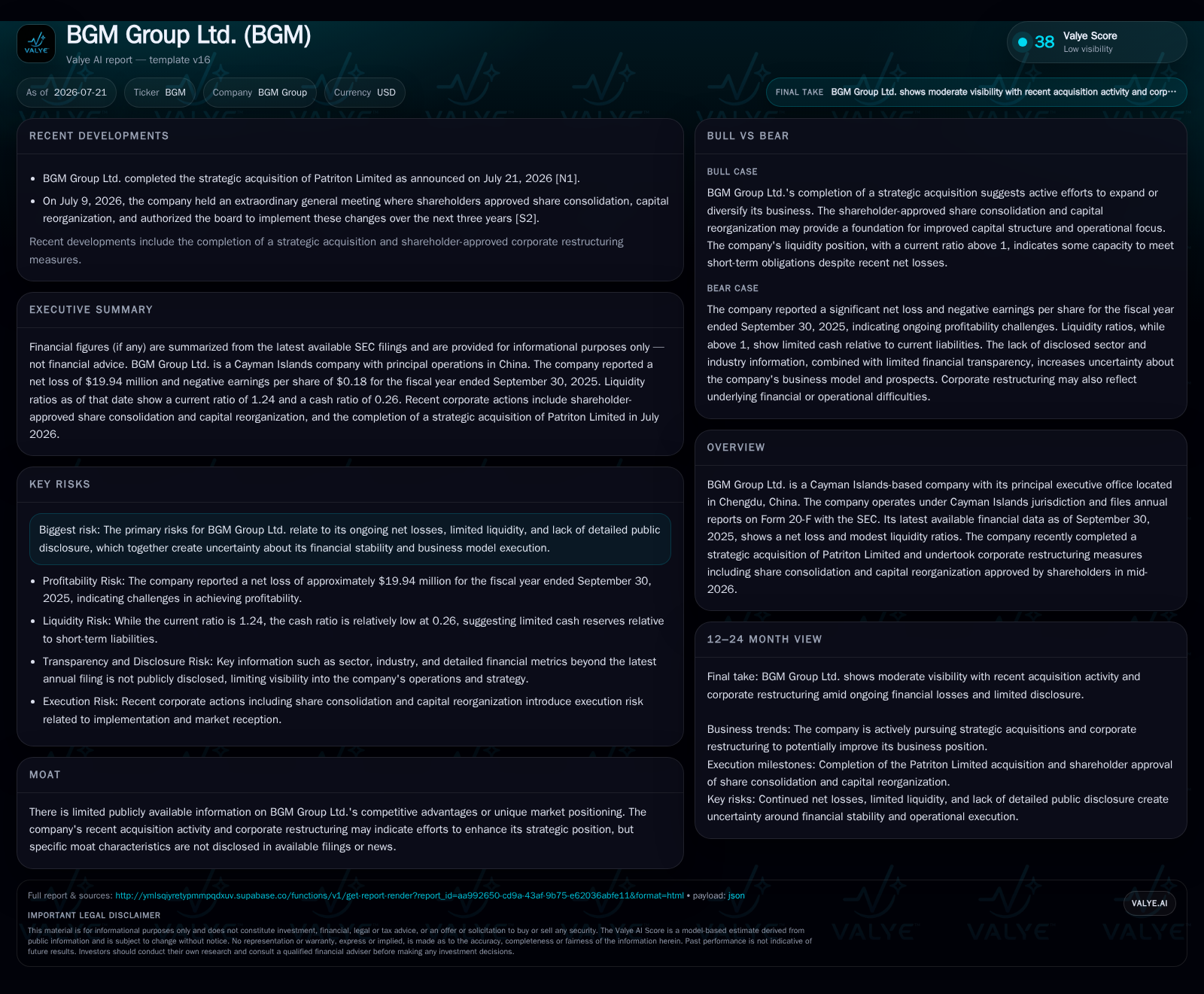
In mid-2026, BGM Group Ltd. undertook significant corporate restructuring including share consolidation authorization with flexible ratios and capital reorganization approved by shareholders, reflecting efforts to strengthen its financial base. The company expanded its technology portfolio with the acquisition of Patriton Limited, reinforcing its strategic focus on AI applications, intelligent robotics, cloud computing, and biopharmaceutical manufacturing. Despite a net loss and liquidity challenges reported in fiscal 2025, BGM is leveraging AI-based platforms targeting insurance underwriting and claims processing as well as integrating AI into pharmaceutical production to optimize operations. Execution risks remain concerning financial stability, regulatory constraints related to VIE structures, and market competition in diversified industrial technology sectors.
Recent Operating Update: Capital Reorganization and Strategic Acquisition
In July 2026, BGM Group Ltd., a Cayman Islands-incorporated company with operational headquarters in Chengdu, China, held an extraordinary general meeting where shareholders approved a flexible share consolidation framework. This authorization allows the board to set share consolidation ratios within a specified range and implement corresponding post-consolidation capital increases and amendments to the company’s memorandum and articles of association over a three-year period [S2]. This capital reorganization initiative aims to enhance the company’s equity structure, potentially supporting compliance with Nasdaq’s minimum bid price requirements and improving capital efficiency.
Earlier in June 2026, BGM completed a private placement raising $12 million through the issuance of 200 million Class A ordinary shares and warrants exercisable over five years [S6]. This capital infusion provides near-term liquidity to fund ongoing operations and strategic initiatives. Concurrently, BGM announced the completion of its acquisition of Patriton Limited, an AI solutions provider, aligning with the company’s strategic expansion into artificial intelligence, intelligent robotics, cloud computing, and biopharmaceutical manufacturing sectors [N1].
Business Model: Integration of Pharmaceutical Manufacturing and AI-Driven Technology Solutions
BGM Group operates a hybrid business model combining traditional pharmaceutical and chemical manufacturing with advanced technology solutions. Its pharmaceutical product portfolio includes licorice products, oxytetracycline, traditional Chinese medicine derivatives (TCMD), heparin, sausage casings, and fertilizers [S1]. These segments involve capital-intensive manufacturing processes with significant fixed costs and regulatory oversight.
Simultaneously, BGM develops and deploys AI applications, intelligent robotics, algorithmic computing power, and cloud computing platforms. The company’s AI-driven solutions primarily target the insurance sector through two proprietary platforms, Du Xiao Bao and Bao Wang. These platforms leverage big data mining and AI agent technologies to deliver comprehensive services including sales and marketing automation, underwriting assessment, claims processing optimization, and customer service automation for insurance companies, brokers, and consumers [S1]. This technology-enabled service model generates revenue through licensing fees and service contracts, contributing recurring revenue streams that complement the product sales from manufacturing.
In biopharmaceutical manufacturing, BGM integrates AI-assisted decision-making across production processes to optimize supply chain management, improve operational efficiency, and predict market trends [S1]. This integration supports precision manufacturing and enhances product quality, aligning with industry trends toward digital transformation in pharmaceutical production
The company’s cost of revenue profile reflects this dual-segment structure [S1]. For fiscal 2025, the cost of revenue for AI solutions increased to approximately $1.87 million from nil in 2024, primarily due to acquisition-related expenses from integrating Patriton Limited. The insurance business segment also reported a cost of revenue of approximately $8.84 million in 2025, up from zero the prior year, indicating the ramp-up of operations in this area
Industry Context and Competitive Landscape
BGM operates within the diversified industrial technology sector, which merges traditional pharmaceutical manufacturing with cutting-edge AI and cloud computing technologies. This sector is characterized by high R&D intensity, regulatory complexity, and rapid technological innovation. Companies in this space often pursue strategic acquisitions to accelerate technology adoption and expand market reach.
BGM’s operational control over its Chinese subsidiaries is maintained through Variable Interest Entity (VIE) contractual arrangements, a common structure for offshore-listed Chinese companies in regulated sectors. While enabling consolidation of financial results under U.S. GAAP, these arrangements introduce regulatory and governance risks due to evolving PRC policies [S1].
Competitive peers include pharmaceutical companies like WuXi AppTec, which integrate AI-driven manufacturing processes and provide contract development and manufacturing services. On the technology side, firms such as Ping An Technology specialize in AI applications for insurance underwriting and claims processing, leveraging big data analytics and intelligent automation. Cloud infrastructure providers like Alibaba Cloud and Tencent Cloud support these AI workloads but do not directly compete in downstream service offerings.
Compared to pure-play SaaS providers, BGM’s AI solution segment is nascent and currently incurs incremental costs associated with integration and scaling. The company’s hybrid model exposes it to operational complexities distinct from those faced by specialized software vendors.
Growth Drivers
BGM’s growth is driven by increasing adoption of AI and intelligent automation in insurance underwriting and claims processing, where comprehensive data-driven solutions are in demand to improve risk assessment accuracy and operational efficiency. The company’s dual-platform approach addresses multiple stages of the insurance value chain, positioning it to capture recurring revenue through licensing and service contracts contingent on client acquisition and retention.
In pharmaceuticals and biopharmaceuticals, growth is supported by rising demand for customized formulations and enhanced manufacturing efficiency enabled by AI-powered supply chain optimization and predictive analytics. Government policies in China promoting high-tech manufacturing and innovation further underpin expansion opportunities.
Strategic acquisitions such as Patriton Limited accelerate BGM’s technology capabilities beyond organic development, while capital restructuring initiatives aim to strengthen the balance sheet to support ongoing investments in manufacturing capacity and R&D.
Cross-industry digital transformation efforts targeting legacy chemical and pharmaceutical manufacturers present additional avenues for BGM to leverage its combined expertise in physical product manufacturing and cloud-based analytics.
Risks and Monitoring Points
Regulatory risks are significant due to reliance on VIE contractual arrangements controlling core Chinese operations, which are subject to evolving PRC regulatory scrutiny [S1]. Compliance with Nasdaq listing standards, particularly minimum bid price requirements, remains a concern, as evidenced by prior notices and the recent authorization of share consolidation [S7].
Execution risks include the challenge of scaling AI solutions across fragmented insurance industry segments, where legacy IT systems and customer adoption barriers may slow growth. Competition from specialized AI software vendors and established pharmaceutical manufacturers advancing internal digital transformation could pressure margins and market share.
Key Developments and What to Watch
Investors and analysts should monitor the implementation of share consolidation ratios within the authorized range following the July 2026 shareholder approval, as this will impact per-share metrics and potentially influence Nasdaq compliance [S2]
Progress in integrating Patriton Limited will be critical to assess operational synergies and cost trajectory within the AI solutions segment. Tracking quarterly changes in cost of revenue and the balance between recurring and one-time revenues in AI offerings will provide insight into scalability and profitability prospects.
Additional capital raising activities, whether equity or debt, will be important to address liquidity constraints and sustain required R&D and capital expenditures in this capital-intensive industry.
Operational KPIs such as customer acquisition costs, churn rates, and retention on the Du Xiao Bao and Bao Wang platforms will indicate market acceptance and competitive positioning in the insurance technology space.
Financial Overview
The company’s capital structure has been recently bolstered by a $12 million private placement completed in June 2026, enhancing working capital to support operational needs and strategic initiatives [S6]. No dividends have been declared or paid, consistent with a capital retention policy focused on reinvestment for growth [S1].
While detailed debt and leverage metrics are not explicitly disclosed post-September 2025, the ongoing capital reorganization and share consolidation efforts suggest management’s focus on optimizing equity composition and financial flexibility [S2][S6]
This analysis integrates the latest quarterly and annual filings with recent corporate developments to provide a comprehensive view of BGM Group Ltd.’s operational strategy, financial condition, and industry context. The company’s hybrid model combining pharmaceutical manufacturing with AI-driven insurance and biopharmaceutical solutions positions it at the intersection of traditional industrial technology and emerging digital transformation trends. However, execution and regulatory risks remain material, underscoring the importance of monitoring operational KPIs, integration progress, and capital structure developments.
Disclaimer: This is an informational analysis based on publicly available filings and does not constitute investment advice.
Disclaimer: This is research-only, informational analysis and not investment advice. It may include AI-generated interpretation and general industry context. Always verify important details using primary sources.

Comments