
Intuitive Surgical Faces Recurring Threats from Third-Party Remanufacturing as Installed Base Drives Consumable Sales
Latest quarterly results highlight solid installed base growth and recurring revenues, balanced by safety and regulatory risks from unauthorized third-party instruments.
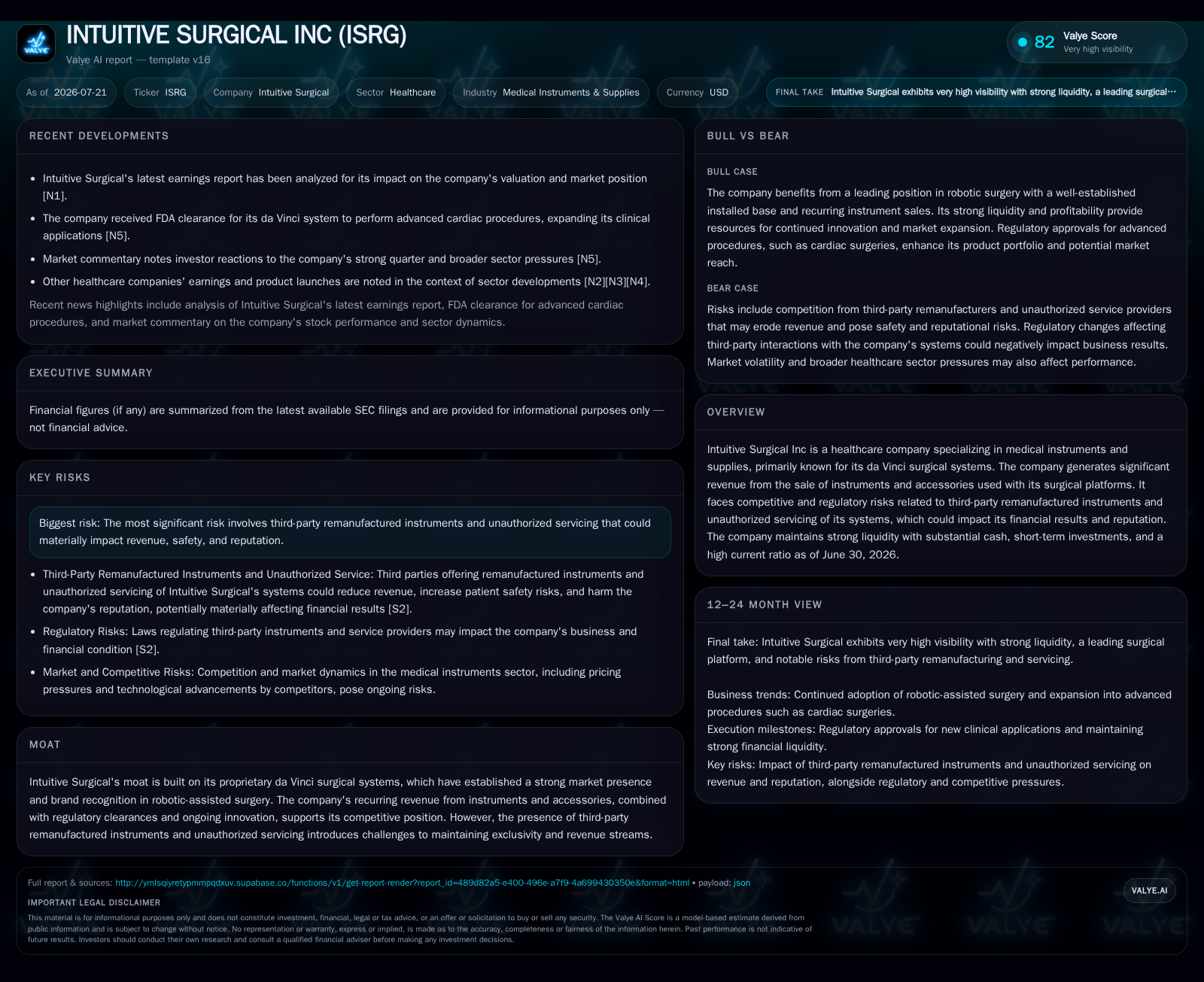
Intuitive Surgical’s Q2 2026 disclosure confirms continued expansion of its da Vinci surgical systems installed base fueling strong recurring instrument and accessory sales. This dual revenue model—capital equipment plus consumables—is foundational but increasingly pressured by third-party remanufactured instruments and unauthorized servicing that could impair revenue and patient safety. Regulatory developments permitting remanufactured products complicate market exclusivity and create a reputational risk. The company’s robust liquidity supports ongoing innovation amidst these structural challenges. Monitoring system utilization, recurring revenue mix, and regulatory outcomes will be crucial to assessing durable growth.
Recent Operating Update: Q2 2026 Results Anchor Growth Amid Challenges
Intuitive Surgical’s 10-Q filing dated July 21, 2026, confirms continued expansion of its installed base of da Vinci surgical systems, which remains the foundational capital equipment platform driving the company’s business model [S2]. The company reported solid growth in revenues from instruments and accessories sales, a key recurring revenue stream that benefits from sustained clinical adoption and increasing average revenue per procedure due to newer limited-use instrument offerings requiring periodic replacement [S2]. This installed base growth and system utilization directly correlate with instrument replacement volumes, a critical operating KPI reflecting recurring revenue strength [S1].
However, the filing highlights intensifying competitive and regulatory challenges from third-party remanufacturers who have obtained regulatory clearance to refurbish certain instruments for use with da Vinci systems. These third-party remanufactured instruments are offered at lower price points and may cannibalize Intuitive’s lucrative aftermarket consumable sales, potentially compressing margins [S2,S4]. Additionally, unauthorized third-party servicing of both da Vinci and Ion endoluminal systems poses operational risks that could affect device performance and patient safety, raising reputational concerns for Intuitive
A recent 8-K filing dated July 16, 2026, further details these operational updates and announces leadership transitions aimed at strengthening commercial execution amid these evolving market dynamics [S3,S18]. Collectively, these disclosures underscore that while Intuitive’s core platform adoption remains robust, third-party competitive pressures and regulatory developments represent material near-term operating considerations.
Business Model Analysis: Capital Equipment Sales Coupled with Recurring Consumables
Intuitive Surgical’s business model centers on selling high-value robotic surgical platforms—primarily the da Vinci systems—to hospitals and surgical centers globally [S1]. These capital equipment sales generate significant upfront revenue but are subject to variability driven by hospital capital expenditure cycles and approval processes. The company’s durable profitability stems largely from recurring revenues generated by proprietary instruments and accessories, which have limited lifespans and require frequent replacement tied to procedure volumes. This dual revenue stream—capital equipment plus consumables—creates a high-margin aftermarket business that sustains cash flow and supports ongoing R&D investments [S1].
The installed base of surgical systems is a leading KPI because each incremental system installed unlocks a predictable volume of instrument and accessory sales, which are sold at premium pricing due to proprietary design and regulatory clearance [S1]. Additional monetization arises from service and maintenance contracts, software updates, and surgeon training programs, which enhance customer retention and platform utilization but remain secondary to consumable sales in revenue contribution
The company faces erosion risk from third-party remanufacturers who refurbish instruments beyond their labeled useful life without Intuitive’s authorization. These remanufactured instruments may be priced lower and lack consistent performance guarantees, potentially impacting patient safety and clinical outcomes—a critical concern given the stringent regulatory environment governing medical devices [S4]. Intuitive’s ability to sustain innovation in device design, expand procedural applications, and maintain regulatory compliance is essential to defending its pricing power and installed base growth.
Industry Structure and Competitive Positioning
Within the medical instruments and supplies sector, Intuitive Surgical is a market leader in robotic-assisted surgery platforms, a segment experiencing secular growth driven by the global shift toward minimally invasive surgical techniques. Peers such as Stryker and Medtronic also compete in surgical robotics but differ in platform scope and integration strategies.
Competition arises from both original equipment manufacturers introducing alternative robotic systems and an expanding set of third-party remanufacturers targeting consumable instruments and accessories. These third-party providers offer lower-cost alternatives that threaten to erode Intuitive’s recurring revenue streams [S4,S7]. Regulatory bodies play a pivotal role, as device approvals and clearances are prerequisites for market access; any regulatory relaxation permitting remanufactured instruments or unauthorized servicing can rapidly alter competitive dynamics
Hospitals and surgical centers evaluate robotic system purchases based on total cost of ownership, which includes capital equipment price, consumable instrument costs, service contract terms, clinical outcomes, and patient safety records. Intuitive’s entrenched brand reputation, extensive surgeon training ecosystem, and integrated service offerings create switching costs that favor incumbent dominance but require vigilance against emerging lower-cost competitors.
Growth Drivers
Key drivers supporting Intuitive Surgical’s growth trajectory include:
- Installed Base Expansion: New da Vinci system placements increase market penetration and instrument consumption volumes.
- Procedure Volume Growth: Higher utilization rates at existing sites amplify consumable demand per system.
- Innovation Pipeline: Development of new instruments and accessories tailored for diverse surgical procedures broadens clinical applications.
- Geographic Market Development: Emerging markets with nascent robotic surgery adoption present potential improvement potential.
- Patient Preference Trends: Increasing demand for minimally invasive surgery driven by improved patient outcomes supports clinical adoption.
- Service Contract Attach Rates: Growing penetration of maintenance and software service contracts complements consumables revenue and enhances customer retention.
Monitoring installed system counts, system utilization rates, and instrument attach rates per procedure provides tangible KPIs to assess growth sustainability and recurring revenue quality [S1,S2]
Risks and Watchpoints
A critical risk factor is the growing presence of third-party remanufactured instruments, which have received selective regulatory clearances, legitimizing refurbishing practices and intensifying price competition in the consumables segment [S4,S7]. This dynamic can depress average selling prices and compress gross margins unless offset by volume growth or premium product introductions.
Unauthorized third-party servicing of da Vinci and Ion systems raises concerns over device reliability and patient safety, potentially leading to adverse clinical events and negative publicity that could undermine clinical confidence and brand reputation [S4]. Regulatory shifts toward more permissive frameworks for aftermarket service providers could exacerbate these risks.
Hospital capital expenditure cycles remain subject to macroeconomic pressures such as inflation and credit market conditions, which can delay or reduce purchases of capital-intensive surgical systems, impacting new system sales and installed base growth [S6]. Technological obsolescence risk requires sustained R&D investment to maintain product leadership amid competitor innovation.
Legal and product liability risks related to device failures or safety incidents pose material threats that could result in costly settlements, recalls, or reputational damage [S4,S20]. Supply chain disruptions may also affect timely delivery of hardware units, influencing quarterly sales cadence.
Key Metrics and What to Watch
Important upcoming indicators to monitor include:
- Quarterly updates on the number of installed da Vinci surgical systems, reflecting market penetration and adoption trends.
- Revenue breakdown between capital equipment sales and instruments/accessories to gauge recurring revenue strength.
- Regulatory developments regarding approvals or restrictions on third-party remanufactured instruments and unauthorized servicing.
- Service contract attach rates as a measure of customer retention and aftermarket revenue stability.
- Clinical data or peer-reviewed studies influencing surgeon preference and supporting new instrument launches.
- Management commentary on competitive pressures from remanufacturers and strategic responses during earnings calls.
- Reports of adverse events linked to unauthorized servicing that could signal reputational or safety issues.
Tracking these variables will provide insight into whether Intuitive Surgical’s growth remains structurally supported or faces erosion from external pressures.
Financial Profile Discussion
As of June 30, 2026, Intuitive Surgical maintains a strong liquidity position with $2.76 billion in cash and cash equivalents, supported by current assets of approximately $9.54 billion against current liabilities of $1.92 billion, resulting in a robust current ratio of 4.96 [F1]. This financial flexibility enables sustained investment in research and development critical for advancing medical device innovation and defending competitive positioning.
The company’s recurring revenue model, driven by consumables and service contracts attached to its installed base, supports high gross margins and cash flow generation, which are essential for funding innovation and absorbing competitive pressures. Maintaining or growing the installed base and system utilization rates will be key to preserving this financial strength.
In summary, Intuitive Surgical’s solid installed base growth and recurring revenue streams underpin its financial resilience, but the company faces mounting challenges from third-party remanufacturers and evolving regulatory landscapes that require careful monitoring.
Disclaimer: This analysis is for informational purposes only and does not constitute investment advice. All data and claims are supported by cited SEC filings and company disclosures.
Disclaimer: This is research-only, informational analysis and not investment advice. It may include AI-generated interpretation and general industry context. Always verify important details using primary sources.

Comments