
General Motors Aligns EV Capacity and Navigates Regulatory Shifts in Q2 2026
GM's latest quarterly filing highlights strategic realignments in EV production, cost discipline, and regulatory adaptation amid evolving market dynamics.
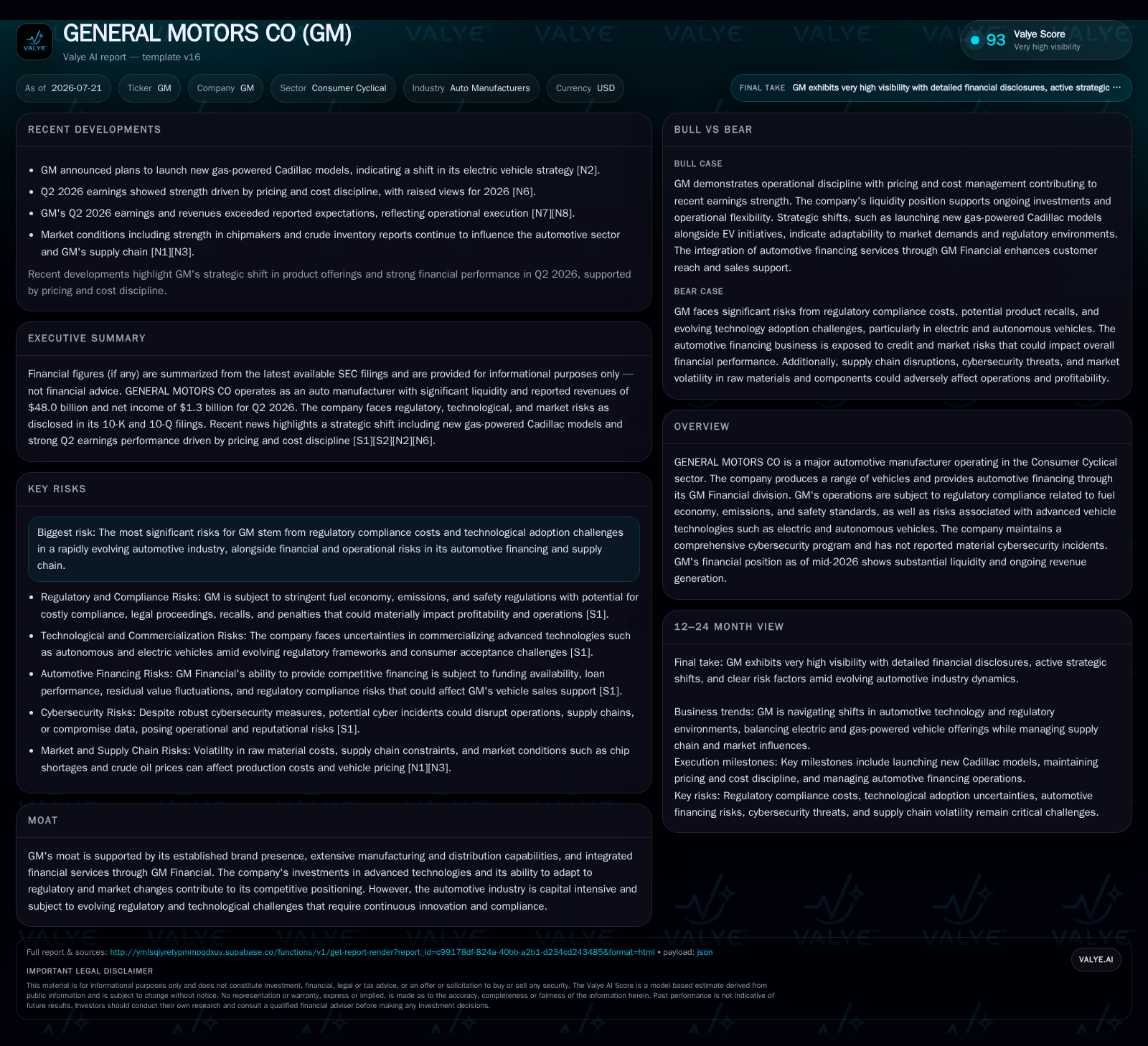
In its Q2 2026 disclosures, General Motors confirmed the completion of a significant strategic realignment of electric vehicle (EV) capacity following a marked slowdown in North American EV demand triggered by regulatory changes. The company maintains focus on high-margin internal combustion engine (ICE) models, particularly trucks and SUVs, while reshaping its autonomous vehicle strategy toward personal vehicles. GM faces industry-wide regulatory and tariff risks but leverages its integrated financing arm and brand legacy to sustain competitive positioning. Key growth hinges on navigating the EV transition carefully and managing supply chain and regulatory headwinds.
Recent Operating Update: Q2 2026 Strategic Realignment
General Motors (GM) reported in its Q2 2026 10-Q filing that it has completed a significant strategic realignment of its electric vehicle (EV) production capacity following a slowdown in North American EV demand driven by the termination of key government incentives and evolving regulatory policies [S2]. This realignment involved substantial restructuring charges totaling $7.9 billion in 2025, reflecting impairments and adjustments to the manufacturing footprint to better align with current market demand [S1]. Despite this recalibration, GM confirmed that its existing retail EV portfolio—including Chevrolet, GMC, and Cadillac models—remains available to consumers, underscoring a cautious but continued commitment to electrification.
Concurrently, GM is maintaining a strong focus on its high-margin internal combustion engine (ICE) vehicles, particularly full-size pickups and SUVs, which continue to exhibit robust consumer demand and support the company’s margin strategy [S1]. Pricing discipline and cost management remain central to GM’s approach amid ongoing inflationary pressures and supply chain challenges.
Business Model: Integrated OEM with Captive Financing Ecosystem
GM operates as a vertically integrated original equipment manufacturer (OEM), encompassing vehicle design, engineering, assembly, and distribution across ICE, hybrid, and EV platforms. The company sells primarily through an extensive dealer network concentrated in North America but with a global footprint. Revenue streams derive mainly from wholesale vehicle sales to dealers, supplemented by aftermarket parts and service revenues, as well as financing products offered through GM Financial, its captive automotive finance subsidiary [S1]. GM Financial supports retail sales by providing loans and leases, thereby generating recurring revenue streams that help stabilize cash flow against cyclical vehicle sales fluctuations
The company’s manufacturing footprint balances legacy ICE production—dominated by trucks and SUVs with higher average selling prices (ASPs) and gross margins—with capital-intensive EV platforms requiring significant investment in battery technology and assembly capacity [S1]. Managing product mix shifts is critical, especially given regulatory requirements such as corporate average fuel economy (CAFE) standards and greenhouse gas (GHG) emissions limits that influence vehicle design and compliance costs
Profitability drivers include gross margin per vehicle, influenced by product mix and pricing power, and operational efficiency in supply chain management amid volatile raw material costs and tariff impacts. GM’s ability to negotiate with suppliers and optimize capacity utilization remains essential to sustaining margins.
Industry Structure and Competitive Positioning
GM competes within a mature legacy automaker cohort that includes Ford, Toyota, and Volkswagen, all navigating the capital-intensive transition from ICE to electrified vehicle portfolios while complying with increasingly stringent safety and emissions regulations. Unlike pure-play EV specialists such as Tesla, GM leverages a broad product portfolio spanning multiple vehicle segments and powertrain types, supported by a well-established dealer network and captive financing operations that provide competitive advantages in market penetration and customer retention.
However, this scale also exposes GM to complex regulatory and trade environments. The company reported $3.1 billion in EBIT-adjusted tariff-related impacts in 2025, with estimates for 2026 ranging from $3.0 billion to $4.0 billion due to ongoing tariffs on vehicles and parts imported into the U.S. [S1]. Additionally, GM faces competitive pressures in international markets, notably within its automotive joint ventures in China, which recorded equity losses driven by impairment and restructuring charges, highlighting challenges in competing against domestic Chinese OEMs [S1].
GM’s autonomous vehicle (AV) strategy has shifted away from Cruise’s robotaxi development, which was curtailed in late 2024, toward integrating personal-use AV technologies within its GM North America segment [S1]. This pivot reflects both technological readiness considerations and evolving regulatory frameworks that affect commercialization timelines and cost structures
Growth Drivers: Electrification Pivot Amid Market Recalibration
GM’s growth outlook is shaped by several key vectors:
- EV Adoption: While North American EV demand slowed in 2025 following the phase-out of consumer tax incentives and regulatory changes, GM expects continued long-term growth potential in electrification, particularly if supportive policies re-emerge and infrastructure expands.
- Advanced Vehicle Technologies: Investment continues in software-enabled features and personal autonomous vehicle capabilities, focusing on enhancing customer experience and safety rather than fleet-based robotaxi services.
- Sustained ICE Demand: Strong consumer preference for full-size pickups and SUVs supports profitability, given their higher ASPs and gross margins relative to smaller or mass-market vehicles.
- Captive Financing: GM Financial’s expanding loan and lease portfolio provides stable, recurring revenue streams that mitigate sales cyclicality.
- Regulatory Environment: Potential easing of GHG emissions regulations and changes in tariff policy could materially affect compliance costs and profitability, warranting close monitoring.
Capacity alignment following the EV production reassessment is critical to avoid excess fixed costs or inventory buildup, with dealer inventory levels and vehicle order backlogs serving as important operational KPIs to watch.
Risks and Constraints
GM faces several material risks that could impact operational and financial performance:
- Regulatory Volatility: Changes in emissions standards, fuel economy requirements, and tax incentives create uncertainty around compliance costs and product development strategies. Notably, impairments related to acquired emissions credits could affect near-term earnings [S1].
- Tariffs and Trade Policy: Ongoing tariffs on imported vehicles and parts impose billions in annual cost burdens, with potential for further trade disputes or policy shifts that could compress margins.
- Supply Chain Disruptions: Semiconductor shortages and constraints on raw materials critical for battery production pose risks to capacity utilization and production schedules.
- Technological Uncertainty: The shift in AV strategy entails potential sunk costs and uncertain timelines for commercial returns.
- Foreign Exchange Exposure: Significant currency exposures to the Canadian dollar, Chinese yuan, and Korean won introduce earnings volatility, despite active hedging programs [S1].
- Consumer Demand Shifts: Rapid transitions from ICE to EVs may outpace infrastructure readiness or consumer affordability, affecting sales volumes.
- Labor Relations: Union negotiations and potential labor disruptions at key U.S. manufacturing facilities could impact production continuity.
- Warranty and Recall Costs: Legacy product liabilities and unexpected recalls remain relevant risks that can affect EBIT margins.
What To Watch Next
Key indicators and milestones to monitor in upcoming quarters include:
- Utilization rates and capacity adjustments following EV production realignment.
- Earnings impacts from ongoing supplier negotiations and restructuring activities.
- Progress and timelines for personal autonomous vehicle technology commercialization.
- Regulatory developments affecting emissions standards, clean vehicle incentives, and trade policies.
- Dealer inventory levels and vehicle order backlogs as signals of demand strength or softness.
- Performance metrics from GM Financial’s loan and lease portfolio, including credit quality.
- Developments in international joint ventures, particularly in China, reflecting competitive positioning.
Financial Profile Discussion
As of June 30, 2026, GM held approximately $20.1 billion in cash and cash equivalents against current liabilities of about $96.8 billion and current assets near $110.0 billion, resulting in a current ratio of approximately 1.14, indicative of adequate short-term liquidity [F1]. While the latest total debt figure available dates back to 2012 at roughly $5.0 billion, the company’s net debt position was negative at that time due to substantial cash reserves, suggesting manageable leverage historically [F1].
Operating income for the calendar year 2025 was approximately $2.9 billion despite significant restructuring and impairment charges related to the EV transition [F1]. Maintaining disciplined capital expenditures aligned with evolving production priorities and rigorous pricing strategies remains essential for preserving free cash flow amid inflationary pressures and raw material cost volatility.
In summary, GM’s Q2 2026 disclosures highlight a strategic recalibration of its EV manufacturing footprint in response to shifting market dynamics and regulatory changes, balanced by continued emphasis on profitable ICE vehicles and a refocused autonomous vehicle strategy. The company’s integrated business model, supported by a broad dealer network and captive financing operations, provides resilience amid industry transformation. Key operational and regulatory developments in the coming quarters will be critical to watch as GM navigates the complex transition toward electrification and advanced vehicle technologies.
Financial position in context
As of 2026-06-30, companyfacts shows $20.1 billion in cash and equivalents, current assets of $110.0 billion, and current liabilities of $96.8 billion, implying a current ratio near 1.14x [F1]
This analysis synthesizes information from General Motors’ SEC filings dated January 27, 2026 (10-K), July 21, 2026 (10-Q), supplemental event filings (8-K), and company facts data as of June 30, 2026 without providing investment research views.
Disclaimer: This is research-only, informational analysis and not investment advice. It may include AI-generated interpretation and general industry context. Always verify important details using primary sources.

Comments