
Triumph Financial's Integrated Platform Accelerates Cash Flow Solutions for Trucking
Latest quarterly results affirm Triumph Financial’s niche strategy of combining banking, factoring, payments, and data intelligence to optimize trucking ecosystem finance.
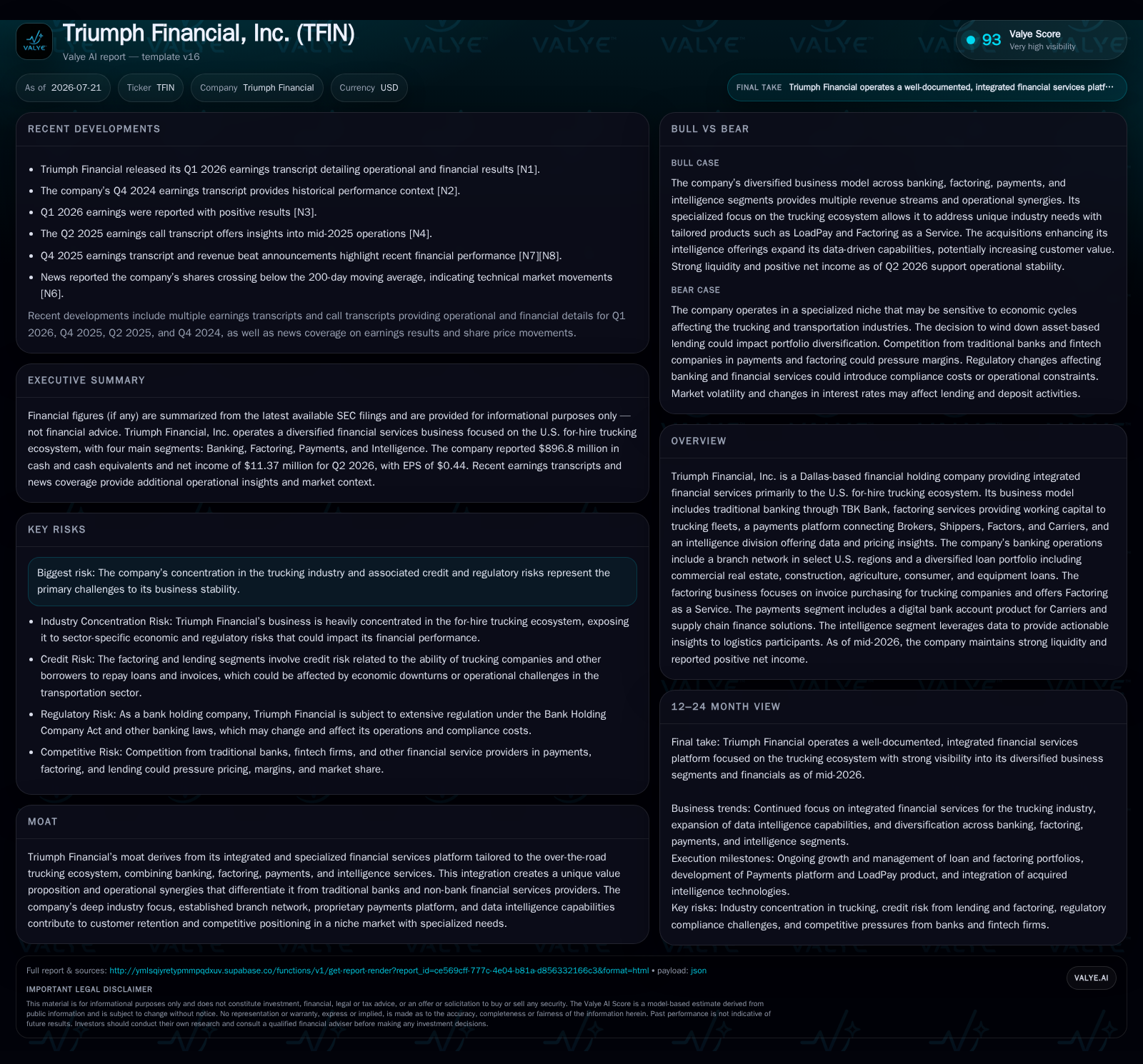
In its Q2 2026 filing, Triumph Financial demonstrated growth in key operating metrics including loan portfolio expansion and payment transaction volume, underpinning the effectiveness of its integrated financial services platform focused on the U.S. trucking industry. The company leverages synergies between TBK Bank’s diversified commercial lending, AI-enabled factoring solutions, a proprietary payments network, and data intelligence products to address specialized working capital needs. While exposure concentration and credit risk remain sector challenges, digital adoption and cross-selling opportunities support near-term growth prospects. A robust liquidity position with significant cash reserves versus modest debt strengthens its capacity to finance asset growth.
Q2 2026 Operating Update Highlights Triumph Financial’s Integrated Trucking Finance Platform
Triumph Financial, Inc. reported solid operational progress for the quarter ended June 30, 2026, reinforcing the effectiveness of its specialized financial services platform tailored to the U.S. for-hire trucking ecosystem. The company recorded growth in total loans held for investment alongside an increase in payment transaction volumes processed through its proprietary payments network connecting Brokers, Shippers, Factors, and Carriers [S2]. This simultaneous expansion in lending assets and payment throughput underscores sustained demand for working capital and cash flow optimization solutions aligned with trucking industry cash conversion cycles.
The loan portfolio growth is supported by stable deposit inflows anchored by TBK Bank’s branch network concentrated in regional markets such as Colorado’s front range and Dallas, Texas. These deposits fund both traditional commercial lending and the factoring segment’s invoice purchasing operations. Triumph’s factoring business employs AI-driven automation to execute instant purchase models, significantly reducing days sales outstanding (DSO) for carriers selling freight invoices, thereby accelerating carrier liquidity and improving receivable pricing predictability [S1]
Payment platform volume growth reflects increased adoption among ecosystem participants seeking streamlined settlement and payment processes across multiple stakeholders [S1][S2]. Transaction fee revenues from this platform complement interest income generated from loans and factored receivables, contributing to a diversified noninterest income stream that supports overall margin stability
Integrated Banking and Factoring Services Deliver Tailored Working Capital Solutions
Triumph’s core competitive advantage lies in integrating traditional banking with specialized factoring services designed exclusively for trucking-related businesses. TBK Bank’s diversified loan portfolio includes commercial real estate, construction, and agriculture equipment loans alongside consumer financing, providing asset base diversification while maintaining alignment with the transportation sector’s working capital needs [S1].
The factoring segment offers immediate funding by purchasing freight invoices, addressing the trucking industry’s extended cash conversion cycles [S1][S2]. Automated credit assessments and instant purchase capabilities enhance carrier retention by enabling quick pay options embedded within the payments platform. Cross-selling opportunities arise naturally as banking clients gain access to factoring services and vice versa, deepening customer relationships and operational synergies
This integrated approach reduces underwriting costs through shared data inputs and creates a more defensible moat compared to standalone factoring firms lacking banking operations, such as TBS Factoring or RTS Financial.
Payments Platform Expansion Supports Transaction Fee Growth Amid Digital Adoption
The payments segment functions as a critical nexus connecting Brokers, Shippers, Factors, and Carriers within the trucking supply chain. Triumph’s digital payments infrastructure efficiently manages audit processes and payment settlements, facilitating faster carrier payments and improving cash flow visibility.
Revenues in this segment derive from transaction fees on payments processed and interest income on factored receivables facilitated through the platform [S1][S2]. The integrated payment and financing model enhances carrier satisfaction by accelerating fund availability, which in turn drives increased transaction volumes and fee income growth
Compared to payment processors like TruckPay or EFS that focus primarily on carrier payments without lending integration, Triumph captures incremental value by tightly coupling financing options with payment facilitation. The company’s expanding supply chain finance offerings further diversify noninterest income streams while addressing the increasing complexity of freight logistics [S1]
Data Intelligence Services Enhance Pricing and Operational Decision-Making
Triumph’s intelligence segment delivers data analytics and pricing insights tailored to Brokers, Carriers, and Shippers, enabling smarter rate setting and utilization optimization amid volatile freight markets [S1]. Though currently contributing approximately 1% of total segment revenue, these services foster customer stickiness through subscription or usage-based fees that complement core lending and payment products
This integrated intelligence offering extends Triumph’s competitive positioning beyond pure data providers like DAT Solutions, which lack embedded financing and payment capabilities.
Risk Profile: Concentration and Credit Quality Remain Key Challenges
Triumph’s concentrated exposure to the over-the-road trucking industry presents inherent credit and cyclical risks tied to freight volume fluctuations and regulatory changes affecting carriers’ operational viability [S1]. A recent bankruptcy filing by a major borrower highlights the importance of rigorous collateral evaluation and asset quality monitoring. While the company currently assesses its collateral position as adequate to secure outstanding loan balances, ongoing bankruptcy proceedings introduce uncertainty that could impact future loss provisions [S1].
Active surveillance of credit quality metrics such as loan charge-offs, nonperforming assets, and provisioning adequacy—particularly related to the seasoning of factored receivables—is critical to maintaining net interest margins and portfolio health [S2]. This sector concentration underscores both the opportunity derived from niche expertise and the vulnerability to trucking industry cyclicality.
Growth Drivers: Digital Supply Chain Finance and Geographic Expansion
Triumph’s growth strategy centers on accelerating adoption of its digitally enabled payments platform and expanding supply chain finance solutions that address the increasing complexity of freight logistics. Geographic expansion through branch network development or targeted acquisitions supports deposit growth, which in turn fuels lending and factoring capacity [S1]
Industry tailwinds include tightening cash flows among smaller trucking fleets, which increase demand for instant pay factoring, and the broader market shift toward integrated financial workflow platforms that encourage deeper cross-selling across existing customers. Technological advancements, including AI-driven credit decisioning, underpin scalability potential if effectively executed.
Key Operating Metrics and Watchpoints for Upcoming Periods
Monitoring deposit base growth and stability is essential to sustaining funding capacity for loan and factoring portfolio expansion [S2]. Changes in loan mix, such as increased exposure to equipment or agriculture-specific lending, may provide further diversification beyond commercial real estate concentrations
Payment transaction volume trends serve as a barometer for digital product adoption and platform relevance within the trucking ecosystem, with sustained growth indicating successful market penetration [N1]
Credit quality indicators, including loan charge-offs and reserve levels, will provide early signals of portfolio resilience amid sector cyclicality and borrower distress events [S2]. These metrics collectively offer insight into the trajectory of Triumph’s integrated platform momentum and emerging operational risks.
Financial Position: Strong Liquidity Supports Portfolio Growth
As of June 30, 2026, Triumph Financial held approximately $896.8 million in cash and cash equivalents against minimal total debt of about $27.1 million based on the latest available data [F1][S2]. This low leverage position affords the company significant capital flexibility to prudently expand its loan and factoring portfolios without reliance on costly external funding.
A stable deposit base further underpins funding stability, which is critical for maintaining net interest margins amid interest rate fluctuations typical in transportation finance [S2]. The company’s liquidity strength supports ongoing investment in technology and product innovation to sustain competitive advantage.
This analysis is based exclusively on publicly available filings from Triumph Financial (TFIN), associated news reports as cited ([S1],[S2],[N1],[F1]), and industry context. It is intended to provide an informed perspective on the company’s operations within its specialized sector and does not constitute investment advice.
Disclaimer: This is research-only, informational analysis and not investment advice. It may include AI-generated interpretation and general industry context. Always verify important details using primary sources.

Comments