
Northrop Grumman's Contract Backlog Growth and Production Challenges Shape Defense Prime Outlook
A significant backlog expansion underscores revenue visibility for Northrop Grumman amid cost pressures and complex program execution.
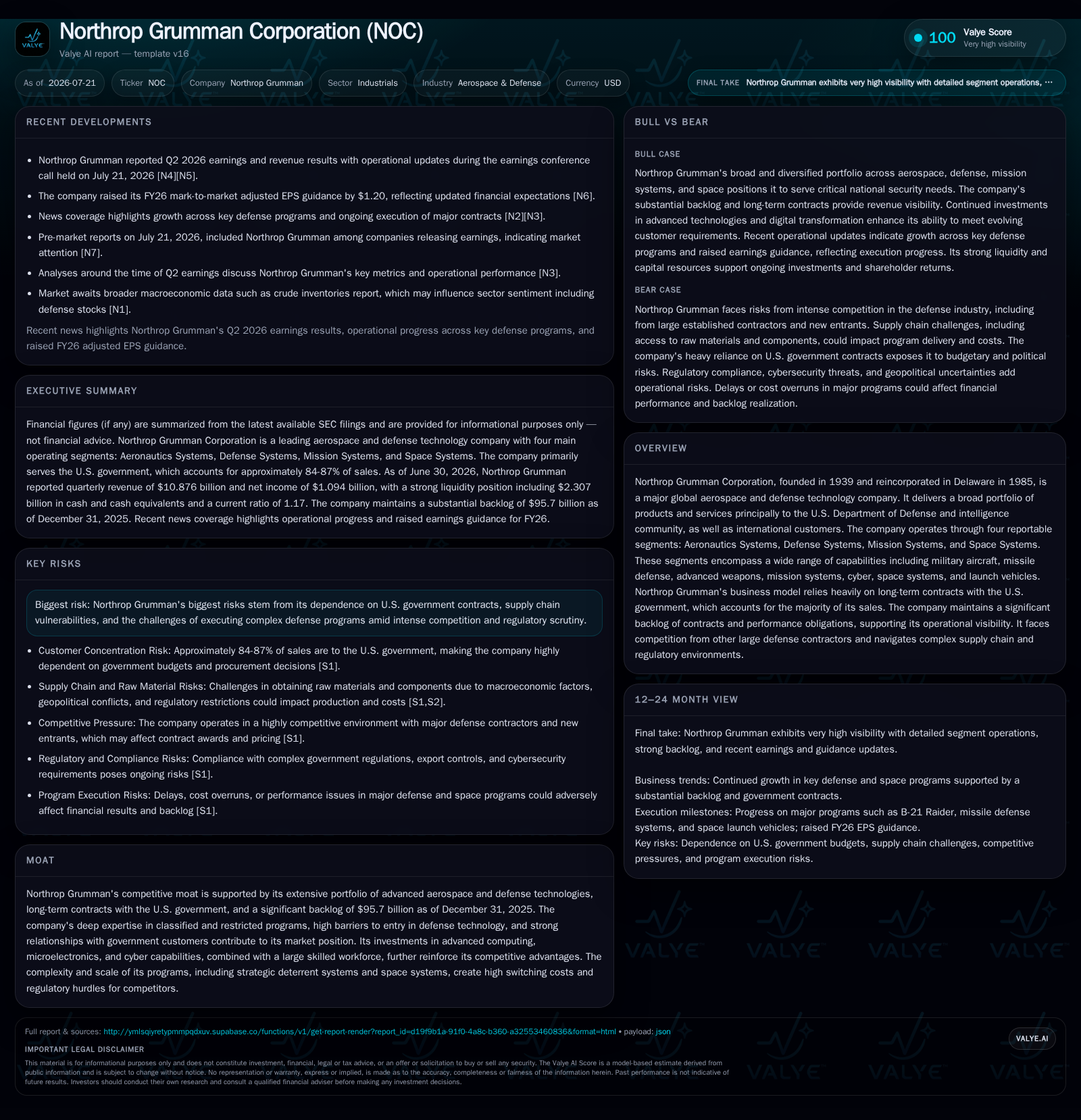
Northrop Grumman reported a backlog increase to $104.7 billion as of June 30, 2026, with roughly 90% expected to convert to revenue within two years, bolstering near-term top-line visibility. The company continues to grapple with costly low-rate initial production (LRIP) challenges on the B-21 bomber program, accruing $1 billion in loss reserves. While defense budget uncertainties and geopolitical tensions sustain demand for advanced aerospace and missile defense systems, execution risks and supply chain pressures remain key constraints. Northrop's position as a prime contractor with broad capabilities in aeronautics, missile defense, space, and mission systems aligns it with peers like Lockheed Martin and Raytheon Technologies. Cash flow remains solid but debt levels are elevated relative to cash on hand.
Recent Operating Update: Backlog Expansion Anchors Revenue Visibility
Northrop Grumman's latest quarterly filing dated July 21, 2026 reveals a sizable contract backlog reaching $104.7 billion at the end of Q2 2026 [S2]. Approximately 35% of this backlog is anticipated to translate into revenue over the next twelve months and a further 55% within twenty-four months. This near-term contract conversion schedule provides strong revenue visibility typical for large defense prime contractors operating under long-term U.S. government award structures. The sustained backlog growth reflects continuing order intake strength driven by geopolitical tensions that elevate allied nations’ demand for sophisticated aerospace, missile defense, and space technology platforms.
However, the company’s performance is tempered by ongoing financial challenges related to the B-21 bomber’s low-rate initial production (LRIP) phase. Northrop has recognized cumulative losses nearing $2 billion against this program since its inception with a residual loss accrual of $1 billion reported as of June 30, 2026 [S2]. This sizeable loss reserve signals persistent program execution complexity — a common structural risk when integrating cutting-edge stealth technology in strategic deterrence aircraft.
Business Model: Government Contracts Drive Revenue Through Multi-Year Programs
Northrop Grumman operates primarily as a prime contractor to the U.S. Department of Defense (DoD), which accounted for an estimated 84% of sales in fiscal year 2025 [S1]. The company’s revenues arise through long-term contracts that span design, development, production, and sustainment phases across four main segments: Aeronautics Systems; Defense Systems; Mission Systems; and Space Systems. These segments collectively cover military aircraft platforms (including legacy stealth aircraft programs), missile defense solutions, classified C4ISR mission systems integration, strategic deterrence assets such as intercontinental ballistic missile support systems, and commercial-class space launch vehicles.
Revenue recognition follows percentage-of-completion accounting reflecting complex milestone-based work spanning multiple years. Contracts often include fixed-price development phases transitioning into production orders subject to LRIP terms — characterized by initially limited quantities sold at higher per-unit costs due to immature manufacturing processes and engineering adjustments. Margins in early LRIP calls tend negative or thin until scale improves with later production lots.
The company also serves international allies through related contracts but maintains these as a relatively smaller portion versus core U.S. DoD workstreams. Long-dated performance obligations embedded in backlog underpin stable cash flow projections if programs execute close to plan.
Industry Structure and Competitive Position
The global aerospace & defense industry is highly concentrated among a handful of primes managing complex supply chains involving numerous specialized suppliers and subcontractors bound by stringent regulatory oversight including ITAR export controls and Cost Accounting Standards (CAS). Northrop Grumman competes directly against peer giants such as Lockheed Martin—especially in strategic bombers and fighter aircraft portfolios; Raytheon Technologies in missile systems; Boeing Defense Space & Security on air platforms; General Dynamics on land/marine systems; and L3Harris Technologies focusing on C4ISR mission systems.
Northrop holds particular advantages rooted in its advanced stealth technology heritage dating back to its B-2 Spirit flying wing development lineage plus broad expansion into space systems post-Orbital ATK acquisition. Its classified program expertise commands high barriers to entry given security clearance requirements and proprietary technology investments.
Nonetheless, the company routinely faces pricing pressure from cost overruns mitigation clauses within government contracts coupled with schedule risk-induced potential penalties or Congress-mandated Nunn-McCurdy breach notifications when certain cost thresholds are exceeded.
Growth Drivers
Northrop’s growth drivers stem chiefly from expanded defense budgets triggered by geopolitical volatility worldwide—exemplified by ongoing tensions involving Russia/Ukraine conflict spillover effects supporting increased allied procurement commitments [S1]. Priorities include modernization of nuclear strategic deterrence capabilities through the B-21 bomber program lifecycle extension; enhancement of missile defense interceptors under multi-layered architectures integrating sensor-to-shooter networks; expansion in space domain awareness solutions plus satellite launch vehicle offerings addressing both government and commercial markets.
Technological advancement investments targeting next-generation computing architectures integral to microelectronics for electronic warfare functions alongside sophisticated cyber defense solutions strengthen competitive moats while aligning with digital transformation trends inside national security agencies.
Additionally, international procurement demand from U.S. allies seeking interoperability with U.S.-developed platforms sustains export opportunities albeit usually representing incremental rather than core revenue streams.
Risks and Watchpoints: Execution Complexity Amid Regulatory Scrutiny
Risks center on dependence on U.S. government contract flows which remain subject to political budgetary decisions leading to potential delays or reprogramming impacting order intake or funding certainty [S14]. Program execution challenges notably persist on flagship development projects like B-21 where unresolved LRIP losses highlight technology maturity gaps or manufacturing inefficiencies requiring mitigation effort.
Supply chain vulnerabilities magnify inflationary material cost pressures along with workforce skill availability constraints potentially impacting schedule adherence [S1], [S14]. Legal proceedings including ongoing federal inquiries related to pension cost accounting have not yet caused material financial penalties but underscore regulatory compliance exposure inherent in government contracting domains [S16].
Market-wise, intense competition among primes necessitates continued R&D spending to sustain technological leadership while balancing margin preservation — a classic tension faced industry-wide.
What To Watch Next
Key milestones include Northrop’s updating of B-21 production cost forecasts alongside potential LRIP rate improvements reflected in future earnings reports — any indication of narrowing loss accruals would markedly improve margin outlooks [S2]. Close monitoring of book-to-bill ratios via new contract awards vis-à-vis backlog consumption can signal demand momentum shifts.
Upcoming government budget cycles and DoD procurement strategy announcements will shape program funding continuity especially around strategic deterrent modernization efforts essential for Northrop’s Aeronautics Systems segment growth trajectory [S1]. Progress reports or delays involving major space launch system contracts also offer insight into growing commercial space market participation potential.
From a financial standpoint, management commentary surrounding share repurchase cadence within the authorized $3 billion program window plus dividend growth rates will inform capital return discipline against ongoing debt leverage levels currently implying net debt above $13 billion despite reasonable liquidity buffers [F1], [S10], [S12].
Financial Profile Discussion
As of June 30, 2026, Northrop holds $2.3 billion in cash and cash equivalents against current liabilities approximating $13.3 billion resulting in a current ratio around 1.17 — reflecting sufficient liquidity for near-term obligations although caution warranted given sizeable current liabilities concentrated partly in program loss reserves such as those tied to B-21 LRIP costs [F1], [S2]. Total debt stood near $15.8 billion at end-2025 with net debt around $13.5 billion considering available cash balances – underscoring a leveraged capital structure typical for large defense primes investing heavily in R&D and production capacity expansions [F1].
The company’s continued free cash flow generation capacity will be pivotal for deleveraging flexibility while maintaining investment levels critical for sustaining competitive positioning through innovation [S10]. Management’s recent dividend hike by seven percent alongside an active share repurchase authorization ($2.5 billion remaining) indicates confidence toward balancing shareholder returns without compromising operational funding needs
In conclusion, Northrop Grumman’s latest operating update highlights robust backlog-driven revenue visibility that supports sustained execution efforts amid well-understood LRIP cost headwinds specific to next-gen strategic platform transitions. Its multifaceted portfolio spanning aeronautics through space systems situates it favorably within a demanding industry environment characterized by high entry barriers yet significant macro-driven growth opportunities tempered by operational execution risks inherent at massive scale.
This analysis reflects information publicly available as of July 21, 2026 without offering investment advice or research views.
Disclaimer: This is research-only, informational analysis and not investment advice. It may include AI-generated interpretation and general industry context. Always verify important details using primary sources.

Comments