
SPS Commerce Strengthens Network Effects and Navigates Leadership Shifts in Q1 2026
Q1 2026 results affirm SPS Commerce’s growing platform traction amid key leadership transitions and strategic capital moves.
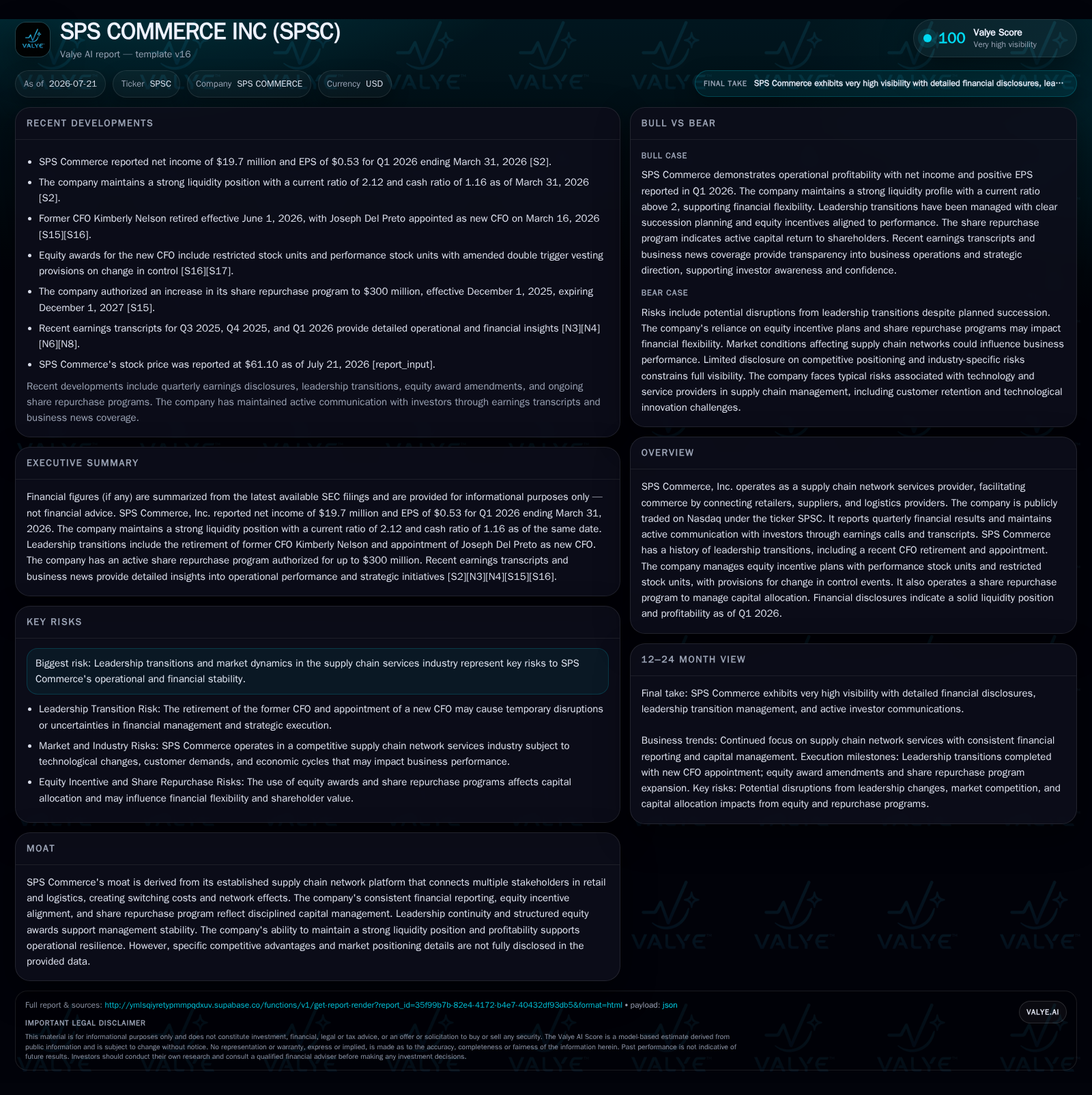
SPS Commerce’s latest 10-Q filing for Q1 2026 reveals sustained momentum in its cloud-based supply chain network platform, underscored by strong customer retention and expansion in connected trading partners, essential for its recurring revenue base. Recent leadership changes, including the CFO’s retirement and board elections, add a watchpoint for strategic continuity though have not disrupted operational execution. The company’s share repurchase program continues to signal disciplined capital allocation aligned with maintaining financial flexibility. Industry tailwinds such as e-commerce growth and complex supply chains support the addressable market expansion for SPS’s subscription model services.
Q1 2026 Operating Highlights Signal Network Strengthening and Leadership Stability
SPS Commerce’s Q1 2026 results, as detailed in the April 30, 2026 10-Q filing [S2], demonstrate continued strengthening of its cloud-based supply chain network platform. The company reported sustained growth in the number of connected trading partners, a key driver of its network effects and recurring revenue base. Customer retention remains robust, supported by low churn rates and strong net revenue retention, which are critical KPIs in its subscription-based electronic data interchange (EDI) platform business. Despite notable leadership transitions, including the planned retirement of the CFO and recent board elections [S15], [S3], operational execution has remained stable with no reported disruptions.
Cloud-Enabled Supply Chain Integration Powers Subscription-Based Recurring Revenues
SPS Commerce operates a cloud-native platform that facilitates seamless electronic data interchange (EDI) among retailers, suppliers, and logistics providers, enabling automated order management, inventory visibility, and logistics integration [S1]. The company’s subscription model generates annual recurring revenue (ARR) by charging clients for continuous access to its cloud services, which are often deeply integrated into customers’ ERP and supply chain workflows. This integration creates significant switching costs, as migrating transaction flows off the platform requires complex reconfiguration across multiple trading partners. SPS enhances client retention and monetization through integration APIs and data analytics layers that provide usage-based consumption and value-added service tiers, contributing to average revenue per user (ARPU) expansion.
Competitive Moat Reinforced by Network Effects and Customer Retention Metrics
Drivers Expanding Addressable Market: E-Commerce Growth & Real-Time Analytics Needs
Structural shifts in retail toward omnichannel strategies are driving demand for scalable order management systems capable of handling increased volume variability and diverse fulfillment options. The rapid expansion of e-commerce elevates the need for platforms that provide real-time inventory visibility and analytics, essential for mitigating supply chain disruptions and reducing stockouts. SPS Commerce’s platform offers transparency across multiple tiers of suppliers and logistics providers, improving operational agility and reducing manual reconciliation errors. Additionally, evolving regulatory requirements for electronic documentation reinforce demand for compliant cloud-based solutions, further expanding the company’s addressable market.
Risks from Integration Complexity, Market Consolidation, and Leadership Transitions
SPS Commerce faces risks common to supply chain software providers. Integration complexity remains a challenge, as connecting disparate ERP and logistics systems requires significant customization and can extend sales cycle length, potentially impacting customer acquisition costs (CAC) and payback periods [S29], [S16]. Market consolidation among retailers and suppliers could reduce the number of unique trading partners, posing a risk to network expansion and top-line growth. Leadership transitions, including the CFO retirement and recent board changes, introduce near-term governance uncertainties and potential strategic shifts [S15], [S3]. While succession planning is in place, these changes warrant monitoring for any impact on execution or risk management.
"Eyes on Execution": Upcoming Milestones for Partner Growth and Retention Trends
Key operating metrics to monitor in upcoming quarters include quarterly ARR growth, net revenue retention rates, and the number of connected trading partners, which collectively indicate the health and scalability of SPS’s network effects [S2]. Management commentary during earnings calls and filings will be important to assess the impact of leadership transitions and the pace of share repurchases under the expanded $300 million authorization, which signals disciplined capital allocation balancing shareholder returns with investment in platform growth [S22], [S25]. Deviations from established retention or partner growth trends could signal shifts in competitive dynamics or integration challenges.
Financial Profile Discussion: Balance Sheet Resilience Supports Strategic Flexibility
As of March 31, 2026, SPS Commerce reported cash and equivalents of approximately $154 million, with current assets totaling about $329 million against current liabilities near $155 million, resulting in a current ratio of approximately 2.12, indicating strong liquidity coverage [F1]. This financial position supports the company’s ability to invest in organic innovation and pursue opportunistic acquisitions within a competitive SaaS landscape. The share repurchase program, now authorized up to $300 million, reflects confidence in capital deployment without compromising investment capacity. These financial characteristics align with industry peers emphasizing sustainable free cash flow generation and operational efficiency.
This analysis is based on SPS Commerce’s SEC filings through April-May 2026 and incorporates recent company disclosures. Financial and operational metrics are drawn exclusively from official sources without speculative projections. The company’s position at the nexus of supply chain network integration underscores the importance of network effects and customer retention in sustaining growth amid leadership transitions and competitive pressures.
Disclaimer: This document is an analyst-style company overview prepared from public filings without investment research views or price targets. It aims to provide sector-contextualized insights grounded entirely in disclosed evidence.
Disclaimer: This is research-only, informational analysis and not investment advice. It may include AI-generated interpretation and general industry context. Always verify important details using primary sources.

Comments