
Starfighters Space Validates STARLAUNCH 1 Amid CEO Litigation and Aircraft Acquisition Delays
The company completed key rocket tests while facing leadership changes, legal disputes, and stalled deals for additional aircraft needed to support growth.
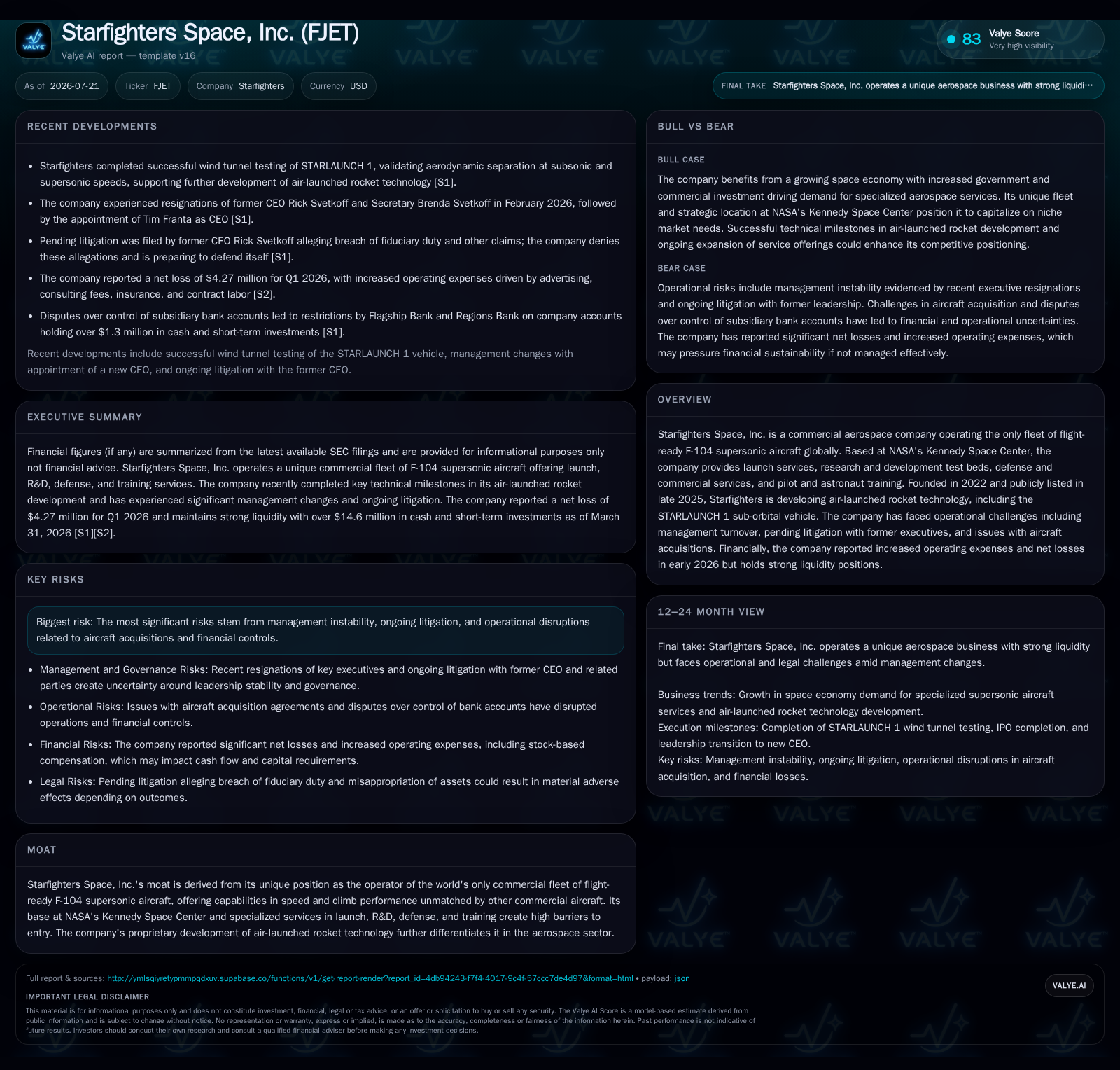
Starfighters Space operates the world’s only commercial fleet of flight-ready F-104 supersonic jets, offering launch services, R&D platforms, and training from NASA's Kennedy Space Center. In Q1 2026, it completed critical wind tunnel testing of its STARLAUNCH 1 air-launched rocket but faces operational headwinds including management turnover and litigation involving its former CEO. Financially, the company shows strong current liquidity yet continues to report sizable operating losses and material uncertainties about its going concern status. Growth hinges on successful progression to flight testing and resolution of acquisition disputes related to additional aircraft.
Recent Operating Update
Starfighters Space's latest quarterly filing dated May 20, 2026, details progress in both technical milestones and operational headwinds that define its near-term outlook [S2][S15]. Most notably, the company announced successful completion of wind tunnel testing for its STARLAUNCH 1 suborbital air-launched rocket. The test campaign validated clean aerodynamic separation behaviors at Mach numbers 0.85 (subsonic) and 1.3 (supersonic) through a combination of computational fluid dynamics modeling and ten physical wind tunnel runs at FAMU/FSU’s Polysonic Wind Tunnel. This result is a critical risk reduction step toward flight validation, underpinning confidence in their aerodynamic models ahead of planned instrumented drop tests for flight condition evaluation
However, operational challenges loom large. The company disclosed a loss from misappropriation of assets totaling $395,033 during Q1 2026 linked to withdrawals by the former CEO without board approval. Concurrently, this former CEO filed litigation alleging fiduciary breaches seeking $26 million in damages—a lawsuit Starfighters intends to vigorously contest [S2][S19]. Management turnover accelerated with the resignation of the founder CEO and Director in February 2026, while Jose Arias was appointed Vice President of Space Operations in May to support ongoing program execution [S2][S19].
Another material operational risk emanates from Starfighters International’s stalled aircraft acquisition agreement with Aerovision LLC concerning twelve used F-4 Phantom II jets. Despite deposit payments totaling $5 million made by January-March 2025 towards phased purchases, Aerovision has failed to confirm aircraft availability or shipment status. Attempts at communication have broken down leading Starfighters to review legal remedies under the contract [S15][S21]. This impasse constrains fleet scaling essential for expanding launch services and defense applications.
Business Model Overview
Starfighters Space monetizes its proprietary fleet of seven Lockheed F-104 supersonic jets—the sole commercial fleet capable of sustained Mach 2+ speed—to provide four core service groups: commercial space launch access via air-launched rockets, aerospace research & development (R&D) test beds supporting industry partners including government agencies, defense-related aviation services spanning civil to academic clients, and specialized pilot & astronaut training programs [S1][S23]. These niche offerings capitalize on unique speed-climb regimes unmatched by competitor aircraft enabling rapid atmospheric transit critical for high-cadence suborbital payload deployment
Operating metrics crucial to financial performance include aircraft availability/utilization rates influenced by maintenance cycles; number of launches executed successfully; payload mass deployed per flight; hours logged in training sessions; regulatory milestone achievements evidenced by launch license progress; backlog levels for R&D test campaigns; and customer contract renewals [S8][S16]. Margins hinge on efficient asset deployment balanced against high fixed costs inherent in aircraft operation plus significant R&D investment evident in STARLAUNCH development expenditures
Industry Structure and Competitive Position
The broader commercial aerospace sector featuring air-launched rockets occupies an intersection between traditional aerospace services providers—such as Boeing Defense—and emerging space-focused firms like Virgin Galactic (suborbital crewed flights) or Rocket Lab (small satellite launches). Unlike peers who predominantly rely on expendable ground-launched rockets or vertical takeoff vehicles, Starfighters leverages supersonic jet platforms allowing mid-air launches providing speed advantages reducing atmospheric drag and fuel consumption for payload delivery.
Their moat stems largely from being the exclusive operator globally with an active fleet of F-104s historically retired military aircraft upgraded for commercial use. The choice of NASA’s Kennedy Space Center base privileges access to established spaceport infrastructure facilitating integration into government contracts while providing a credible ecosystem for aerospace partnerships [S1]. However, unlike well-capitalized peers such as Blue Origin or Sierra Space investing heavily in reusable orbital technology or autonomous vehicles, Starfighters’ focus remains more tactical—enabling short-duration microgravity experiments via STARLAUNCH’s suborbital platform with planned expansion targeting orbital infrastructure contingent on regulatory licenses.
This differentiation provides a defensible niche but constrains scale until technological validation advances beyond wind tunnel tests into consistent flight success records accepted across government/civil markets. Additionally, competition emerges not only technologically but also through supply-chain constraints for critical components amid global aerospace part shortages. Operational capability concentrations on limited supersonic jets introduce capacity bottlenecks impacting utilization optimization.
Growth Drivers
Starfighters’ growth trajectory hinges foremost on progressing the STARLAUNCH program through key R&D stages culminating in flight demonstrations deploying payloads fulfilling microgravity science demands increasingly sought after by academic researchers, biotechnology companies, and defense science agencies seeking rapid access at reduced costs relative to orbital launches.
Concurrently expanding pilot & astronaut training offerings aligns with growing demand spurred by new entrants into commercial space travel requiring flight credentials specific to supersonic regimes rarely accessible elsewhere. Increased government budgets favoring hypersonic vehicle development underpin additional test bed contracts leveraging the company’s clean aerodynamic separation expertise validated recently.
Geographically diversified operations via Midland International Air & Space Port supplement Florida base efforts positioning Starfighters strategically within emerging U.S. spaceport networks fostering collaborative opportunities with state/local economic development corporations incentivizing aerospace expansion [S23]. Technological advancements in telemetry instrumentation embedded in upcoming drop test articles enhance data fidelity supporting iterative design improvements driving reliability perceptions essential for commercial adoption.
Additionally, macroeconomic trends promoting satellite constellations necessitate frequent rapid payload deployment servicing illustrate medium-term demand tailwinds complementing organic growth initiatives. Furthermore, any resolution enabling acquisitions of additional supersonic assets through Aerovision agreement could materially increase sortie rates enhancing revenue visibility.
Risks and Constraints
Significant hurdles temper optimism surrounding Starfighters’ prospects. Most immediate is management instability highlighted by the founder CEO’s abrupt departure amid accusations culminating in multi-million dollar litigation risks that impose legal expense burdens while distracting leadership focus [S19]. These governance issues compound longstanding concerns regarding internal controls underscored by asset misappropriation losses recognized recently diminishing investor confidence.
Operationally stalled aircraft acquisitions obstruct capacity enhancement ambitions crucial for scaling test bed utilization or large-scale launch service offerings risking customer attrition or market share ceding pending contract fulfillment capabilities realization [S15][S21]. Regulatory complexity poses another barrier where successful licensing for airspace corridors enabling supersonic flight corridors must navigate Federal Aviation Administration scrutiny balancing safety certifications against noise/environmental impacts potentially delaying timetable adherence.
Financially, the company faces material uncertainties about its ability to continue as a going concern without securing additional financing given persistent operating cash burn [S2]. Negative cash flows from operations peaked near $4 million in Q1 2026 reflecting steep burn relative to constrained revenue generation ($15k other income versus prior $87k) challenging path to break-even absent significant new financing rounds or strategic partnerships [S2].
Extrinsic macroeconomic threats including international geopolitical tensions affecting capital markets accessibility (Russia-Ukraine conflict sanctions cited) along with inflationary pressures magnify funding risks potentially impairing competitive positioning vis-à-vis deeper-pocketed aerospace incumbents investing aggressively in next-gen launch modalities [S1]. Supply chain fragility impacting spare parts availability further complicates maintenance scheduling critical for maintaining high aircraft availability metrics required for customer retention.
What To Watch Next
Key forthcoming milestones include execution results of instrumented drop tests aimed at validating STARLAUNCH’s operational behavior under true flight conditions—a decisive indicator for progression toward commercial launch waivers issuance accelerating revenue transitions beyond R&D phases [S15]. Regulatory developments concerning FAA approvals around Midland International’s proposed high-speed airspace corridor will also signal feasibility constraints or enhancements underpinning future operations scalability.
Monitoring resolution paths surrounding Aerovision contract disputes will be critical: either successful aircraft deliveries would boost fleet scale-out capacity while prolonged uncertainty may necessitate alternative sourcing strategies adding cost/time risks. Settlement outcomes or further litigation decisions linked to ex-CEO claims will impact governance perceptions alongside associated financial contingencies potentially affecting available capital reserves.
Operational KPIs like flight hours logged per jet, number of pilot training sessions booked/delivered, and rising order backlogs may begin providing early evidence on market traction once expanded programmatic scope manifests post-IPO maturity phases.
Financially addressing going concern qualifications requires close attention—specifically whether upcoming fundraising efforts meet targets sufficient to bridge losses toward sustainable EBITDA levels without dilutive equity issuance pressure that could unsettle shareholder bases.
Financial Profile Discussion
As of March 31, 2026, Starfighters maintains cash reserves totaling approximately $1.4 million against current liabilities around $3.5 million resulting in solid liquidity ratios (current ratio ~5.2x), reflecting prudent working capital controls aiding short-term solvency though underscoring reliance on converting investments or financing arrangements into ongoing funding sources [F1][S2][S9]
Nonetheless, operating expense escalation evident over recent quarters marked by soaring consulting fees aligned with IPO activities alongside professional service outlays suggest that structural cost optimization remains pivotal before achieving scale economies typical within aerospace services peers such as Rocket Lab or Blue Origin which demonstrate more mature cost absorption profiles.
Though debt-free as per latest measure reflecting balance sheet conservatism precluding leverage-induced credit risk amplification [F1], sustained negative cash flows imply strategic reliance on equity capital markets supplemented potentially by grants or government partnerships aligned with expanding U.S. space policy spending priorities targeting hypersonics testing infrastructure investment support.
This analysis synthesizes recent regulatory disclosures together with sector-specific context to detail Starfighters Space’s unique positioning within commercial aerospace launch services amidst prevailing internal challenges and external industry dynamics shaping growth prospects and operational resilience. It does not offer investment advice nor forecast future financial performance but aims to clarify underlying business factors impacting evolving valuation narratives.
Disclaimer: This is research-only, informational analysis and not investment advice. It may include AI-generated interpretation and general industry context. Always verify important details using primary sources.

Comments