
RedCloud Holdings Expands AI-Powered FMCG Platform Amid Liquidity and Execution Challenges
RedCloud continues scaling its AI-driven digital marketplace for FMCG supply chains, while navigating capital constraints and competitive dynamics.
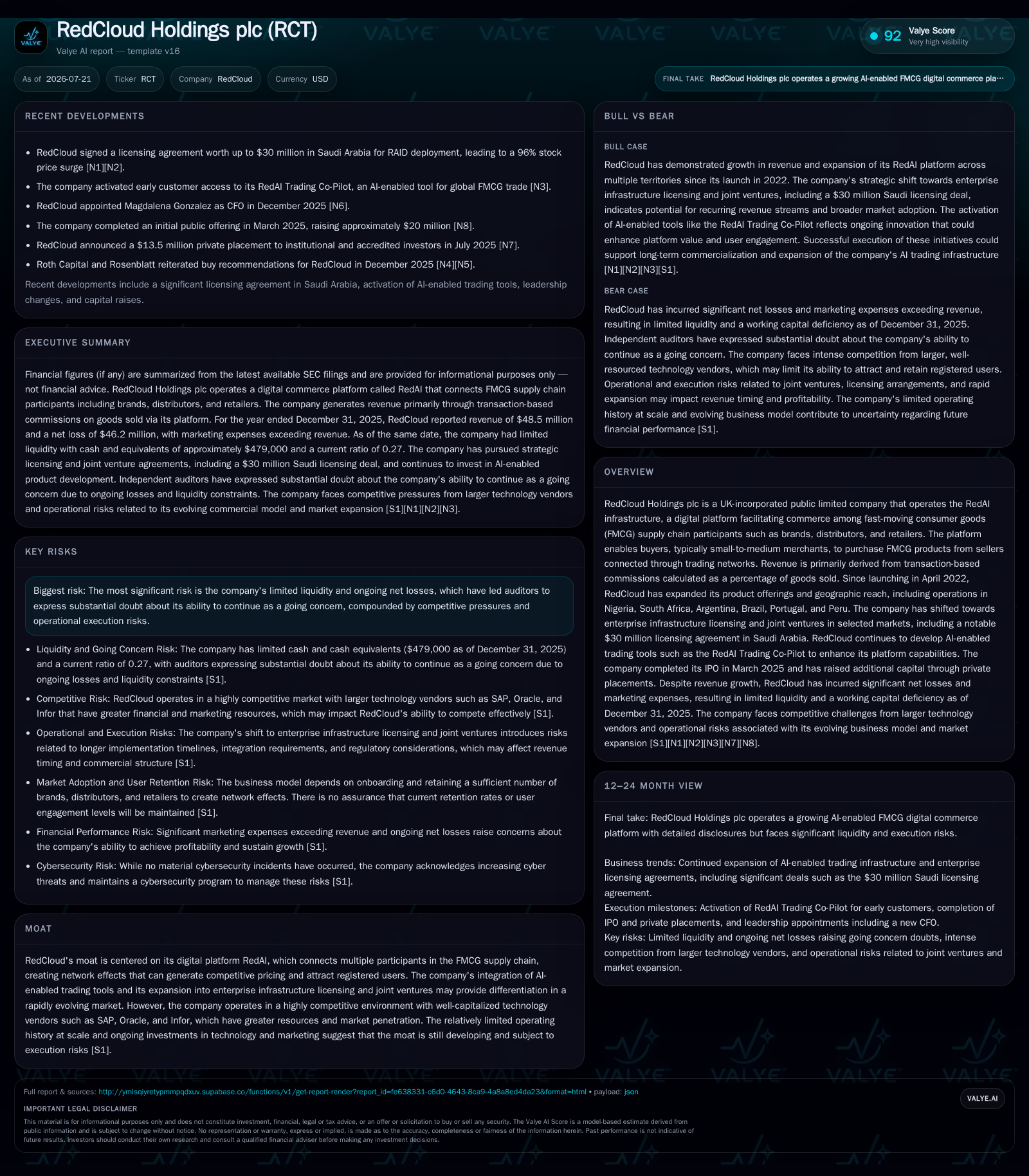
RedCloud Holdings plc operates RedAI, a global digital platform that connects fast-moving consumer goods brands, distributors, and retailers through transaction-based commissions. The recent launch of its CORE trade execution engine highlights ongoing technological investments to enhance pricing and operational efficiency. Despite modest 2025 revenue growth to $48.5 million, the company faces substantial net losses exceeding $46 million and limited liquidity with under $0.5 million in cash at year-end. Its competitive position benefits from network effects and AI capabilities but remains pressured by larger enterprise software vendors and execution risks tied to expanding geographically via licensing and joint ventures. The equity line of credit and convertible notes raised early in 2026 provide critical financing runway, but sustained capital access and platform user growth remain key watchpoints.
Recent Operating Update: CORE Trade Execution Engine Launch and Governance Stability
On July 13, 2026, RedCloud Holdings plc announced the launch of its CORE trade execution engine, a foundational technology integrated within its RedAI digital marketplace infrastructure [S2]. This AI-powered engine is designed to enhance trade execution speed, pricing optimization, and operational efficiency—key factors in the fast-moving consumer goods (FMCG) supply chain sector where transaction velocity and pricing accuracy directly impact platform GMV and commission revenue. The introduction of CORE represents a strategic investment in AI-enabled trading tools aimed at improving the platform’s take rate and user experience, which are critical KPIs for marketplace scalability.
In parallel, the company’s mid-2026 general meeting confirmed board continuity with the reappointment of key directors, including CEO Justin Floyd, underscoring management stability during this pivotal growth and technology integration phase [S3]
Business Model: AI-Driven Digital Marketplace with Transaction Commissions and Licensing
RedCloud operates RedAI, a global digital marketplace connecting FMCG brands, distributors, and predominantly small-to-medium merchants across emerging and frontier markets [S1; S7]. The platform facilitates commerce by enabling buyers to order products from sellers within proprietary trading networks such as Red101 and TradeX. Revenue is primarily generated through transaction-based commissions, calculated as a percentage of Gross Merchandise Value (GMV) transacted on the platform.
Key operating variables influencing revenue growth include the number of registered users (both buyers and sellers), transaction volume and frequency, average order value, and the take rate (commission percentage). The deployment of CORE aims to optimize pricing and demand forecasting, potentially increasing transaction frequency and average order size by improving price discovery and trade execution efficiency.
In addition to transaction commissions, RedCloud is pursuing enterprise infrastructure licensing agreements and joint ventures to expand its geographic footprint and diversify revenue streams [S1]. These licensing deals provide more predictable, recurring revenue through fixed or subscription fees, complementing the variable transaction-based model. While specific details on the Saudi Arabia licensing deal are not directly cited, the company’s filings indicate ongoing efforts to enter new markets via partnerships and licensing arrangements
Industry Context and Competitive Positioning
RedCloud operates within the digital FMCG supply chain platform sector, which includes multi-sided marketplaces that connect supply chain participants without owning inventory. Competitors range from regional digital marketplaces focused on fragmented retail sectors in emerging economies to large enterprise software vendors such as SAP Ariba and Oracle NetSuite, which provide comprehensive procurement and supply chain infrastructure solutions for multinational corporations.
While SAP and Oracle benefit from established enterprise client bases and extensive product suites, RedCloud differentiates itself by focusing on AI-enabled trading tools tailored to the fast-paced FMCG environment. The company’s competitive moat relies heavily on network effects generated by increasing registered users and transaction volumes, which enhance platform liquidity and pricing competitiveness [S1; S7].
Critical KPIs to monitor include registered user growth segmented by buyers and sellers, GMV expansion, average order values, user churn rates, and take rate stability or improvement driven by upselling infrastructure licensing and AI-powered features.
Risks and Operational Challenges
Despite technological advancements, RedCloud faces several significant risks:
Competitive Pressure: The company competes against well-capitalized incumbents with broader product portfolios and entrenched customer relationships. This dynamic increases CAC and challenges RedCloud’s ability to scale user acquisition profitably.
Execution and Geographic Expansion Risks: Rapid expansion into multiple emerging markets—including Nigeria, South Africa, Brazil, and Argentina—exposes RedCloud to regulatory complexities, currency volatility (notably GBP/USD, Nigerian Naira, South African Rand, Brazilian Real, Argentine Peso), and operational challenges that can impact margins and cash flow unpredictably [S1]
Capital Access Uncertainty: Although RedCloud secured an Equity Line of Credit (ELOC) facility up to $30 million and raised approximately $4 million through senior convertible notes, supplemented by shareholder loans and warrant exercises in early 2026, ongoing access to affordable capital remains uncertain amid macroeconomic tightening [S1; S2; S3].
Platform Adoption and Monetization: Sustaining growth in registered users and transaction volumes while controlling churn requires continuous investment. The balance between marketing spend and monetization efficiency will be critical to improving gross margins and moving toward profitability.
Key Metrics and What to Monitor
Investors and analysts should focus on the following operational and financial indicators to assess RedCloud’s trajectory:
CORE Integration Impact: Quarterly updates on the CORE trade execution engine’s effect on transaction velocity, pricing accuracy, and average order values will indicate the success of AI-enabled enhancements [S2]
User Base Growth: Trends in the number of active registered buyers and sellers across core markets will reflect network effect scalability and platform liquidity.
GMV and Revenue Growth: Correlating GMV expansion with revenue growth and marketing expense ratios will provide insight into margin improvement potential and CAC efficiency [S1]
Liquidity and Capital Raising: Monitoring drawdowns against the ELOC facility, convertible note utilization, and any new equity or debt issuances will inform the company’s runway and financial flexibility [S2; S3].
Regulatory and Currency Risk Management: Updates on strategies to mitigate foreign exchange volatility and regulatory compliance in key markets such as Nigeria and Brazil will be important given their material impact on operating results [S1].
Financial Overview
Early 2026 financing activities, including equity line of credit drawdowns, senior convertible note issuances, shareholder loans, and warrant exercises, have provided critical near-term funding to support ongoing operations and technology investments [S2; S3]. However, sustained capital access and disciplined cash flow management remain essential for RedCloud to progress toward profitability and platform scalability.
This analysis is based solely on publicly filed materials and does not constitute investment advice or forecasts. It integrates company disclosures with sector-specific context to provide a detailed understanding of RedCloud Holdings plc’s operational and financial position as of mid-2026.
Disclaimer: This is research-only, informational analysis and not investment advice. It may include AI-generated interpretation and general industry context. Always verify important details using primary sources.

Comments