
NewHold Investment Corp IV’s Strategic Launch and Capital Integrity Amid SPAC Market Dynamics
NewHold Investment Corp IV completed a $201 million IPO establishing foundational SPAC structures, with investor protections and sponsor incentives shaping its path toward a business combination.
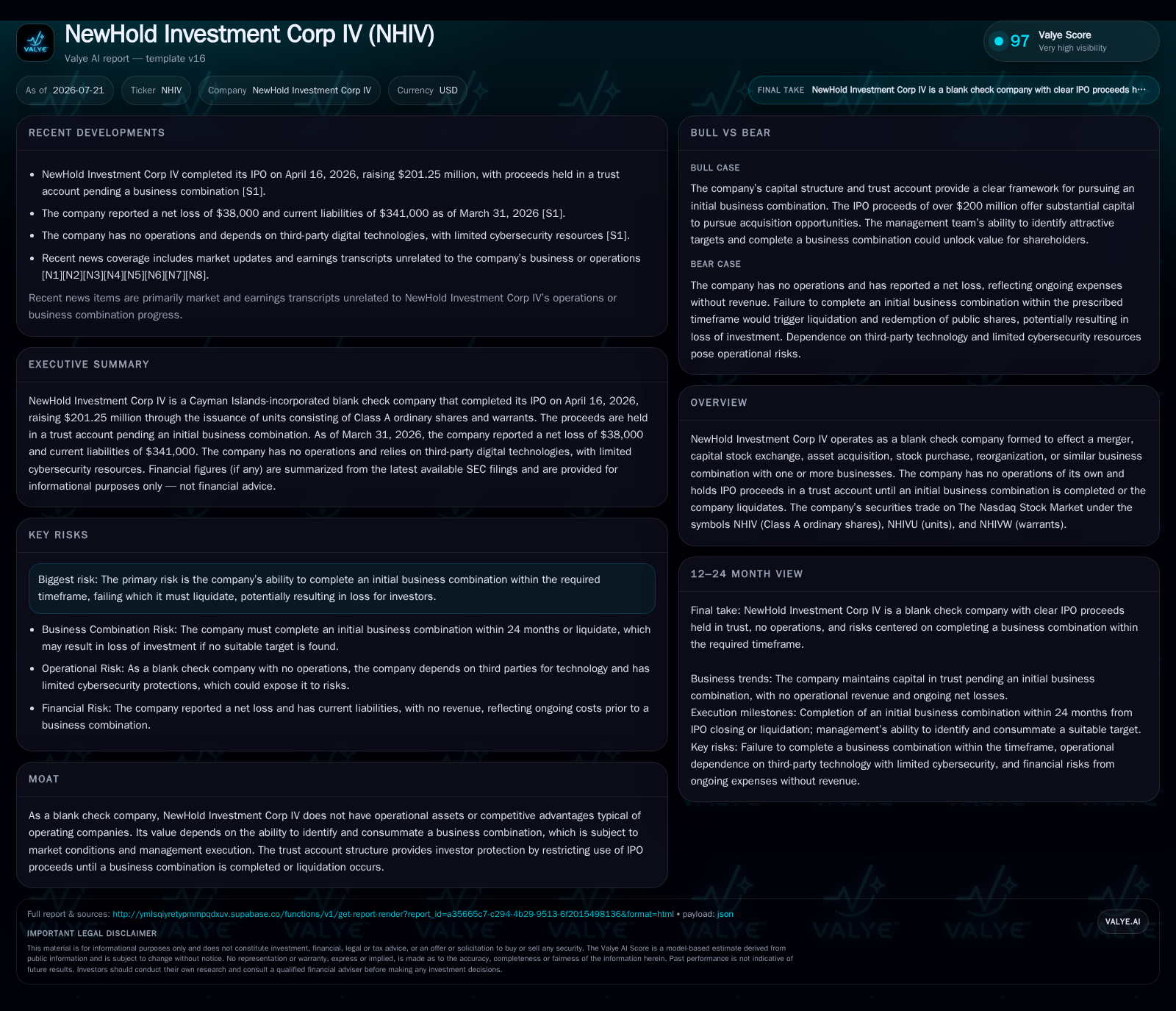
NewHold Investment Corp IV launched its initial public offering in April 2026, raising $201.25 million and placing proceeds in a U.S.-based trust account to shield investors pending a qualifying business combination. The SPAC’s unit structure includes one Class A ordinary share plus one-third of a redeemable warrant exercisable at $11.50, framing potential dilution and upside mechanics for investors. Sponsor alignment is established through private placement units and indemnity agreements balancing motivation with risk mitigation. Operational risks focus on the mandated 24-month business combination timeline and reliance on third-party cybersecurity measures, while redemption rights offer investors protection at the potential expense of available acquisition capital. Tracking trust account balance, redemption activity, warrant exercise, and deal deadlines will be critical to assessing NHIV’s progression toward a successful de-SPAC transaction.
Recent Operating Update: Strong Capital Foundation Post-IPO
NewHold Investment Corp IV (NHIV) launched its lifecycle as a Special Purpose Acquisition Company (SPAC) with a successful initial public offering (IPO) in April 2026, raising gross proceeds of $201.25 million through the issuance of 20,125,000 units, including full exercise of the underwriters’ over-allotment option [S7]. This capital raise reflects robust market demand and underwriting confidence. The proceeds from the IPO, combined with concurrent private placement units purchased by the Sponsor and underwriter BTIG LLC, were deposited into a U.S.-based trust account managed by Continental Stock Transfer & Trust Company, serving as trustee [S11].
The trust account structure is a critical investor protection mechanism, legally restricting the use of funds until the completion of a qualifying business combination, shareholder redemptions triggered by failure to consummate a deal within the prescribed 24-month timeline, or liquidation events [S2][S6]. This arrangement preserves the integrity of investor capital during the pre-combination phase, aligning with industry-standard SPAC governance practices.
Business Model Fundamentals: Unit Structure, Monetization, and Investor Safeguards
NHIV’s capital structure consists of units, each comprising one Class A ordinary share and one-third of a redeemable warrant exercisable at $11.50 per share [S5][S7]. This hybrid security design provides investors with immediate equity exposure and optionality to increase ownership post-merger through warrant exercise, enabling leveraged upside participation if the de-SPAC transaction enhances valuation above the warrant strike price. However, warrant exercises introduce dilution risk, a key variable to monitor as it affects post-merger capital structure and shareholder value.
Revenue generation and cash flow for NHIV are contingent on successfully completing a business combination, as the company operates solely as a blank check entity without commercial operations or revenues until that event [S2]. Upon consummation of a merger, NHIV typically earns fees and realizes equity appreciation through sponsor promote shares, which are private placement units purchased at IPO without underwriting discounts, aligning sponsor incentives with public shareholders [S9][S11].
Investor protections include redemption rights allowing public shareholders to redeem their shares for cash prior to approving any merger agreement. While these rights safeguard liquidity, elevated redemption rates can reduce the capital available for acquisition financing, potentially necessitating supplemental funding such as private investment in public equity (PIPE) deals or sponsor contributions. NHIV’s 24-month deadline to complete a business combination imposes strict time pressure; failure to meet this deadline triggers mandatory liquidation and return of funds net expenses to shareholders [S2][S6]. This framework balances sponsor urgency with investor safeguards.
Sponsor Alignment and Governance: Private Placement Units and Indemnity Agreements
The Sponsor acquired 440,000 private placement units at $10 per unit concurrently with the IPO, without underwriting fees, ensuring alignment of economic interests with public investors while bearing appropriate risk exposure [S9][S11]. BTIG LLC, the lead underwriter, also purchased private placement units under similar terms. These private placement units typically convert into promote shares post-merger, often representing approximately 20% of the post-transaction equity, incentivizing active deal sourcing and execution.
Governance protections include indemnity agreements executed with directors and officers, including sponsors, which provide legal protection against liabilities arising from fiduciary duties except in cases of gross negligence or willful misconduct [S10]. Such agreements promote managerial stability and risk management during the inherently uncertain de-SPAC process.
Operational Risks: Timeline Constraints and Cybersecurity Dependencies
NHIV faces operational risks primarily related to the 24-month deadline to consummate a business combination. Failure to complete a deal within this timeframe results in liquidation, which negatively impacts sponsor returns and investor expectations [S2]. This deadline creates a compressed timeline for deal sourcing, due diligence, negotiation, and shareholder approval processes.
Cybersecurity risk is heightened due to NHIV’s lack of internal operational infrastructure and reliance on third-party digital platforms, including cloud services and trustee systems [S13][S14]. Any cybersecurity incident affecting these third-party providers could compromise sensitive data or disrupt transaction workflows. NHIV’s limited internal resources dedicated to cybersecurity increase vulnerability compared to operating companies with proprietary IT capabilities.
Redemption Rights and Capital Availability: Balancing Investor Protection and Deal Execution
Redemption rights afford public shareholders the option to redeem shares for cash before merger approval, providing liquidity protection against unwanted post-merger exposure. However, high redemption rates can materially reduce the funds available for acquisition financing, potentially constraining deal size or necessitating alternative capital sources such as PIPE investments or increased sponsor contributions.
NHIV’s redemption provisions align with industry norms designed to balance investor confidence with sponsor flexibility. Monitoring redemption rates and their impact on trust account balances will be essential to assess deal viability and capital sufficiency.
Competitive and Sector Context: Positioning Within the SPAC Ecosystem
NHIV operates within a competitive SPAC landscape characterized by numerous blank check companies targeting diverse sectors. While specific peer comparisons are not disclosed, NHIV’s IPO size of $201.25 million places it in the mid-range of SPAC capital raises, which typically vary from $100 million to over $500 million depending on target sector and sponsor reputation.
Key sector KPIs relevant to NHIV include IPO proceeds raised, redemption rates, warrant exercise activity, trust account balance, sponsor promote percentage, and time to complete a business combination. These metrics collectively influence the potential for successful de-SPAC transactions and post-merger market capitalization.
Key Growth Drivers and Monitoring Milestones
The 24-month window commencing April 2026 sets a definitive timeline for NHIV’s management to identify and execute a qualifying business combination [S6]. Progress toward this goal will be evidenced by public disclosures of target identification, proxy statement filings soliciting shareholder approval, and voting outcomes.
Market sentiment can be gauged through trading activity and price trends of NHIV’s units (NHIVU), ordinary shares (NHIV), and warrants (NHIVW). Positive price momentum may indicate investor confidence in deal prospects, while volatility could signal concerns regarding valuation or timing risks.
Additional critical variables to monitor include trust account balance changes following redemption cycles, warrant exercise rates affecting dilution, and sponsor promote conversions. These factors will provide insight into the robustness of the capital pool and the evolving ownership structure ahead of the de-SPAC transaction.
Management disclosures in quarterly filings, including updates on deal progress and risk management strategies, will offer further clarity on NHIV’s trajectory from a blank check vehicle toward realizing its de-SPAC value creation objectives.
Disclaimer: This is research-only, informational analysis and not investment advice. It may include AI-generated interpretation and general industry context. Always verify important details using primary sources.

Comments