
RF Acquisition Corp III Advances Nasdaq Listing Path with HCC Healthcare Deal
The recent Business Combination Agreement with HCC Healthcare marks a pivotal milestone in RF Acquisition Corp III’s progression toward de-SPAC transition amid strong liquidity and governance controls.
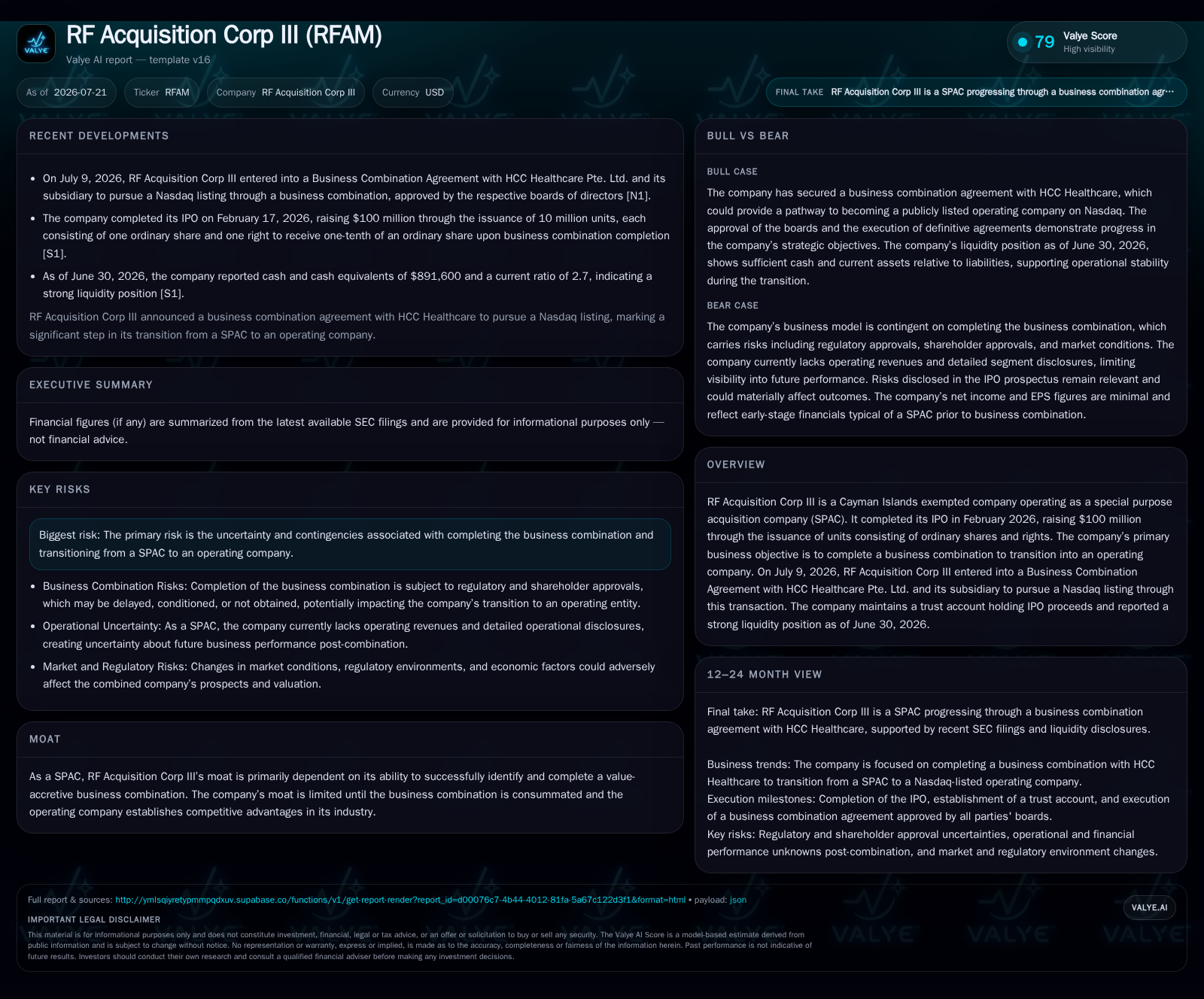
RF Acquisition Corp III, a Cayman Islands-based SPAC, announced on July 9, 2026, the signing of a definitive Business Combination Agreement with HCC Healthcare Pte. Ltd., setting the stage for a Nasdaq listing and transition from a shell to an operating company [S3][N1]. The SPAC completed its IPO in February 2026, raising approximately $100 million, which remains secured in a trust account to protect investor capital pending the merger closing [F1][S9]. The quarter ending June 30 shows a robust liquidity position with a current ratio of 2.7 and cash of $891,600, all critical as shareholder redemption rights loom before deal approval [F1][S2]. This transaction crystallizes key SPAC lifecycle dynamics including timing pressure, redemption impact on funding, regulatory conditions, and the pathway from sponsor-controlled shell to public operating entity.
Recent Milestone: Business Combination Agreement With HCC Healthcare Sets De-SPAC Trajectory
In July 2026, RF Acquisition Corp III ("RFAM"), having raised approximately $100 million through its February IPO, announced execution of a definitive Business Combination Agreement with HCC Healthcare Pte. Ltd. This agreement initiates RFAM's transition from a blank-check shell to an operating company listed on Nasdaq via a de-SPAC transaction [S3][N1][F1]. Securing this agreement represents significant advancement beyond capital formation toward operational status.
This phase triggers critical next steps including filing a Form F-4 registration statement with the SEC, soliciting proxies for shareholder approval of the merger, and satisfying customary closing conditions such as regulatory approvals and absence of material adverse changes [S3]. Having elapsed only about five months since IPO places RFAM well ahead within the typical SPAC timeframe of up to 18-24 months allowed to complete business combinations or face liquidation.
A key dynamic at this stage involves shareholder redemption rights that can materially reduce funds available for merger financing if exercised at scale prior to deal consummation.
SPAC Model Mechanics: Capital Structure and Trust Account Safeguards
RFAM's capital structure consists of units issued at IPO each containing one ordinary share plus one right convertible into one-tenth of an ordinary share upon business combination completion — standard industry practice balancing initial capital raise with potential future dilution through rights/warrants [S9][S14].
Proceeds from the IPO are held in a trust account managed under strict legal terms designed to protect investors by restricting premature access until either business combination closing or liquidation. As of June 30, cash and equivalents totaled approximately $891,600 with current assets around $945,548 against current liabilities near $349,808 [F1][S2]
Governance requires RFAM to obtain shareholder approval via vote before closing the business combination. Shareholders maintain redemption rights allowing exit at IPO price plus accrued interest before deal closure — introducing variability in available merger funding depending on redemption levels [S3]. RFAM's move to sign its business combination agreement only five months after IPO reflects relative timing efficiency that mitigates risk related to forced liquidation deadlines or financing constraints.
Nonetheless, unpredictable shareholder redemption behavior upon announcement can significantly reduce available cash unless offset by complementary PIPE financing or sponsor contributions. While no direct PIPE financing details have been disclosed for RFAM yet, these mechanisms are commonly employed across industry peers.
Sponsor reputation and alignment influence investor confidence affecting redemption patterns and overall market reception. RFAM's sponsor Alfa 30 Limited participated in private placement units concurrent with the IPO purchase indicating aligned incentives supportive of deal execution [S20].
Risks: Redemption Impact and Regulatory Approvals
Execution risks revolve around obtaining requisite shareholder vote approval coupled with regulatory clearances necessary for Nasdaq listing post-merger [S3][S28]. The Business Combination Agreement includes termination rights triggered by failure to secure approvals or governmental actions impeding legality — any such event could cause deal delay or cancellation subject to negotiated cure periods
Substantial redemptions could reduce merger proceeds requiring possible renegotiations or additional financing that would dilute equity interests further. Outstanding rights/warrants exercisable post-combination also pose dilution risk potentially pressuring share price after listing.
Valuation accuracy and integration capacity uncertainties regarding HCC Healthcare add layers of financial forecast risk that may affect investor perception during transition from shell to operating entity.
Growth Drivers: Alternative Public Listing Demand in Healthcare Sector
The partnership with HCC Healthcare situates RFAM within healthcare—a sector where private companies increasingly seek faster public market access through SPACs rather than traditional IPOs. Drivers include complex regulatory environments and desire for speedier capital access amid demographic shifts and digital transformation trends enhancing demand for healthcare services platforms [N1].
SPACs offer flexibility in negotiation and appeal to institutional investors seeking structured growth exposure. Innovations like PIPE rounds complement capital structures when redemptions arise.
What To Watch Next: Proxy Statement Filing and Shareholder Vote Outcome
Following July filings indicating imminent Form F-4 submission to the SEC [S3], key milestones include mailing definitive proxy statements and conducting shareholder votes for transaction approval within scheduled timelines barring unforeseen delays.
Investors should monitor proxy disclosures detailing voting conditions alongside early indications of shareholder sentiment. Delays or adverse developments could trigger authorized extension periods common in SPAC deals.
Redemption rate announcements will be critical metrics influencing residual cash availability essential for final merger consideration payments.
Financial Profile Discussion: Liquidity Adequacy Amid Pre-Combination Expenses
At June 30 quarter-end, RFAM reported an operating loss around $303,527 consistent with pre-revenue SPAC administrative costs while net income was positive at approximately $566,737 largely due to non-operating accounting items not reflective of cash flow generation [F1]
Cash held in trust ($891,600) combined with current assets ($945,548) against current liabilities ($349,808) supports operational runway covering legal and administrative expenses leading up to closing.
Ultimately financial sustainability hinges on timely business combination completion as ongoing expenses reduce working capital absent revenue streams or external financing inflows.
This analysis synthesizes recent SEC filings through July 2026 alongside financial data and news releases documenting RF Acquisition Corp III’s progress towards completing its de-SPAC transaction with HCC Healthcare. The focus remains on confirmed facts without speculative projections beyond documented evidence.
Disclaimer: This is research-only, informational analysis and not investment advice. It may include AI-generated interpretation and general industry context. Always verify important details using primary sources.

Comments