
MSCI Expands ESG Offering and Navigates Fee Pressures with Recurring Revenue Strength
MSCI's Q2 2026 results underscore growth in sustainability analytics amid industry fee pressures and client consolidation risks.
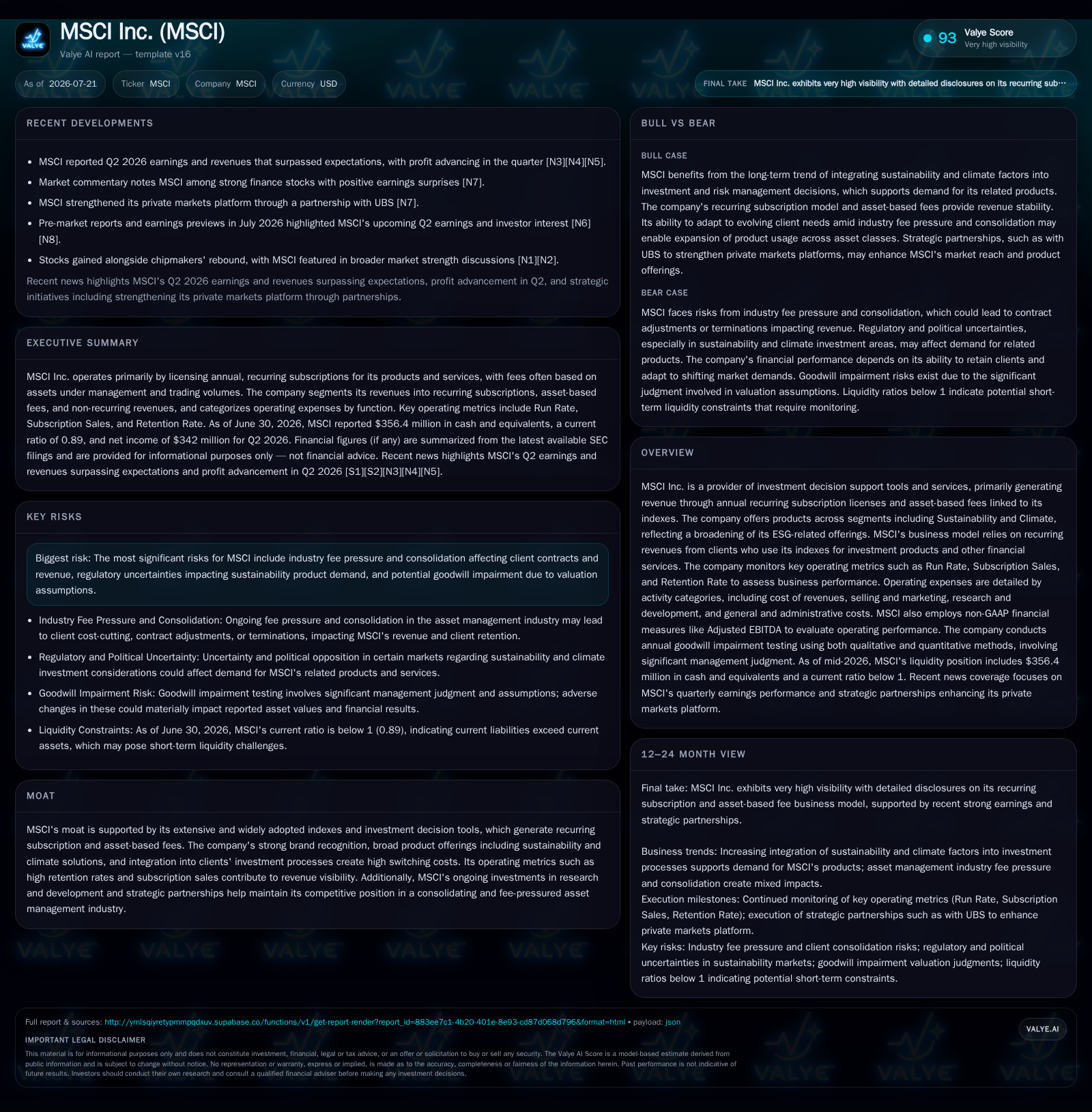
In its latest quarterly filing, MSCI reported steady growth driven by recurring subscription licenses and asset-based fees linked to its indexes, especially within its expanding Sustainability and Climate segment. The company's business model relies on high client retention and recurring revenues from asset managers leveraging MSCI indexes in investment products. Despite ongoing fee pressure and consolidation in the asset management industry posing risks to contract terms, MSCI's broad product suite and integration into investment workflows support revenue visibility. The firm’s significant debt load underlines the need for efficient capital allocation amid uncertain regulatory environments surrounding ESG solutions.
Recent Operating Update: Q2 2026 Earnings
MSCI Inc.'s second quarter ended June 30, 2026, demonstrated continued resilience in its financial data and analytics SaaS business amid persistent fee pressures and consolidation trends in the asset management industry [S2]. The company reported stable growth supported by recurring subscription licenses and asset-based fees that fluctuate with assets under management (AUM) linked to MSCI’s proprietary indexes [S1], [S5]. Despite ongoing industry-wide fee compression, MSCI’s revenue run rate remains robust, underpinned by strong subscription sales momentum and high client retention rates, reflecting the entrenched role of MSCI’s indexes and analytics in portfolio construction, benchmarking, and risk management workflows [N1], [N2].
The Sustainability and Climate segment, renamed from "ESG and Climate" in early 2025 to reflect a broader product suite, continues to expand as demand for ESG and climate-related analytics grows globally [S1], [S5]. While regulatory uncertainty, particularly in the United States, presents adoption challenges, evolving disclosure mandates and investor preferences worldwide support long-term growth prospects for MSCI’s sustainability offerings [S1].
Business Model: Recurring Revenue Anchored by Index Licenses and Asset-Based Fees
MSCI’s business model centers on licensing annual recurring subscriptions for its indexes, data sets, risk models, and analytics platforms, which are primarily billed upfront and recognized ratably over the contract term [S1], [S5]. This subscription revenue stream provides high visibility and stability, driven by long-term contracts with high renewal and retention rates—a critical operating KPI for the company. Complementing these are asset-based fees, which vary based on client AUM or trading volumes linked to MSCI indexes, including ETFs and mutual funds [S1], [S5]. These fees expose MSCI to market fluctuations but also enable participation in global AUM growth trends.
Non-recurring revenues, such as one-time licensing fees and implementation services, represent a smaller and more variable portion of total revenues [S1]. Overall, MSCI’s revenue mix is heavily weighted toward recurring streams, supporting a predictable run rate and facilitating efficient capital allocation.
Industry Structure and Competitive Position
Operating upstream in the financial value chain, MSCI serves asset managers, institutional investors, banks, and financial intermediaries that rely on its indexes, benchmarks, risk analytics, and ESG data for investment decision support and regulatory compliance [S5]. Competitors include S&P Global, FTSE Russell (part of London Stock Exchange Group), Bloomberg Indexes, and specialized ESG data providers. Competition focuses on data breadth, analytics sophistication—especially in sustainability and climate risk—and seamless integration into client workflows.
MSCI benefits from high switching costs due to the widespread adoption of its benchmarks and embedded analytics, which sustain strong retention rates and subscription sales. However, fee compression and vendor consolidation driven by asset manager mergers and cost-cutting initiatives pose risks to contract terms and pricing [S1]. Larger clients may negotiate lower fees or consolidate vendors, but MSCI’s broad product suite and ability to cross-sell across asset classes may offset some margin pressure.
Growth Drivers
Several structural factors underpin MSCI’s growth outlook:
Expansion of ESG & Sustainability Analytics: Regulatory mandates globally are increasing transparency requirements around climate risks and sustainability metrics. MSCI’s comprehensive sustainability and climate analytics position it to capture this growing demand, despite regional regulatory and political uncertainties, especially in the U.S. [S5], [N10].
Rising Adoption of Index-Linked Investment Products: The proliferation of ETFs and mutual funds indexed to MSCI benchmarks drives asset-based fee growth. Growth in factor-based and multi-asset indexing strategies further supports recurring revenues linked to AUM [S7], [S18].
Private Assets and Real Assets Analytics: MSCI’s expansion into private markets analytics through acquisitions and product development, including Private Capital Intel and Real Assets solutions, opens new verticals complementing its public markets offerings [S12], [N10].
Technological Innovation and R&D: Ongoing investments in research and development enhance MSCI’s analytics capabilities, particularly in climate risk modeling, and improve API-driven integration, enabling clients to embed MSCI’s tools in their internal systems [S6], [S18].
Client Consolidation Effects: While consolidation among asset managers may increase pricing pressure, it also creates opportunities for MSCI to deepen relationships by providing comprehensive, multi-asset class solutions, potentially increasing wallet share per client.
Risks and Watchpoints
Key risks to monitor include:
Fee Pressure and Vendor Consolidation: Intensifying competition and cost-cutting among large asset managers could compress MSCI’s pricing and affect contract renewals, impacting revenue growth visibility.
Regulatory Uncertainty in Sustainability Products: Political opposition and evolving regulatory frameworks, particularly in the U.S., may slow adoption or limit market opportunities for MSCI’s sustainability analytics.
Market Volatility Impacting Asset-Based Fees: MSCI’s variable fees tied to AUM are sensitive to market downturns, which could reduce fee income during prolonged periods of asset depreciation.
Goodwill Impairment: Acquisitions contributing to goodwill on the balance sheet carry impairment risk if future earnings do not meet valuation assumptions.
Data Quality and Cybersecurity: Dependence on accurate data and secure delivery platforms exposes MSCI to operational risks requiring continuous oversight.
Monitoring subscription renewal rates during peak periods, net new subscription bookings—especially in Sustainability and Private Assets segments—AUM trends linked to MSCI indexes, and adjusted EBITDA margins reflecting cost management amid R&D investments will be critical indicators of MSCI’s performance trajectory.
What To Watch Next
Upcoming milestones include:
- Quarterly updates on Annual Recurring Revenue (ARR) growth, with emphasis on Sustainability segment adoption.
- Subscription sales trends in newly integrated private assets solutions following recent acquisitions.
- Adjusted EBITDA margin trends indicating balance between growth investments and operational efficiency.
- Outcomes of contract renewals with large consolidated clients, which may signal pricing or vendor consolidation shifts.
- Regulatory developments globally that could influence ESG product demand and adoption.
- Progress in integrating acquisitions such as Foxberry to enhance front-office index technology capabilities.
Financial Profile Discussion
As of June 30, 2026, MSCI reported approximately $356 million in cash and equivalents against total debt of about $6.4 billion, resulting in net debt near $6.1 billion [F1]. This leverage level underscores the importance of consistent free cash flow generation to service debt obligations. The company’s current ratio stands at approximately 0.89, reflecting working capital dynamics typical of subscription-based software firms that rely on upfront billing rather than inventory turnover [F1].
Balancing capital allocation between funding strategic acquisitions and innovation initiatives versus deleveraging remains a key financial priority, especially given potential volatility in AUM-linked fees and regulatory uncertainties impacting growth segments.
Conclusion
MSCI exemplifies a financial data and analytics SaaS firm anchored by sticky recurring revenues and variable asset-based fees tied to widely adopted proprietary indexes. Its strategic emphasis on sustainability and climate analytics aligns with secular trends toward ESG integration, despite geopolitical and regulatory complexities. Industry dynamics marked by fee compression and client consolidation require MSCI to maintain competitive differentiation through innovation and broad product offerings while preserving high retention rates. The company’s substantial leverage highlights the need for disciplined capital management amid cyclical and regulatory uncertainties. Overall, MSCI’s operating model and product positioning support a resilient franchise navigating evolving market landscapes with clear growth levers in sustainability, private assets, and technology innovation.
This analysis synthesizes publicly filed SEC reports dated through July 21, 2026 ([S1],[S2],[S3]) combined with companyfacts data snapshots ([F1]) without constituting investment advice or research views.
Disclaimer: This is research-only, informational analysis and not investment advice. It may include AI-generated interpretation and general industry context. Always verify important details using primary sources.

Comments