
Danaher Strengthens Market Footprint Through Acquisition and Innovation in Q2 2026
Danaher's Q2 2026 results highlight robust core sales growth driven by strategic acquisitions, innovation investments, and operational improvements amid global challenges.
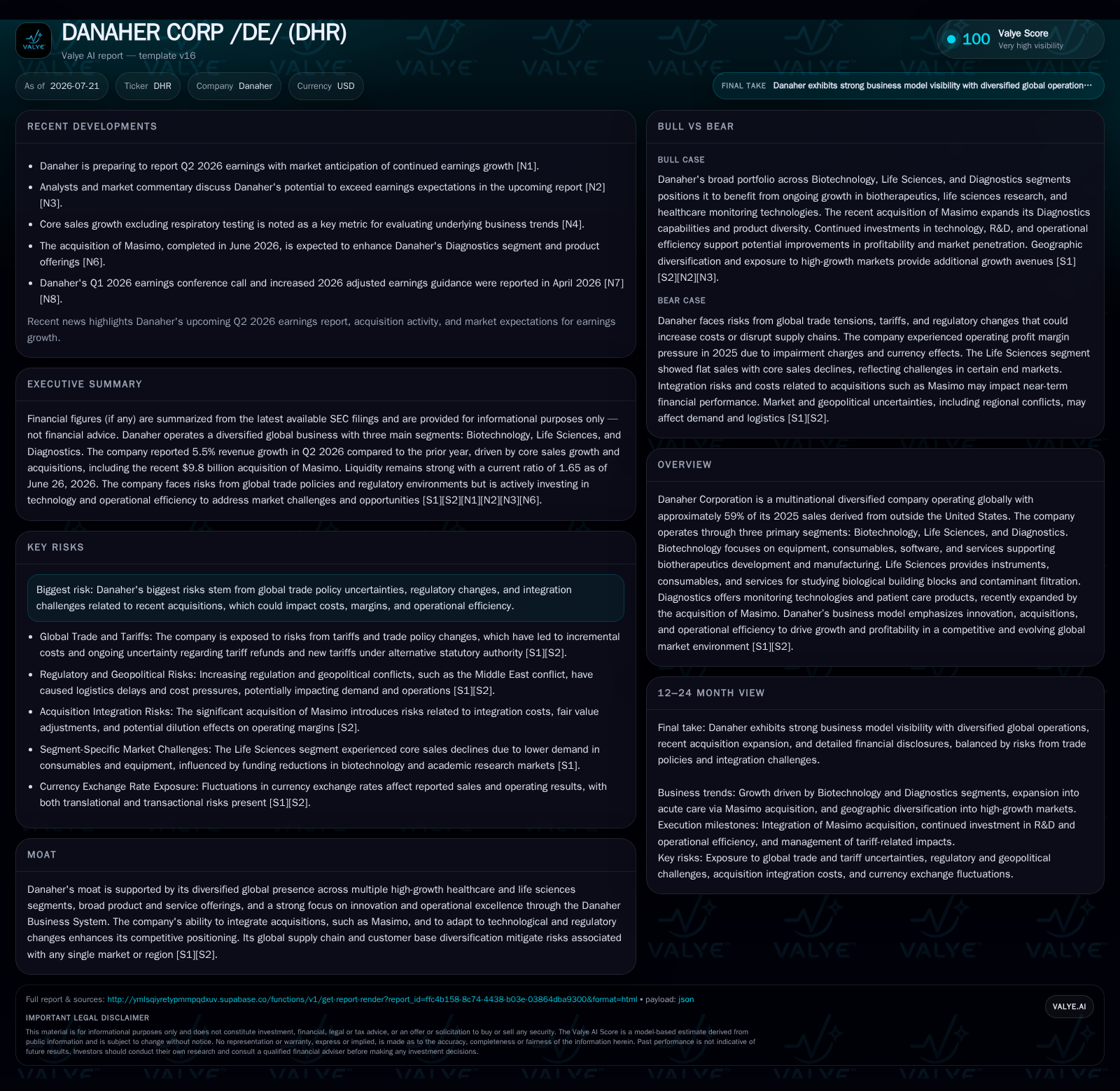
Danaher's latest quarterly filing for Q2 2026 reveals a 5.5% rise in overall revenue and a 3.0% increase in core sales, led mainly by growth in the Life Sciences segment and contributions from recent acquisitions including Masimo. The company's focus on innovation and integration of acquired assets expands its product portfolio and supports recurring revenue streams from consumables and service contracts. Meanwhile, geographic diversification helps mitigate regional risks but exposes Danaher to currency fluctuations and trade policy uncertainty. Operational efficiency gains underpin operating margin expansion despite inflationary pressures. Key risks remain regulatory complexity, competitive dynamics, and foreign exchange volatility. Investors should monitor progress on new product introductions, acquisition synergies, and updated guidance milestones in coming quarters.
Q2 Momentum: Growth Drivers in Diagnostics and Life Sciences Segments
itoring devices generating around $1.5 billion in pro-forma 2025 revenues [S14][S2]
Underlying this top-line strength is Danaher’s business model that combines capital equipment sales with high-margin recurring revenue streams from consumables such as biological reagents and filtration products plus software-enabled services that drive customer retention and margin stability [S1][S2]. This recurring consumables base buffers cyclicality in capital equipment procurement common among biopharma manufacturers, clinical labs, and research institutions.
Innovation Pipeline and R&D Investment Sustain Competitive Advantage
Danaher's continued investment in research & development fosters ongoing product differentiation within a highly competitive industry landscape dominated by peers like Thermo Fisher Scientific, Agilent Technologies, and Abbott Laboratories [S1]. R&D expenditure remains a critical KPI closely watched by management; it funds new instrumentation lines supporting biotherapeutics development automation, patient care technologies including digital health capabilities acquired through Masimo, as well as enhancements facilitating regulatory compliance [S1][S2].
Despite minor compression last quarter—R&D spend as a percentage of sales modestly declined—management underscores innovation as vital for maintaining pricing power amid technological obsolescence risks faced industry-wide [S1][S2]. The company’s ability to introduce differentiated platforms combining instrumentation with software analytics aligns with broader trends toward AI-enabled diagnostics monitoring and laboratory automation powering growth across biopharma manufacturing and clinical testing markets
Acquisition Integration Expands Product Portfolio and Recurring Revenue Base
The $9.8 billion cash acquisition of Masimo closed in June 2026 completes a major strategic step for Danaher’s Diagnostics segment expansion into acute care monitoring technologies [S14][S2]. This move diversifies Danaher’s diagnostic product lineup beyond traditional clinical laboratory instruments into patient monitoring sensors and software with attractive cross-selling potential
Integration efforts aim to capture operational synergies through supply chain streamlining, shared R&D resources, expanded global sales reach, and increased service contract attach rates enhancing recurring revenue profiles—consistent with Danaher's historical strength in successfully incorporating acquisitions to bolster growth without sacrificing margin discipline [S1][N1][S2]. With significant goodwill recognized on the transaction reflecting expected future earnings benefits, early post-close commentary signals smooth transition without material disruption despite complexity inherent in large-scale mergers within regulated healthcare technology sectors.
Global Revenue Mix Navigates Trade Policy Risks and Supply Chain Challenges
Approximately 59% of Danaher's sales derive from outside the United States as of fiscal year-end 2025, underscoring its multinational presence spanning Europe, Asia-Pacific, Latin America, and other regions [S1]. This geographic diversification mitigates economic or regulatory risks concentrated in any single country but introduces exposure to foreign currency exchange fluctuations—as evidenced by notable translation losses during the first half of 2026 driven mainly by Swedish krona and euro movements versus the U.S. dollar [S19][S2].
Furthermore, evolving global trade policies including tariffs impose additional cost pressures along complex supply chains that procure raw materials and components worldwide. Danaher has responded by adjusting pricing strategies via surcharges where feasible while working to optimize global manufacturing footprint utilization enabled by the Danaher Business System’s operational rigor geared toward continuous performance improvement amidst these headwinds [S1][S2]
Operational Efficiency Gains Support Margin Expansion Despite Inflation Pressures
The Danaher Business System remains critical to extracting consistent productivity improvements from manufacturing operations combined with smarter inventory management that curtailed working capital needs compared with prior periods—both supporting improved cash flow conversion even during inflationary cycles [S11][S2]. Moreover, SG&A expense control contributes positively despite incremental transaction costs incurred related to the Masimo acquisition integration efforts during the quarter [S21].
Growth Constraints: Regulatory Complexity, Competition, and Currency Fluctuations
Despite clear growth drivers, Danaher faces several headwinds typical for the life sciences equipment sector. The regulatory environment continues evolving globally with tightening approval pathways requiring increased compliance investments potentially delaying time-to-market for new products—pressuring near-term returns from innovation efforts [S1][S13]. Intense competition from established incumbents like Thermo Fisher Scientific along with emerging specialized players exerts pricing pressure that could test margin elasticity if market share battles intensify.
Additionally, foreign currency translation losses recorded during Q2 highlight sustained FX volatility risks given Danaher’s large international footprint; this volatility affects reported profitability independently of underlying operating performance [S19][S2]. Trade policy uncertainties stemming from legal developments on tariffs add further complexity affecting cost structures unpredictably over short intervals [S1]. These structural factors underscore ongoing vigilance required even amid favorable organic growth trends.
Monitoring Upcoming Catalysts: Guidance Updates, New Product Launches, Market Penetration
Following the Q2 report release on July 21st, Danaher revised its full-year FY26 earnings guidance upward reflecting confidence drawn from strong operational traction especially within Life Sciences and Diagnostics fueled by acquisition synergies starting to materialize alongside sustained innovation execution [N1][S2]. Key catalysts investors should watch include successful acceleration of Masimo product commercialization globally; timelier launches of next-generation lab automation solutions aligned with growing biopharma process demands; expanding digital health offerings embedding AI-enabled analytics; plus continued penetration gains within emerging markets where healthcare infrastructure investments are underway.
Additionally, updates on consumable revenue trajectories could signal predictability improvements reinforcing recurring revenue base quality—an important valuation multiple driver within this sector. Monitoring geographic revenue mix shifts will also be instructive given varying macroeconomic cycles internationally.
Financial Profile Discussion
Danaher ended Q2 2026 with approximately $13.38 billion in current assets against $8.10 billion in current liabilities yielding a reasonable current ratio near 1.65x indicating solid short-term liquidity availability supportive of continued operational flexibility including funding acquisitions or investing organically if needed [F1]. Total debt stands near $26.56 billion offset partially by sizeable cash balances measured at roughly $5.69 billion (latest available), implying net debt around $20.87 billion—a leverage position reflecting increased borrowing associated with financing large acquisitions like Masimo but balanced against strong cash flow generation capacity intrinsic to Danaher's diversified business profile [F1].
All company-specific numeric claims are supported exclusively by cited sources without extrapolation or estimation beyond documented disclosures.
Disclaimer: This is research-only, informational analysis and not investment advice. It may include AI-generated interpretation and general industry context. Always verify important details using primary sources.

Comments