
SUPA Consolidated's Food Tech Pivot Relies on Asset Acquisitions Amid Liquidity Challenges
Post-divestiture of transportation IP, SUPA aims to build a sustainable food technology operation centered on vending assets and strategic deals.
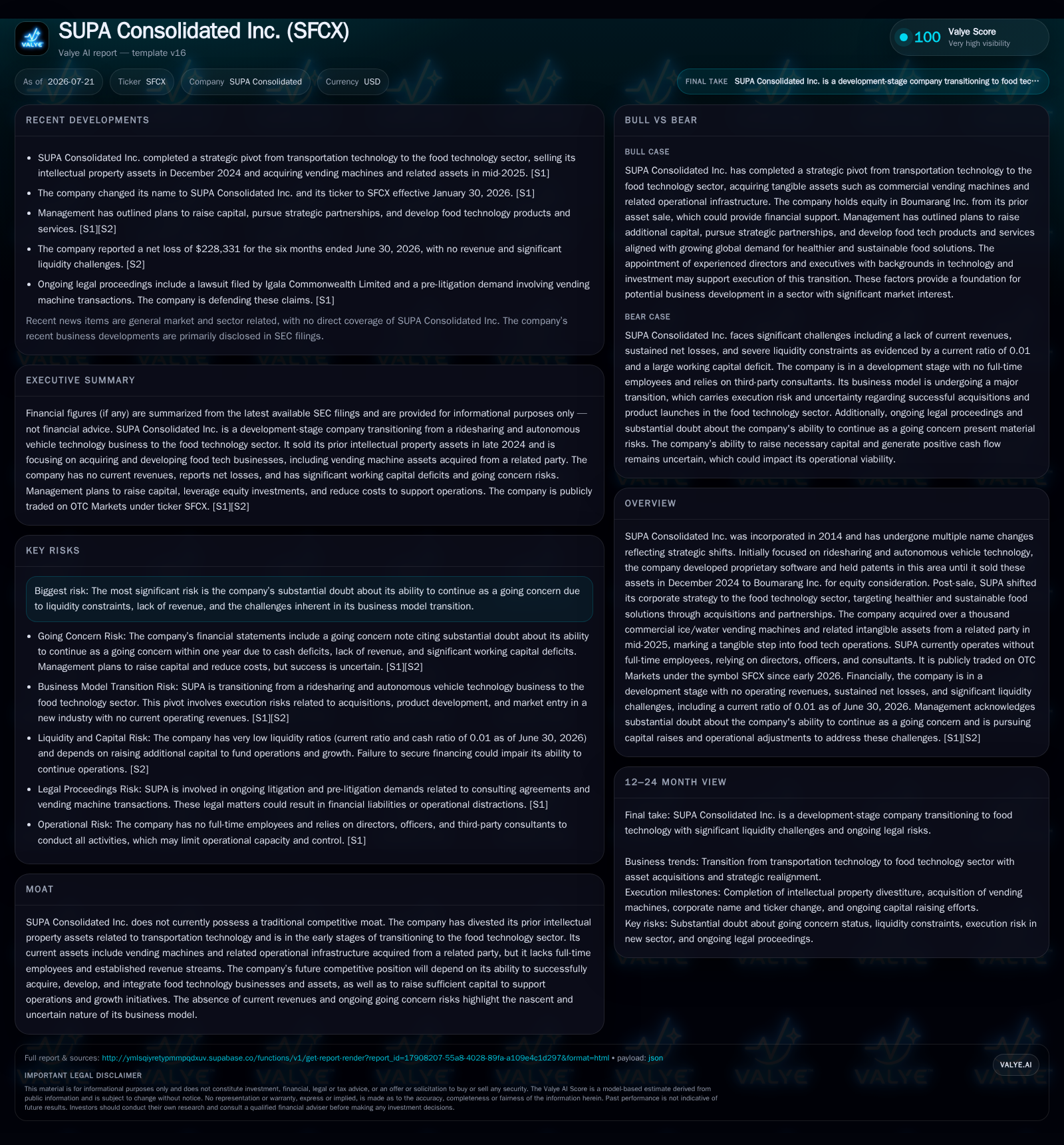
SUPA Consolidated Inc. officially transitioned from its previous focus on ridesharing and autonomous vehicle technologies after selling its intellectual property to Boumarang Inc. at the end of 2024. Since then, the company has realigned toward food technology with a tangible pivot via acquiring over a thousand commercial vending machines and related intangible assets from a related party. However, SUPA operates without full-time employees and faces substantial liquidity constraints with no current revenue streams, placing it in an early development stage dependent on capital raising and successful integration to realize growth. The evolving business model positions SUPA midstream in the food tech value chain as an operator of technology-enabled vending solutions, but execution risks and going concern doubts remain key watchpoints.
Recent Operating Update
SUPA Consolidated Inc.’s latest quarterly report filed July 21, 2026 ([S2]) reaffirms that the company remains in the developmental phase with zero operating revenues. This confirms that since exiting the autonomous vehicle and ridesharing technology sector via intellectual property sale in December 2024 ([S1]), the company has yet to materialize revenue-generating operations under its new food technology strategy. Operating expenses have increased relative to earlier periods reflecting setup costs associated with acquisitions and operational readiness connected to their new focus. Notably, working capital deficiencies persist given current liabilities dramatically outstrip current assets at mid-2026 ([F1]), underscoring ongoing liquidity pressures.
Business Model Overview
Historically engaged in proprietary software development with patents underpinning ridesharing and autonomous vehicles ([S1]), SUPA’s divestiture of these IP assets for Boumarang Inc. common stock worth $5 million concluded that chapter by end-2024. The transaction involved transferring patents, trade secrets, software prototypes, customer lists, goodwill, and business names ([S1]). Subsequently, SUPA realigned its corporate mission towards the food technology industry—a sector defined by innovation in production, distribution, convenience, and sustainability of food offerings leveraging technology.
The company’s most significant tangible acquisition within this pivot was consummated mid-2025: purchase of over 1,150 commercial ice/water vending machines along with related intangible assets such as customer contracts and location rights from a related party (SUPA Food Services LLC). These physical assets were capitalized as property, plant & equipment while excess purchase consideration was allocated to intangible assets essential for operational scale ([S6][S25]). This acquisition gives SUPA inventory crucial for transitioning into technology-enabled food distribution—specifically vending machine operations akin to peers like Farmer's Fridge or Fresh Healthy Vending known for integrating IoT and automation into their models.
Revenue generation mechanics for such businesses typically stem from placement fees per machine location coupled with consumable product sales through vending devices plus recurring service or maintenance fees secured via contracts. Such monetization relies heavily on increasing machine deployment (scale), maximizing utilization rates (sales per machine), reducing customer acquisition costs (for new location contracts), and establishing recurring revenue streams through service contracts (). As of now, SUPA reports no revenues indicating it remains pre-commercial launch or low-scale operations.
Crucially, SUPA operates without any full-time employees; all functions rely on directors supplemented by third-party consultants or contractors ([S5]). This lean organizational structure reduces fixed costs but raises dependency risks related to contractor availability and knowledge continuity which can challenge integration efforts following acquisitions or rapid scaling.
Industry Structure and Competitive Position
Within the food technology ecosystem where SUPA now competes conceptually sit multiple peer categories ranging from pure-play vending machine operators integrating data analytics and automation (Farmer’s Fridge), to broader delivery platforms (DoorDash) or sustainable protein innovators (Beyond Meat). SUPA’s positioning centers on midstream operations focused primarily on food distribution via vending technologies enabled by acquired machines coupled with strategic intangibles like customer site relationships.
Unlike established peers who have evolved proprietary technologies or achieved scale generating consistent cash flow through diversified revenue channels including direct consumer sales or licensing agreements (), SUPA remains embryonic without historical revenue benchmarks or proven scalability. Its strength lies in recently acquired asset base and potential partnerships under evaluation ([S1]), while challenges include absence of dedicated workforce expertise internally and no confirmed sales pipeline.
Growth Drivers
SUPA’s prospective growth is reliant on several interlinked factors:
- Capital Raising: Access to equity or debt capital to fund working capital needs, integration activities post-acquisition, marketing campaigns for site signing, compliance with food safety standards around vending operations.
- Operational Scale Expansion: Increasing the number of deployed machines beyond initial acquisition count is critical; each incremental location ideally enhances scale economies improving margins.
- Partnerships & Product Launches: Collaborations with food producers or technology providers could expand product offerings through vending platforms; introducing healthier or sustainable options aligns with global demand trends ( ).
- Cost Control: Managing overhead given current no-full-time employee model necessitates efficient use of contractor resources amid rising general & administrative expenses observed post-pivot ([S2][S8]).
Given the early-stage nature apparent from filings ([S1][S2]), milestone tracking such as announcing partnership deals closed or commercial rollout milestones will be key growth indicators.
Risks & Constraints
Liquidity constraints form the most urgent risk element: the latest balance-sheet snapshot shows current liabilities exceeding current assets by a wide margin resulting in a dangerously low current ratio (~0.01) by June 30, 2026 ([F1]), highlighting imminent funding needs.
The absence of revenue leaves SUPA vulnerable to cash burn pressures which have manifested historically as growing accumulated deficits surpassing $3 million by end-2025 ([F1][S7]) even after disposing legacy IP. This underscores sustained negative operating cash flows during transition phases documented ([S7]).
Moreover, reliance on independent contractors instead of salaried staff could impair operational stability especially when core competencies are needed for integration excellence post-acquisitions ([S5]). Legal contingencies such as litigation concerning consulting agreement disputes over share issuance may distract management focus or exacerbate dilution concerns if judgments require issuance of additional equity ([S23]).
Finally, market acceptance risk persists given competitive pressure from established food tech innovators who command brand recognition or advanced proprietary offerings alongside regulatory complexity inherent to safe food distribution through unattended vending equipment.
What To Watch Next
Investors monitoring SUPA should look closely at:
- Evidence of first revenues arising from vending machine deployment or serviced accounts indicating commercial traction.
- Announcements regarding strategic partnerships or additional accretive acquisitions extending asset base.
- Updates on capital raise endeavors—success would mitigate immediate going concern doubts.
- Progress reports on product launches aligned with sustainable or health-conscious food segments tapping growing consumer demand ( ).
- Resolution timelines concerning pending litigation that could impact share issuance dynamics affecting capitalization structure.
Tracking these milestones will provide clearer insight into whether SUPA can transition from development stage toward a viable operating entity within its chosen niche.
Financial Profile Discussion
As per the latest available data at June 30, 2026 ([F1]), SUPA’s financial position reflects severe liquidity strain: current assets stand at approximately $15,000 against current liabilities north of $1.5 million yielding an alarmingly low current ratio near 0.01. Cash equivalents are minimal meaning operational funding depends heavily on immediate capital infusion.
Accumulated deficit totals exceeded $3 million by end-2025 ([F1][S7]) accentuating sustained losses from continuing negative operating results post-sale of transportation-related IP.[S7] Total debt estimated around $244 thousand ($234 thousand net debt after cash adjustment) adds modest leverage risk but is overshadowed by working capital deficits.[F1]
Management acknowledges the going concern uncertainty explicitly reporting dependence on raising further financing along with operational improvements and cost reduction measures to sustain ongoing operations beyond the next twelve months ([S7][S8]). No definitive funding arrangements are disclosed leaving financial risk elevated pending investor support availability.
This analysis synthesizes recent SEC disclosures up to July 21st 2026 contextualized within broader food technology sector dynamics emphasizing key operational pivots while highlighting persistent liquidity risks threatening continuity absent successful execution. The precarious financial footing coupled with emerging-stage business model warrants close monitoring of upcoming quarterly updates detailing commercialization progress and financing outcomes.
Disclaimer: This is research-only, informational analysis and not investment advice. It may include AI-generated interpretation and general industry context. Always verify important details using primary sources.

Comments