
Marsh & McLennan's Q2 2026 Growth Sustains Amid Margin Compression and Strategic Capital Moves
MMC reports 6% revenue growth driven by consulting strength and sustained insurance brokerage expansion despite rising operating costs.
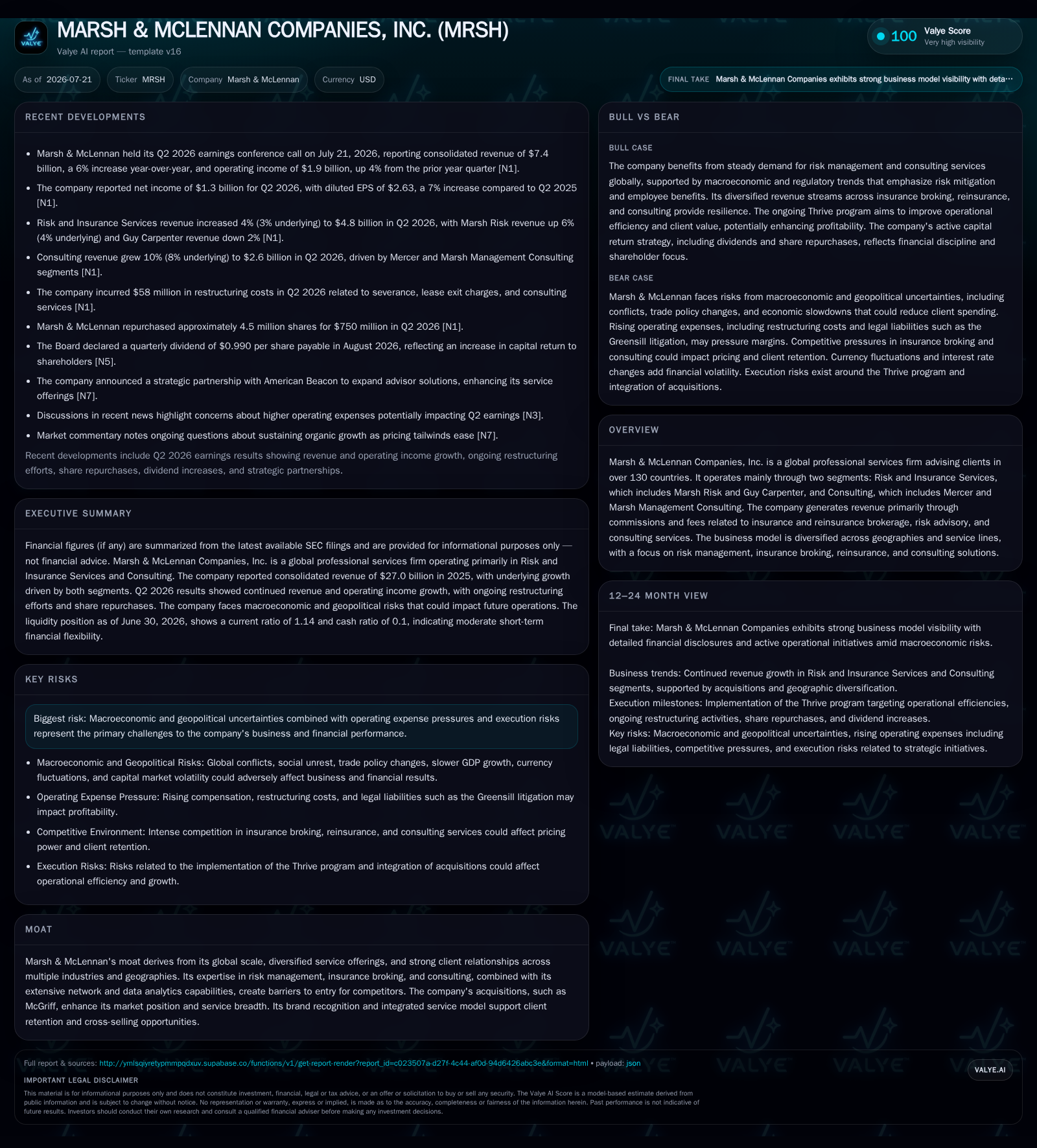
Marsh & McLennan Companies, Inc. showed continued underlying revenue growth of 5% in Q2 2026, fueled primarily by its Consulting segment’s robust expansion alongside steady performance in Risk and Insurance Services. However, operating income for the first half of 2026 declined as higher expenses tempered margin gains. The company’s diverse service lines and global footprint underpin resilience, while ongoing acquisitions and capital deployment reflect management’s focus on broadening capabilities and shareholder returns. Key risks persist around macroeconomic uncertainty and expense inflation, with upcoming milestones including integration success of recent deals and monitoring client demand amidst geopolitical tensions.
Recent Operating Update: Sustained Revenue Growth during Expense Pressures
This mixed earnings pattern underscores MMC's challenge balancing growth investments against expense inflation in an environment of persistent macroeconomic volatility. The company’s diversified portfolio across Marsh Risk insurance brokerage, Guy Carpenter reinsurance advisory, Mercer human capital consulting, and Marsh Management Consulting gives it multiple levers to mitigate segment-specific pressures [S1]. However, Guy Carpenter's revenue dipped slightly (-2%) during the quarter with only flat underlying growth through H1 2026, suggesting headwinds in specialty reinsurance markets possibly stemming from market pricing adjustments or client caution [S2]. Meanwhile, Marsh Risk posted healthy organic gains of roughly 4%-6%, affirming continued demand for traditional insurance broking services.
Business Model: Commission-and-Fee Based Diversification with Cross-Selling Focus
MMC operates primarily through two segments: Risk and Insurance Services (RIS), which includes Marsh Risk insurance brokerages plus Guy Carpenter reinsurance advisory; and Consulting which combines Mercer’s human capital solutions with Marsh Management Consulting [S1]. Its revenue is predominantly fee-based via commissions from insurance brokerage placements and consulting fees derived from project engagements and ongoing advisory contracts. Underlying revenue growth depends heavily on insurance premium volumes (affecting commission bases), market renewal pricing dynamics, client penetration across service lines, geographic expansion into markets like EMEA, Asia-Pacific, Latin America [S1], alongside throughput in consulting engagements tied to strategic corporate initiatives.
A key operational strength lies in MMC’s ability to cross-sell services across segments—clients engaged for risk management may also access Mercer’s HR consultancy or Marsh Management Consulting solutions. This multi-service approach supports high retention rates even during competitive pricing pressures common in the insurance brokerage industry. Clients benefit from integrated solutions spanning risk transfer advice to organizational strategy consulting.
Commission yield volatility can affect RIS margins depending on retained business mix between high-premium corporate accounts versus smaller clients. Similarly, consulting projects tend to show more variability tied to economic cycles but offer scalable fee models.
Recent acquisition activity — including the full purchase of a previously partially owned subsidiary for $54 million completed mid-2026 — reflects management’s strategy to broaden capabilities and enhance distribution networks critical to sustaining long-term fee bases [S2]. Acquisitions like McGriff in recent years have expanded U.S.-based broking scale considerably [S1].
Industry Structure and Competitive Position
MMC sits at the apex of a highly specialized professional services industry encompassing global insurance brokers (e.g., Aon plc), reinsurance advisors (Guy Carpenter itself is a leading name), large management consultancies (Deloitte Consulting among peers), human capital consultancies (Mercer), and risk advisory specialists. Its moat is mostly derived from extensive geographic reach serving over 130 countries with diversified service lines that reduce single-market dependency. Strong brand recognition combined with proprietary data analytics fortifies barriers to entry.
Competition occurs along multiple axes: price sensitivity pressures insurance brokerage commissions; consulting faces demand cyclicality tied to economic growth; while reinsurance advisory contends with fluctuating premium volumes impacted by catastrophe cycles and underwriting discipline across carriers. Nonetheless, MMC's integrated model fosters tighter client relationships than many peers focused on a single vertical.
Cross-selling success is critical as it enhances wallet share per client and improves retention amid fragmented competitor offerings. Strategic acquisitions act as both defensive moves against local competitors and offensive expansions into emerging regions or specialty niches.
Growth Drivers
Several distinct drivers underpin MMC's growth outlook:
- Increasing complexity of global risk environments prioritizes sophisticated risk management services.
- Rising demand for specialized consulting engagements addressing workforce transformation fuels Mercer’s backlog.
- Expansion into emerging markets boosts geographic diversification providing above-average growth opportunities.
- Growth in insurance and reinsurance premiums globally benefits commission-based RIS revenues though subject to market cycles.
- Leveraging technology advancements including data analytics improves service quality enhancing client retention.
- Regulatory shifts requiring advanced compliance advisory increase consulting engagement frequency.
- Acquisitions broaden capability sets allowing entry into new verticals with established client relationships.
Underlying revenue growth rates—sustaining mid-single digits organically despite macroeconomic headwinds—show resilience backed by favorable global trends combined with effective integration of new acquisitions.
Risks and Watchpoints
MMC faces several pertinent risks that could constrain near-term performance:
- Macroeconomic downturns lower client spending on discretionary consulting projects or delay insurance renewals impacting commissions.
- Geopolitical conflicts disrupt international operations or client confidence leading to volatility especially in premium pricing.
- Regulatory changes including tax reforms could affect effective tax rate stability despite recent benign impacts from U.S. 'OBBBA' legislation [S2].
- Competition promoting price compression within insurance brokerage challenges margin sustainability.
- Integration risks linked to acquisitions could delay anticipated synergies or inflate costs temporarily.
- Operating expense inflation notably higher compensation levels compress operating income margins despite revenue growth.
- Client concentration risks exist but are mitigated by broad diversification across sectors/geographies.
- Data security breaches pose reputational threats given reliance on proprietary data systems.
- Dependency on key personnel expertise creates vulnerability amid talent competition especially within consulting segments.
- Market volatility influences the reinsurance advisory segment through fluctuating premium rates affecting fee base robustness.
Monitoring these factors through metrics such as client retention rates, new business wins, consulting project backlogs, employee utilization rates, and fee/commission yields will be essential surveillance points for MMC’s operational health.
What to Watch Next
Going forward investors should focus on:
- Updates on post-acquisition integrations especially recently completed deals to ensure value creation.
- Quarterly organic growth pace across Marsh Risk relative to broader market premium trends indicating sustained pricing power.
- Guy Carpenter’s ability to rebound from slight Q2 declines reflecting reinsurance market dynamics.
- Consulting backlog evolution signaling future revenue visibility amid economic uncertainties.
- Operating income margin trajectory as management manages inflationary pressures versus productivity improvements.
- Dividend declarations or share repurchase cadence reflecting financial flexibility supported by subsidiary dividends [S2], [S1].
- New contract wins indicative of cross-selling effectiveness sustaining recurring revenues beyond core brokerage fees.
- Geographic mix shifts highlighting growing contribution from faster-growing international regions enhancing diversification benefits.
Financial Profile Discussion
MMC’s liquidity position remains solid as of June 30, 2026 with cash and equivalents at approximately $1.7 billion against current liabilities near $21.4 billion yielding a current ratio of approximately 1.14—a modest buffer indicating sufficient short-term asset coverage though working capital is heavily influenced by fiduciary liabilities that do not represent corporate-use cash [F1], [S2].
Total debt stood at about $11.2 billion per latest available data but net debt is moderated when factoring cash balances [F1]. The company depends largely on dividends and payments from its operating subsidiaries—which conduct most business operations—to meet its corporate-level obligations including debt servicing and capital returns programs [S2], [S1]. This legal separation requires efficient cash flow upstreaming from profitable units such as Marsh Risk and Mercer enabling stable dividend payouts exceeding $1.7 billion annually recently [S1].
In sum, MMC's financial structure supports operational initiatives facilitating adaptability across cyclical swings while maintaining shareholder distributions backed by diversified earnings streams from its dual-segment model.
This analysis synthesizes material drawn exclusively from Marsh & McLennan Companies’ public filings through July 21, 2026 ([S1], [S2], [S3]), supplemented by verified news sources ([N1]-[N14]). No investment advice or research view is provided.
Disclaimer: This is research-only, informational analysis and not investment advice. It may include AI-generated interpretation and general industry context. Always verify important details using primary sources.

Comments