
Genuine Parts Co. Expands Footprint Through Acquisitions While Managing Margin Pressure and Strategic Separation
Genuine Parts Company’s Q2 2026 update highlights acquisition-driven growth, margin optimization efforts, and a planned separation of automotive and industrial operations.
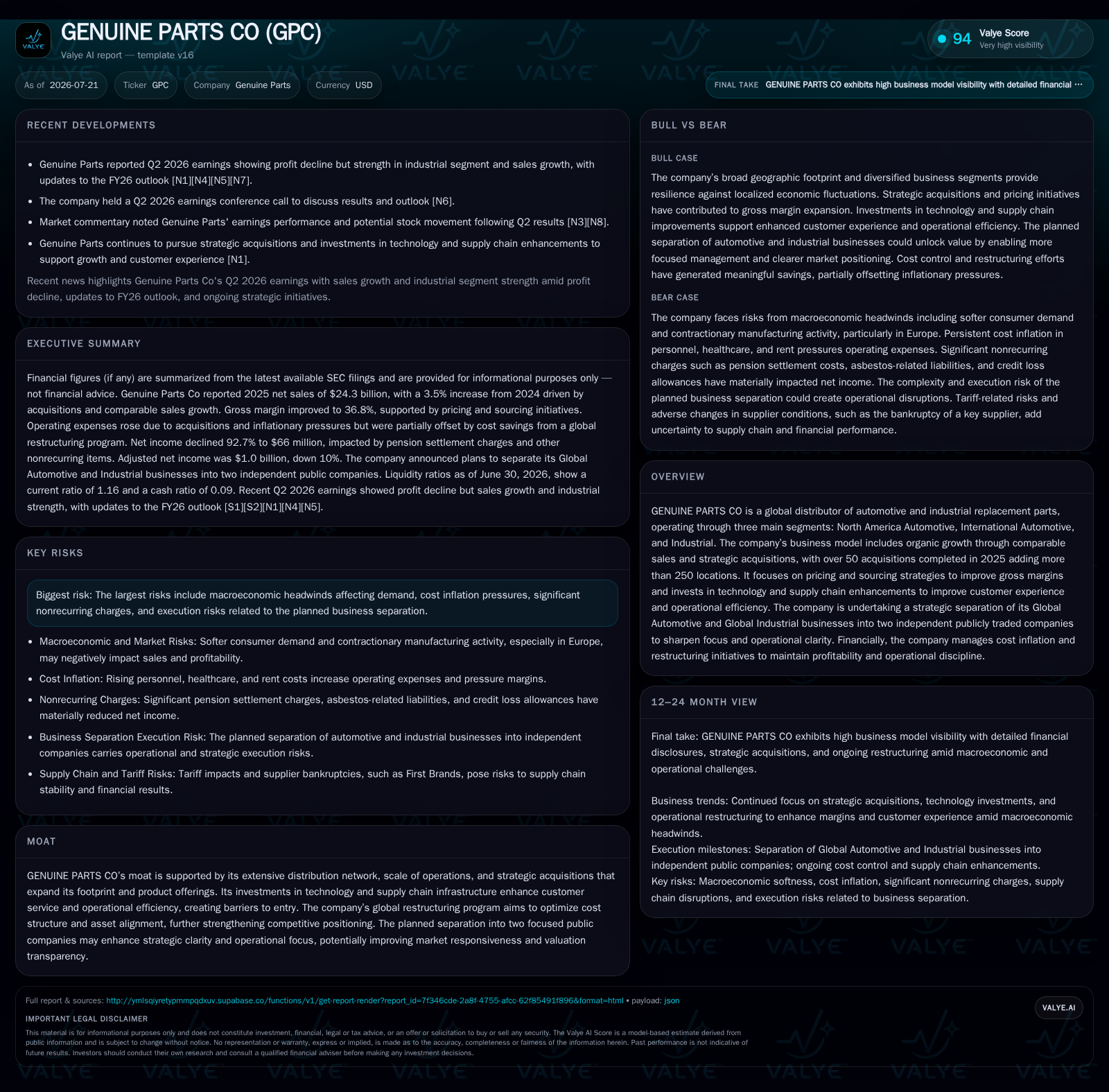
In Q2 2026, Genuine Parts Company (GPC) continued to grow its distribution network organically and through acquisitions, adding over 250 locations in 2025 alone. The company is balancing pricing strategies against inflationary cost pressures while investing in technology to improve supply chain efficiency and customer service. A key strategic initiative is the planned split of its Global Automotive and Global Industrial businesses into independent public entities, aimed at sharpening operational focus. Macroeconomic headwinds and execution risks related to this separation remain notable challenges.
Recent Operating Update: Strategic Growth Amid Margin Pressures
Genuine Parts Company (GPC) reported its second-quarter 2026 results on July 21, 2026, continuing a trajectory of moderate net sales growth primarily driven by acquisitions completed in 2025 [S2][S3][S1]. The company completed over 50 acquisitions last year, adding more than 250 distribution locations globally, with a focus on expanding its retail footprint in the North America Automotive segment. Notable transactions include the acquisition of independent NAPA stores across the U.S. and Benson Auto Parts in Canada, which broaden the company’s product offerings and strengthen its presence in key Canadian provinces such as Ontario and Quebec
Despite this expansion, Genuine Parts faces ongoing margin pressures due to persistent inflationary cost headwinds, including raw material price volatility and tariff-related cost increases. The company is employing a calibrated pricing strategy to partially pass through these input cost increases while optimizing sourcing and supply chain operations to protect gross margins [S1]. Investments in technology aim to enhance supply chain efficiency by improving inventory turnover ratios and reducing working capital intensity, critical KPIs in the distribution business that directly impact cash flow and profitability [S3].
A significant strategic development is the announced plan to separate the Global Automotive and Global Industrial businesses into two independent publicly traded companies. This business separation is intended to sharpen operational focus and improve capital allocation for each segment but introduces execution risks related to transitional costs, regulatory approvals, and potential market reception challenges [S3].
Business Model Overview: Acquisition-Driven Distribution Network Expansion
Genuine Parts operates as a leading distributor of automotive aftermarket and industrial replacement parts, sourcing components from OEMs and aftermarket manufacturers. The company monetizes its extensive product portfolio through a multi-channel distribution network comprising retail stores (including independent affiliates such as NAPA), wholesale outlets, and service centers. Customers include independent repair shops, commercial fleets, dealerships, and industrial operators.
Revenue growth is driven by a combination of organic comparable sales increases—supported by factors such as aging vehicle fleets requiring more frequent maintenance—and inorganic growth through strategic acquisitions that expand geographic reach and product breadth [S1]. Pricing strategy is a critical lever to manage gross margin percentage amid fluctuating commodity costs and inflation, directly influencing cost of goods sold and gross profit performance.
Operational efficiency gains stem from technology investments targeting supply chain optimization, including enhanced inventory management systems, improved order accuracy, and reduced delivery lead times. These improvements support higher inventory turnover ratios, a key operating metric reflecting how effectively inventory is converted to sales, and contribute to better working capital management [S1][S3]. Enhanced customer service capabilities also differentiate Genuine Parts in a competitive aftermarket environment where service responsiveness is increasingly valued by repair shops and commercial customers
Industry Structure and Competitive Position
The automotive and industrial parts distribution industry is characterized by fragmentation with ongoing consolidation as companies seek scale advantages. Genuine Parts’ diversified segmentation into North America Automotive, International Automotive, and Industrial aligns with industry peers such as AutoZone, Advance Auto Parts, and LKQ Corporation, who similarly pursue acquisition-driven growth combined with technology-enabled supply chain enhancements.
Genuine Parts’ global footprint provides geographic diversification, mitigating risks associated with regional economic cycles and currency fluctuations. However, it also exposes the company to macroeconomic headwinds such as manufacturing slowdowns and softer consumer demand in Europe and North America, which can dampen aftermarket parts consumption [S1].
Scale economies from an expanded retail footprint and wholesale distribution network create barriers to entry and support customer retention through localized presence and service. Nonetheless, competition remains intense, with pricing pressure from other distributors and retailers, as well as the risk of customer attrition in commercial fleet contracts or independent repair shop loyalty.
Growth Drivers
Key growth drivers for Genuine Parts include:
- Acquisition Activity: The addition of over 50 acquisitions in 2025, resulting in more than 250 new locations globally, enhances route-to-market capabilities and product diversity, particularly in the competitive North American automotive aftermarket [S1].
- Pricing Strategy: Tactical price increases help offset inflationary cost pressures while balancing volume retention across price-sensitive customer segments [S1].
- Supply Chain & Technology Investments: Upgrades in inventory management and logistics systems improve stock availability and reduce carrying costs, positively impacting gross margin and working capital efficiency [S3].
- Aging Vehicle Fleets and Fleet Growth: Increasing average vehicle age drives aftermarket parts demand, while growth in commercial and industrial vehicle fleets supports replacement cycles in the industrial segment.
- Geographic Diversification: Expansion into Canadian markets via acquisitions like Benson Auto Parts and international automotive operations spreads risk and captures growth opportunities beyond the U.S. market [S1].
Risks and Watchpoints
Several factors could constrain Genuine Parts’ outlook:
- Macroeconomic Headwinds: Elevated interest rates, subdued consumer spending in Europe, and contractionary manufacturing activity in the U.S. industrial sector weigh on demand for replacement parts [S1][N1].
- Cost Inflation: Continued raw material price volatility and tariff impacts challenge margin preservation despite pricing efforts [S1][S2].
- Acquisition Integration Risks: The rapid pace of acquisitions necessitates disciplined integration to realize expected synergies; failure to do so could impair earnings [S1].
- Business Separation Execution: The planned split into two public companies introduces complexity, including potential transitional expenses, management focus dilution, and regulatory uncertainties [S3].
- Competitive Pricing Pressure: Intense competition may force pricing concessions or loss of key customers, affecting profitability.
- Supply Chain Disruptions: Persistent global logistics challenges could impact inventory turnover targets, leading to stockouts or excess inventory and increased working capital requirements.
Key Metrics and What to Watch Next
Monitoring the following indicators will provide insight into Genuine Parts’ operational and strategic progress:
- Updates on the business separation timeline and milestones, including regulatory approvals and spin-off execution.
- Comparable sales trends by segment to gauge organic demand health relative to acquisition-driven growth.
- Gross margin progression reflecting the effectiveness of pricing strategies and cost control amid inflation.
- Integration success of recent acquisitions, measured by productivity improvements and synergy realization.
- Operating expense ratios, particularly in relation to restructuring charges and investments in technology and infrastructure.
- Macroeconomic indicators relevant to aftermarket demand, such as manufacturing PMI data and vehicle age trends.
Financial Profile Discussion
Genuine Parts maintains a balance sheet supportive of its acquisition-driven growth strategy. As of June 30, 2026, the company reported current assets of approximately $11.07 billion against current liabilities of about $9.55 billion, yielding a current ratio of 1.16, indicative of manageable near-term liquidity [F1][S2]. Total debt stood near $4.82 billion at the end of 2025, with net debt (total debt less cash equivalents) around $3.92 billion, reflecting leverage levels consistent with peers pursuing aggressive expansion through acquisitions [F1].
The company’s capital structure supports ongoing investments in technology and distribution infrastructure, critical to sustaining operational efficiency and competitive positioning. However, the leverage level necessitates continued focus on cash flow generation and working capital management, especially amid macroeconomic uncertainties.
This analysis incorporates information from Genuine Parts Company’s Q2 2026 Form 10-Q dated July 21, 2026 [S2], current reports filed July 21, 2026 [S3], their latest annual Form 10-K dated February 20, 2026 [S1], supplemented by current financial snapshot data from SEC sources [F1] and related news coverage [N1]–[N14]. It focuses exclusively on factual disclosures without offering investment advice or forecasts.
Disclaimer: This is research-only, informational analysis and not investment advice. It may include AI-generated interpretation and general industry context. Always verify important details using primary sources.

Comments