
Eagle Nuclear Energy Advances Vertical Integration with Uranium Asset Acquisition and Early SMR Development
The Q2 2026 filing details Eagle Nuclear Energy’s progress in securing uranium exploration assets and developing proprietary small modular reactor technology, underscoring the challenges of early-stage commercialization in a capital-intensive nuclear sector.
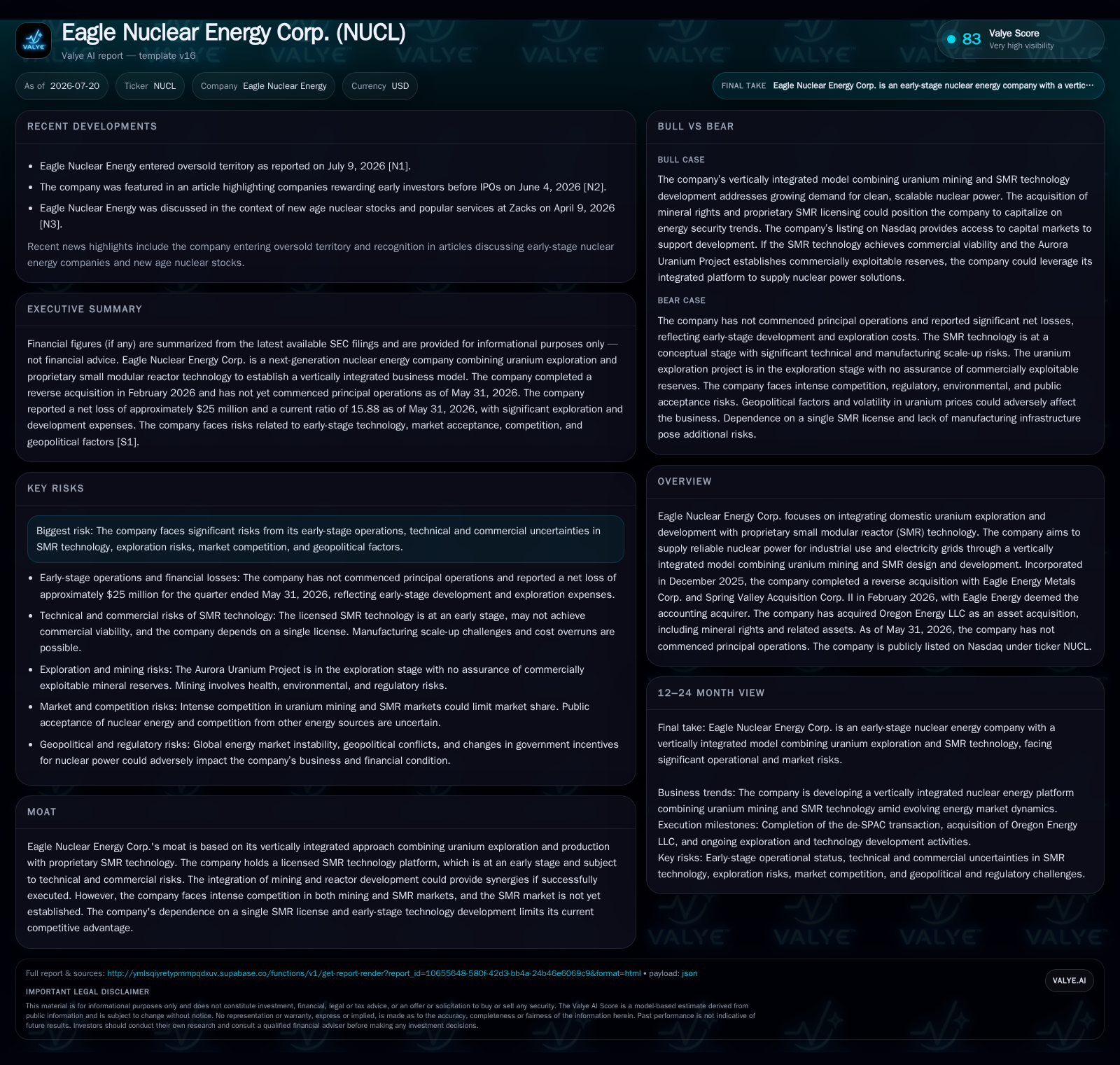
Eagle Nuclear Energy Corp. has solidified its vertical integration strategy by acquiring extensive uranium mining claims through Oregon Energy LLC and maintaining strong liquidity after its February 2026 de-SPAC transaction. Although pre-revenue and without commenced principal operations, the company is focused on combining upstream uranium resource development with next-generation small modular reactor (SMR) technology to address energy security and clean power demands. Execution risks remain high due to early operational status, regulatory hurdles, and significant capital needs. Key near-term value drivers include advancing SMR design milestones and progressing permitting and exploration activities on acquired mineral claims.
Recent Operating Update: Establishing Core Assets While Remaining Pre-Revenue
Eagle Nuclear Energy Corp.’s Q2 2026 filing highlights foundational progress in building a vertically integrated nuclear platform despite no principal operations having commenced. The company finalized its reverse recapitalization transaction in February 2026, consolidating Eagle Energy Metals Corp., focused on uranium exploration, with Spring Valley Acquisition Corp. II into a single publicly traded entity. Eagle Energy was designated the accounting acquirer for reporting continuity purposes [S2], [S12].
A pivotal development this quarter was the acquisition of Oregon Energy LLC’s mineral rights encompassing roughly 43 square kilometers across Malheur County, Oregon, and adjacent areas in Nevada within the Aurora Uranium Project (AUP). This acquisition included over three hundred unpatented lode and placer mining claims, representing a significant land position for uranium exploration [S15]. The transaction was accounted for as an asset acquisition under ASC Topic 805 without goodwill recognition due to absence of substantive processes acquired, indicating ownership primarily of raw mineral rights rather than operating assets or facilities [S2].
This expanded claim portfolio provides vital upstream control over uranium feedstock essential for future fuel supply security—an uncommon integrated approach that differentiates Eagle Nuclear from many pure-play SMR developers reliant on external suppliers.
Business Model: Vertical Integration Across Uranium Mining and SMR Development
Eagle Nuclear pursues a dual-pronged strategy combining domestic uranium resource development with proprietary small modular reactor technology tailored for industrial customers and grid operators seeking scalable low-carbon baseload power. By integrating mining operations with reactor design efforts, the company aims to reduce supply chain vulnerabilities while capturing value across multiple segments of the nuclear fuel cycle.
This contrasts typical industry segmentation where companies specialize either in upstream uranium mining (e.g., Cameco Corporation) or advanced reactor technologies (e.g., NuScale Power or TerraPower). Vertical integration offers potential operational synergies but also concentrates execution risk due to the capital-intensive nature of both mining exploration/development and complex nuclear technology R&D.
Revenue generation prospects are currently speculative; initial cash flows would likely derive from successful delineation and sale of uranium concentrates upon commercial production milestones followed by licensing or deployment revenues from SMR commercialization once regulatory approvals are secured. Key operating metrics to watch include measured resource estimates (pounds of uranium), grade/recovery rates from exploration programs, plus progress toward reactor prototype construction or regulatory submissions.
Industry Context: Competitive Landscape and Sector Challenges
Within the nuclear energy sector, established uranium miners typically boast large-scale reserves enabling cost-effective production amid volatile commodity markets. Junior miners often face higher geological uncertainty and permitting complexity. On the advanced reactor side, well-capitalized firms such as NuScale Power are leading U.S. NRC licensing efforts for integral pressurized water reactors while TerraPower pursues next-generation fast reactor designs with substantial strategic partnerships.
Eagle Nuclear’s unique positioning lies in its integrated model linking upstream resource control directly with downstream reactor ambitions. However, this approach requires navigating diverse expertise areas spanning mineral exploration regulations, environmental compliance obligations, detailed nuclear engineering standards, and extensive capital deployment over protracted timelines.
Growth Drivers: Aligning With Macro Trends Favoring Nuclear Expansion
Several broader industry trends support Eagle Nuclear’s strategy:
- Increasing Demand for Low-Carbon Energy: Heightened climate policies worldwide incentivize nuclear power expansion as a reliable zero-emission source.
- Energy Security Priorities: Geopolitical disruptions have underscored reliance on foreign uranium imports; domestic resource development gains strategic importance.
- Technological Innovation: Advances in SMR designs promise shorter construction schedules and lower upfront costs compared to traditional reactors.
- Emerging Policy Support: Regulatory reforms aimed at facilitating SMR licensing could accelerate commercialization timelines.
- Potential Partnerships: Early-stage collaborations may validate market demand for proprietary reactors or secure feedstock commitments aiding financing efforts.
Critical KPIs include acreage permitting status enabling drilling programs, resource estimates quantifying recoverable uranium pounds at viable grades, plus incremental technical milestones such as engineering design certifications or NRC license applications.
Risks and Watchpoints: Navigating Execution Complexity Amid Early Development
Key risk factors include:
any to operational or market risks localized to specific assets.
Investors should monitor capital raises (PIPE financings or equity issuances), regulatory filings evidencing permitting approvals or design certifications progress, alongside exploration results validating economic potential.
Outlook: Milestones Defining Near-Term Progression
Upcoming developments to watch closely include:
- Exploration drilling outcomes confirming ore body quality within acquired mining claims.
- Regulatory engagement updates related to submission or acceptance of SMR design certification dossiers by authorities such as the U.S. Nuclear Regulatory Commission.
- Capital raising initiatives extending operational runway amid pre-revenue status.
- Strategic partnership announcements supporting reactor deployment pilots or securing feedstock sales enhancing commercial prospects.
Given absence of current revenues, investor sentiment will hinge significantly on tangible technical advancements demonstrating feasibility across both mining resource development and modular reactor innovation domains.
Financial Profile Discussion
As of May 31, 2026, Eagle Nuclear held approximately $28.9 million in current assets predominantly comprising cash equivalents versus $1.8 million in current liabilities — yielding a strong current ratio near 15.9x that supports short-term operational stability during this nascent stage [F1]. Operating cash flow usage was about $4.7 million during Q2 reflecting ongoing costs related to corporate overhead, exploration groundwork initiation, and technology development activities [S13].
Capital expenditures were restrained ($47K additions to property plant & equipment plus ~$30K intangible asset purchases), consistent with controlled spending aligned with asset acquisition accounting treatment rather than large-scale buildout at this phase.
Cash inflows were primarily driven by a sizeable private investment in public equity (PIPE) financing totaling nearly $29.7 million alongside proceeds from common stock issuances supporting liquidity needs essential for sustaining long-term project development until commercial operations commence [S13]
Overall, Eagle Nuclear’s financial profile typifies emerging-growth companies balancing dual capital-intensive sectors where patient capital management is critical amid extended timelines required for de-risking geological resources alongside pioneering advanced nuclear technologies.
Disclaimer: This is research-only, informational analysis and not investment advice. It may include AI-generated interpretation and general industry context. Always verify important details using primary sources.

Comments