
Pineapple Financial’s Concentrated INJ Treasury Strategy Elevates Volatility and Leverage Risks
The company’s focus on Injective tokens as its core digital asset amid rising leverage and evolving internal controls defines its near-term risk and operational profile.
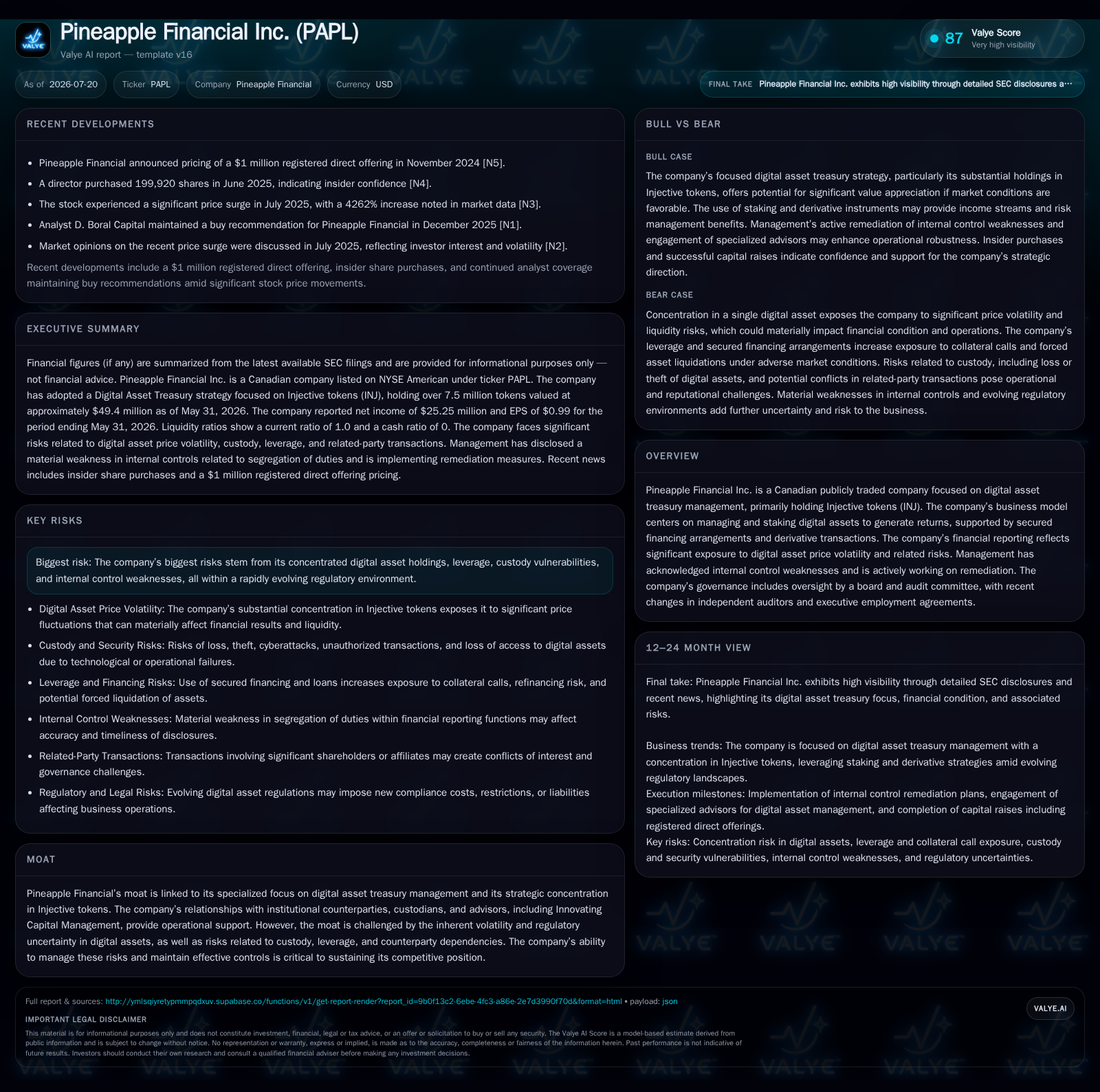
Pineapple Financial Inc. has strategically pivoted to a digital asset treasury model centered on managing and staking a substantial Injective (INJ) token portfolio, creating significant exposure to asset price volatility and related financial risks. The latest quarterly disclosures highlight ongoing challenges in internal controls remediation, leverage management through secured financing, and counterparty dependencies. Governance enhancements, including a newly appointed advisory agreement with Innovating Capital Management and expanded board oversight, aim to stabilize operations amid regulatory uncertainties. Key near-term focus areas include collateral maintenance, liquidity preservation, and execution of the treasury reserve policy reflecting broad sector pressures on crypto-focused financial managers.
Latest Operating Update: Intensifying Focus on Digital Asset Treasury Amid Governance Enhancements
Pineapple Financial Inc.’s 10-Q filing dated July 20, 2026, confirms the company’s strategic pivot to a concentrated digital asset treasury model centered on Injective tokens (INJ). As of May 31, 2026, Pineapple holds approximately 7.56 million INJ tokens valued at $49.4 million, representing a substantial digital asset portfolio concentrated in a single protocol’s native token [S2]. This concentration exposes the company to significant price volatility, which directly affects earnings and shareholders’ equity through mark-to-market fair value accounting, a standard practice in digital asset financial services that introduces pronounced income statement fluctuations even without realized sales.
Alongside this operational focus, Pineapple has taken steps to strengthen governance and internal controls in response to previously disclosed material weaknesses. On May 31, 2026, the company entered into a Management Services and Advisory Agreement with Innovating Capital Management LLC, which is responsible for designing, implementing, and overseeing the digital asset treasury strategy, including risk management and collateral oversight [S16]. Complementing this, an Advisory Committee composed of board members and representatives appointed by the Injective Foundation now provides direct oversight of treasury policies and execution [S27]. These governance enhancements aim to mitigate operational risks inherent in managing a concentrated digital asset portfolio amid evolving regulatory and market conditions.
In a move to proactively manage capital structure and shareholder dilution, Pineapple’s Board expanded the share repurchase program authorization from $3 million to $15 million in April 2026. This expanded buyback capacity allows the company to repurchase shares opportunistically in the open market, potentially offsetting dilution from ongoing equity-linked financings and signaling confidence in long-term shareholder value management [S5]. Despite these initiatives, Pineapple reported an operating loss of approximately $2.95 million for the fiscal year ended August 31, 2025, reflecting non-cash fair value losses tied to INJ price volatility and increased expenses related to governance and advisory services [F1][S16].
Business Model: Specialized Digital Asset Treasury Anchored by INJ Holdings
Pineapple Financial operates as a specialized digital asset treasury manager with a business model focused on concentrated holdings of Injective tokens. The company monetizes its portfolio primarily through staking rewards earned by delegating INJ tokens within the Injective network’s proof-of-stake protocol. These staking rewards depend on token inflation rates, network participation, and validator performance, which collectively influence yield generation and timing [S29].
Revenue and risk drivers central to Pineapple’s model include:
- Staking Rewards: Yield derived from locking INJ tokens in staking protocols, subject to slashing risks and protocol-specific tokenomics.
- Fair Value Volatility: Earnings volatility from mark-to-market accounting of INJ holdings, reflecting market price fluctuations.
- Derivative Transactions: Use of purchased puts and written calls to hedge or enhance returns introduces collateral requirements, counterparty exposure, and liquidity management complexities [S14].
- Leverage via Secured Financing: The company employs secured loans collateralized by digital assets, amplifying potential returns but increasing liquidity risk and fixed repayment obligations, especially during adverse price movements [S14][S26].
This concentrated approach contrasts with more diversified digital asset financial services firms such as Galaxy Digital and Coinbase, which manage multi-asset portfolios and offer broader service lines including custody, trading, and lending [S2][S14]. While Pineapple’s specialization may yield outsized returns if Injective’s ecosystem strengthens, it also heightens exposure to token-specific risks and market liquidity constraints.
Industry Structure and Competitive Positioning
Within the digital asset financial services sector, Pineapple occupies a niche as a treasury manager focused on a single blockchain protocol’s native token. This specialization differentiates it from crypto hedge funds that actively trade diversified digital asset baskets and custodians that primarily provide secure storage solutions without active portfolio management.
Pineapple’s competitive set includes specialized staking service providers who optimize yield generation across proof-of-stake networks, digital asset custodians emphasizing security and operational resilience, and crypto hedge funds employing derivatives-based risk management strategies. The company’s domain expertise in Injective tokenomics and its partnership with Innovating Capital Management provide operational advantages but are balanced against concentration risk and the sector-wide challenges of regulatory uncertainty and counterparty dependencies.
Growth Drivers
Several industry trends underpin potential growth opportunities for Pineapple Financial:
- Institutional Adoption: Increasing institutional interest in regulated digital asset exposure supports demand for professional treasury management services.
- Expansion of Staking Protocols: Growth in proof-of-stake networks enhances yield-generating opportunities beyond simple price appreciation.
- Regulatory Clarity: Progress toward clearer regulatory frameworks may facilitate broader market participation while raising compliance standards that favor well-governed firms.
- Innovation in Derivatives: Development of tailored derivatives products supports sophisticated risk management and return enhancement strategies.
- Advances in Custody Technology: Improved security and custody solutions reduce operational risks, enabling safer scaling of digital asset holdings.
For Pineapple, disciplined execution of its treasury reserve policy, overseen by Innovating Capital Management, and prudent use of secured financing could enable incremental staking or selective portfolio expansion, contingent on navigating regulatory and market volatility [S16][S18].
Risks and Watchpoints
Pineapple’s concentrated digital asset treasury strategy entails several interconnected risks:
- Asset Concentration and Price Volatility: The company’s substantial INJ holdings expose it to significant market price swings, which affect net asset value, earnings volatility, and liquidity thresholds for collateral maintenance [S2][S14].
- Leverage and Collateral Risk: With loans payable reported at approximately $21.4 million as of May 31, 2026, leverage amplifies risk case. Declines in INJ prices could trigger collateral calls, requiring additional liquidity or forced asset sales at unfavorable prices [S14][S26].
- Internal Control Weaknesses: Previously disclosed material weaknesses in financial reporting controls necessitate ongoing remediation to ensure reliable governance and investor confidence [S1].
- Counterparty and Custody Risks: Reliance on a limited number of institutional counterparties for custody, financing, staking, and trading concentrates operational risk. Disruptions or insolvencies could materially impair asset access or valuations [S15][S26].
- Regulatory Uncertainty: Evolving laws may impose new restrictions on INJ transactions, custody standards, derivatives usage, and reporting obligations, potentially disrupting business operations [S23].
- Derivative Exposure: The company’s derivative positions, including written calls and purchased puts, introduce complex market, liquidity, and valuation risks that require active collateral and risk management [S14].
- Liquidity Constraints: The company’s current ratio approximates 1, indicating tight liquidity buffers relative to current liabilities and underscoring the importance of prudent cash and collateral management amid volatile market conditions [F1][S26].
Monitoring key operational variables such as collateral coverage ratios, staking reward stability, derivative notional values, and frequency of collateral calls will be critical indicators of financial resilience and risk management effectiveness.
What to Watch Next
Key developments to monitor include:
- Progress on remediation of internal control deficiencies to strengthen governance and financial reporting reliability.
- Effectiveness of the Treasury Reserve Policy under Innovating Capital Management’s oversight in managing liquidity and collateral requirements.
- Market dynamics of INJ token prices, including volatility trends and potential diversification efforts to mitigate concentration risk.
- Frequency, size, and management of collateral calls under secured financing arrangements as indicators of liquidity stress.
- Regulatory developments affecting staking protocols, derivatives usage, custody requirements, and cross-border compliance frameworks.
- Changes in derivative position sizes and structures reflecting shifts in hedging strategies or risk appetite.
- Share repurchase activity relative to dilution from equity-linked financings as a measure of capital structure management.
Disclaimer: This analysis is for informational purposes only and does not constitute investment advice. It incorporates company filings and general industry context. Readers should consult primary sources for verification.
Disclaimer: This is research-only, informational analysis and not investment advice. It may include AI-generated interpretation and general industry context. Always verify important details using primary sources.

Comments