
FedEx's Strategic Network Optimization and Sustainability Drive Amid Competitive Pressures
FedEx updates on 2026 Q3 operational performance, strategic initiatives, and sustainability ambitions under evolving regulatory and market conditions.
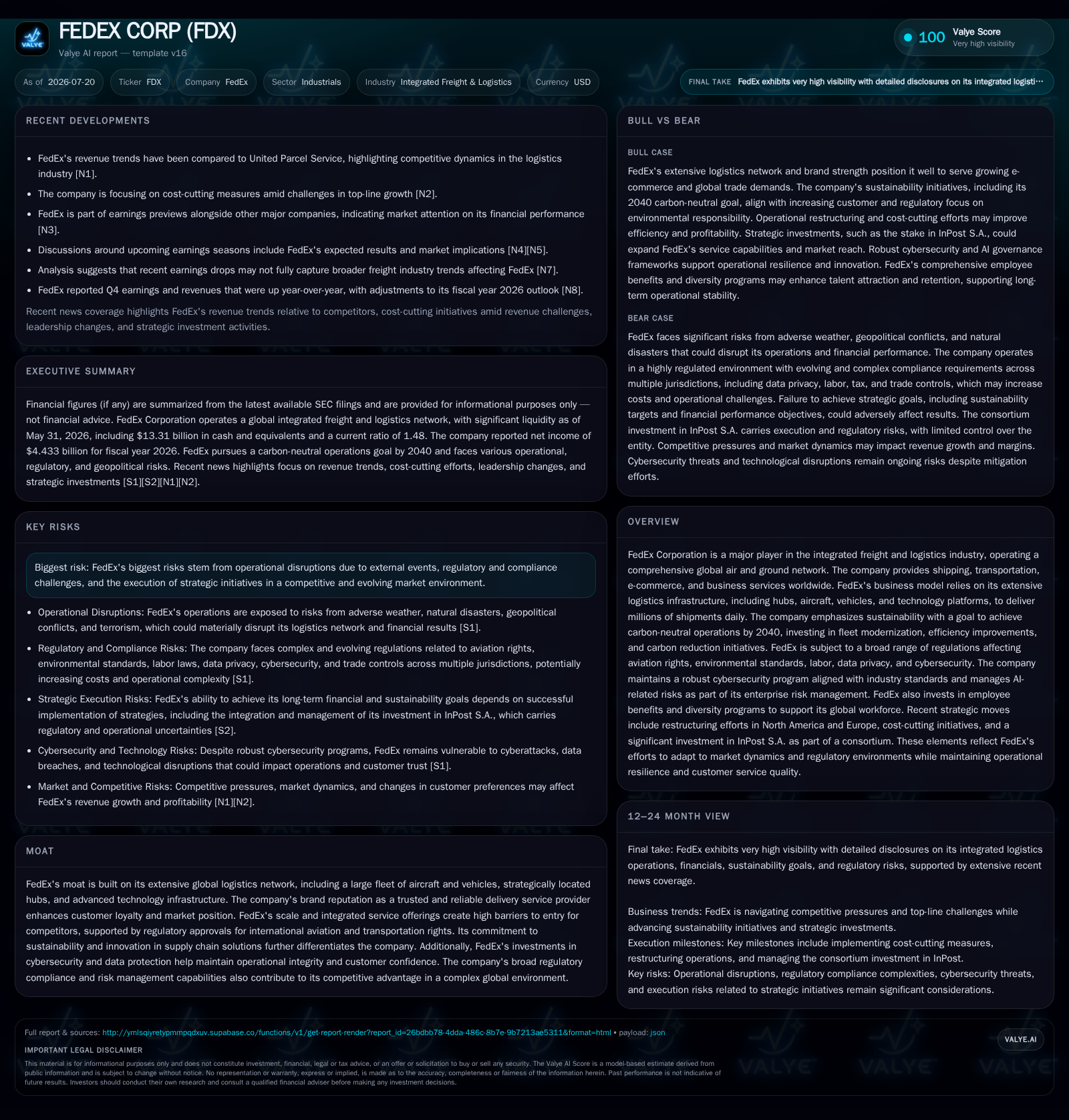
In its latest quarterly filing, FedEx reported strong operating income reflecting effective capacity and cost management amid macroeconomic challenges. The company continues to face intense competition while advancing its carbon neutrality goal through fleet modernization and green logistics investments. Regulatory complexities in aviation rights, labor markets, and data privacy pose ongoing risks. Strategic investments like the InPost consortium and digital platform enhancements aim to strengthen last-mile delivery and supply chain visibility, positioning FedEx to adapt to evolving customer demands and regulatory environments.
Recent Operating Update: Q3 2026 Performance Highlights
FedEx reported operating income of $5.46 billion alongside net income of $4.43 billion for the quarter ending February 28, 2026 [F1][S2]. This demonstrates effective cost discipline amidst macroeconomic headwinds impacting shipment volumes—a common challenge in the integrated freight logistics industry’s cyclical environment. The company highlighted targeted capacity management strategies responding to variability in parcel volumes largely influenced by e-commerce demand fluctuations [S2]. These operational results align with progress toward FedEx’s multi-year financial targets extending through calendar year 2029 [S2].
Business Model: Integrated Network with Sustainability Focus
FedEx operates a sophisticated global hub-and-spoke network that integrates air cargo fleets with extensive ground transportation assets [S1][S13]. Revenue generation depends on shipping fees that consider shipment volume, weight, distance, service level tiers (express versus standard), and fuel surcharges—contracted through relationships with retailers, manufacturers, third-party sellers, and direct consumers. Beyond parcel delivery, FedEx offers freight forwarding, e-commerce fulfillment services, and supply chain management solutions supported by advanced digital logistics platforms enhancing real-time shipment tracking and operational efficiency
Strategic emphasis on sustainability reflects rising regulatory demands and shifting customer preferences. FedEx targets carbon neutrality by 2040 through a combination of fleet modernization towards alternative fuels and electric vehicles, improvements in operational efficiency across air and ground modes, acquisition of renewable energy credits, and investment in emerging carbon reduction technologies despite uncertainties surrounding carbon credit market pricing [S1][S24]. These initiatives influence capital expenditure priorities and operating costs but enhance competitive positioning among peers adopting green logistics innovations.
Industry Structure & Competitive Positioning
FedEx competes primarily with integrated logistics providers such as United Parcel Service (UPS) and DHL for global express freight business while facing growing pressure from specialized e-commerce logistics operators including Amazon Logistics as well as technology-driven startups employing flexible labor models for last-mile delivery. Competitive dynamics are characterized by pricing discipline challenges during some players operating at minimal or negative margins supported by strategic capital deployment or market share objectives [S13]
FedEx’s extensive fleet subject to Federal Aviation Administration regulations combined with bilateral government agreements securing international aviation rights create substantial entry barriers for competitors lacking similar infrastructure or permissions [S9][S11]. However, ongoing consolidation within the sector could rapidly shift competitive balances.
Growth Drivers
Structural growth drivers include expanding global online retail fueling increased parcel volumes; rising complexity in international supply chains demanding integrated transportation solutions; increased outsourcing trends from manufacturers seeking efficient third-party logistics partners; urbanization driving demand for innovative last-mile delivery solutions; and sustainability mandates encouraging investment in environmentally friendly supply chains consistent with FedEx’s strategy.
The company’s strategic investment in the InPost consortium seeks to enhance European last-mile delivery capabilities via automated parcel locker networks while maintaining arm’s length commercial arrangements post-acquisition completion [S2][S17][S18]. Concurrently, digital platform deployments enhancing supply chain transparency differentiate FedEx’s offerings by enabling customers to optimize inventory flow within increasingly complex fulfillment networks [S1][S22].
Risks & Watchpoints
Operational risks include disruptions from adverse weather events potentially intensified by climate change or geopolitical conflicts affecting flight schedules and ground operations reliability [S16]. Regulatory complexity is increasing globally with stringent data privacy laws (including evolving EU GDPR frameworks), emerging artificial intelligence legislation impacting operational systems, environmental regulations imposing costs related to emissions compliance or carbon credit purchases, alongside evolving labor laws affecting contractor models—all influencing cost structures substantially [S9][S11][S12][S18].
Competitive threats persist as major shippers develop internal delivery networks that may erode traditional FedEx revenue streams. Labor availability constraints coupled with unionization efforts introduce risks to operational continuity; outcomes of collective bargaining negotiations materially affect cost controls [S13][S18]. Execution risk also arises from integration challenges associated with acquisitions like InPost where FedEx holds a minority stake.
What to Watch Next
Relevant indicators include quarterly shipment volume trends signaling demand resilience or softness amid macroeconomic conditions; progress reports on Network 2.0 optimization reflecting improved capacity utilization; sustainability milestone achievements particularly relating to fleet transition timelines; developments regarding regulatory approvals for international routes; outcomes of labor contract negotiations; adoption rates of digital platforms among customers; earnings trends monitoring margin stability against cost pressures; plus updates on the integration progress of the InPost investment.
Financial Profile Discussion
As of May 31, 2026, FedEx held approximately $13.3 billion in cash and equivalents versus total debt near $23.7 billion resulting in net debt around $10.4 billion alongside a current ratio of 1.48—indicating solid short-term liquidity supporting ongoing capital-intensive fleet modernization efforts as well as strategic initiatives including participation in the InPost consortium [F1]. Operating income remains robust relative to sector peers due to scale advantages but is challenged by exposure to fuel price volatility and wage inflation inherent in labor-intensive transport services. Monitoring free cash flow will be critical for funding future green investments without excessive leverage expansion.
This analysis integrates FedEx's recent disclosures within an industry context defined by capital intensity, regulatory complexity, evolving technology adoption, competitive pricing dynamics, labor market challenges, and heightened sustainability commitments typical of integrated freight logistics leaders.
Disclaimer: This report is prepared solely for informational purposes based on publicly filed documents as of July 20, 2026. It does not constitute investment advice or research views.
Disclaimer: This is research-only, informational analysis and not investment advice. It may include AI-generated interpretation and general industry context. Always verify important details using primary sources.

Comments