
ANVI Global's Acquisition Ambitions and Liquidity Challenges Shape Its Early-Stage Holdings Strategy
ANVI Global remains acquisition-less with pressing liquidity constraints, placing execution at the heart of value creation prospects.
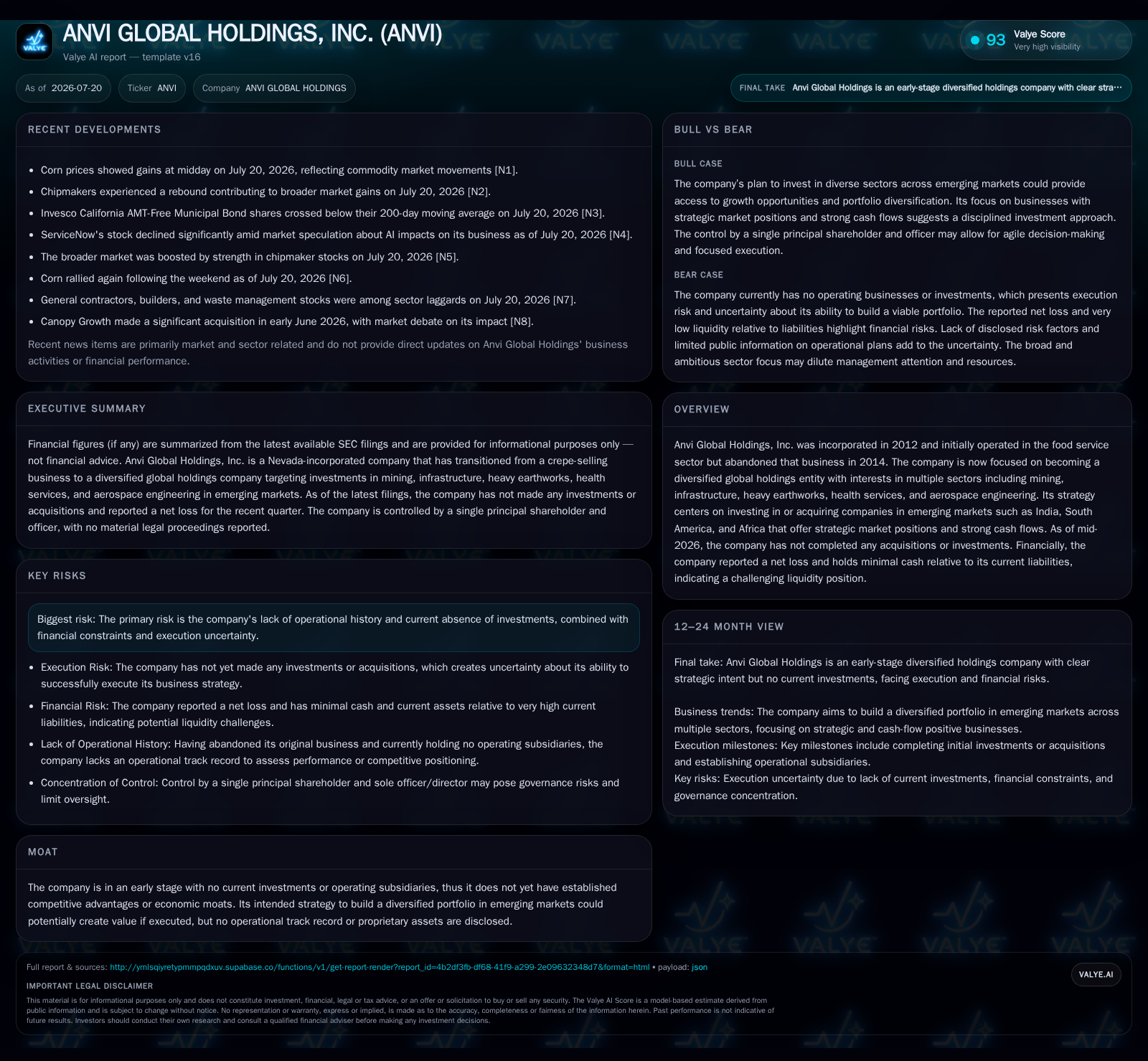
ANVI Global Holdings, Inc. continues to pursue a strategic pivot from a defunct food service business into a diversified global holdings company targeting emerging markets. The latest July 2026 10-Q confirms no acquisitions or investments have been made, while liquidity metrics show significant weakness, with current liabilities vastly exceeding current assets. This exposes the company to execution risk given its dependence on successful capital-raising and deal closure for long-term value creation. Peer contextualization highlights that ANVI's path contrasts with established diversified investors who leverage scale and cash flow-generative subsidiaries to drive growth and shareholder returns.
July Quarter Snapshot: Stalled Investment Activity Amid Tight Liquidity
The July 20, 2026 quarterly report confirms ANVI Global Holdings remains in an embryonic stage without any acquisitions or investments completed despite its multi-sector ambitions targeting mining, infrastructure, heavy earthworks, health services, and aerospace engineering sectors across emerging markets [S2][F1]. Financially, the balance sheet reveals a pronounced liquidity mismatch: current liabilities total approximately $2.43 million compared to current assets just under $12 thousand—a current ratio effectively at zero—highlighting severe short-term funding constraints that undermine the company's ability to pursue its strategic investment objectives without urgent capital infusion [F1][S2]. This lack of deployed capital stifles any near-term revenue potential as there are no operating subsidiaries contributing cash flows or dividends.
The persistence of net losses underscores ongoing expenditures presumably related to corporate overheads rather than earnings from portfolio companies; thus ANVI is financially dependent on raising new funds or closing deals imminently to avoid solvency risks. Without tangible asset acquisition or diversification progress since the prior annual report issued just over a month earlier, the latest filings deepen uncertainty around the firm's capacity to execute on its outlined strategy [S2][S1]
From Crepes to Conglomerate Ambitions: Understanding ANVI’s Business Model Pivot
ANVI Global’s business origin starkly contrasts its current stated direction. Incorporated in 2012 for a crepe-selling venture abandoned by 2014 after a change in control, it now seeks transformation into a global diversified holdings platform focused on emerging markets [S1]. This pivot moves the company from direct consumer-oriented operations to an upstream investment role wherein revenue arises primarily from strategic acquisitions that ideally own profitable businesses generating cash flows internally.
In such a capital allocation model prevalent among diversified holding companies and investment firms, deploying capital prudently into complementary sectors is critical for value creation. However, absence of any operating subsidiaries means ANVI generates no operational revenue; all financial results hinge on the successful identification, due diligence, acquisition completion, integration efficiency, and active portfolio management post-deal closure—a multidimensional challenge particularly daunting for nascent holding entities without track records or established financing capacity [S1]. This reliance amplifies the importance of disciplined investment pipeline development and robust capital structure design.
Emerging Markets Focus Meets Execution Realities
Targeting emerging markets like India, South America, and Africa aligns with broader themes seen among some leading diversified investors who seek higher growth trajectories coupled with valuation arbitrage opportunities relative to developed economies [S1]. Yet these geographies typically bring complex regulatory landscapes, geopolitical instability risks, currency volatility exposure, and uneven legal frameworks for cross-border M&A activities.
For ANVI, this international scope intensifies execution complexity by demanding specialized regional insights alongside sector expertise across diverse domains like mining and aerospace engineering. Regulatory due diligence burdens can delay transaction timelines and escalate costs requiring significant upfront resourcing—factors particularly challenging given the company’s acute liquidity constraints noted in the recent quarter [S2][S1]. Without disclosed intermediates such as local partners or experienced operators in these markets yet reported by peers like KKR’s emerging market private equity arm or Temasek’s Singapore-based diversified portfolio approach, ANVI faces material barriers before realizing intended portfolio composition benefits.
Competitive Positioning Within Diversified Holdings: Comparing Peer Models and Strategies
While ANVI professes ambitions shared by large-scale diversified investment platforms such as Brookfield Asset Management or global conglomerates historically exemplified by General Electric’s multi-sector footprint, it currently operates on a vastly different scale without subsidiary revenues or proven deployment history. These peers benefit from deep operational integration capabilities across acquired businesses that sustain positive EBITDA margins and generate recurring dividend streams fueling further acquisitions—advantages ANVI lacks at this stage.
Private equity firms specializing in emerging markets (e.g., KKR) also deploy structured deal sourcing pipelines with dedicated regional teams minimizing geopolitical uncertainties through localized governance frameworks. By contrast, ANVI’s disclosed approach remains conceptual with no confirmed transactions indicating lengthier gestation periods typical for start-up investment vehicles facing ramp-up hurdles.
This context invites caution in extrapolating prospects; success will depend not only on securing capital but also rapidly building managerial competencies adept at navigating multifaceted challenges inherent in diverse sector exposures nested within high-risk jurisdictions.
Growth Path Contingent on Acquisitions and Market Dynamics
The central driver for ANVI’s evolution is successful deal origination culminating in acquisitions possessing strategic market positioning coupled with strong cash flow generation potential [S1]. Key performance indicators naturally focus on number of acquisitions closed as initial proof points followed by incremental portfolio revenue growth tracked through eventual consolidated financial reporting.
Margins expand when operational efficiencies are uncovered post-acquisition via active management interventions enhancing EBITDA contribution—pivotal given that diversified holding returns predominantly arise from such improvements rather than solely multiple expansions. Macro conditions supportive of growth include sectoral opportunities such as infrastructure buildouts in emerging economies driven by urbanization trends or soaring demand for aerospace components aligned with technological upgrades.
However satisfying these growth prerequisites rests heavily upon overcoming liquidity constraints limiting deal funding capacity coupled with establishing credible local presence amidst competitive bidding environments often dominated by well-capitalized global players [S1]. Thus both internal execution effectiveness and external economic trends jointly shape attainable growth paths.
Liquidity Constraints and Balance Sheet Implications for Capital Deployment
Recent financial disclosures raise alarm regarding immediate resource adequacy required for pursuing targeted acquisitions. The extreme divergence between meager liquid resources ($11.9k) versus outsized short-term obligations ($2.43 million) sharply restricts maneuverability absent material capital injections [F1][S2]
Such strain curtails strategic options since transaction costs—legal fees, consulting expenses—and bridging finance needs cannot be sustained internally. It also heightens susceptibility to dilution risk if new equity issuances occur under distressed terms weakening existing shareholder value proposition. Without self-sustaining revenue streams from operating subsidiaries commonly held by more mature diversified companies, funding new investments represents an existential hurdle requiring prompt resolution.
Risks from Operating Inexperience and Geopolitical Complexities
ANVI confronts several non-financial headwinds linked closely to early-stage operating realities typical of start-up holding entities entering heterogeneous industries dispersed geographically. Notably absent is any operational subsidiary delivering recurrent cash flows which typically buffer earnings volatility allowing patient build-out phases elsewhere in the industry [S1]
Moreover, managing disparate regulatory environments spanning India to South America necessitates sophisticated compliance capabilities rarely developed without substantial prior experience. Geopolitical tensions could impose unexpected transaction disruptions via changes in foreign investment policies or taxation regimes amplifying valuation uncertainty.
Integration complexities multiply when managing businesses across dissimilar sectors (mining vs aerospace) requiring distinct managerial skill sets complicating synergy realization efforts. These risks compound for ANVI due to its untested governance structures underscoring potential difficulty fulfilling stated diversification objectives efficiently.
What To Watch For Evidence of Portfolio Building Momentum or Dilution Risks
Upcoming performance indicators critical for validating ANVI’s trajectory include timely announcements regarding initial acquisitions confirming movement beyond stated intentions toward tangible portfolio formation; absence thereof may signal stalled momentum exacerbating financial stress [S2][S1].
Further signals comprise demonstrable progress expanding net asset value metrics through valuation uplifts post-investment alongside more balanced liquidity profiles achieved via successful fundraising rounds alleviating immediate solvent pressures. Conversely prolonged inactivity paired with deteriorating financial ratios would heighten concerns over viability absent turnaround catalysts.
A near-zero current ratio marked by scant cash reserves against significant short-term liabilities signals precarious liquidity risking operational continuity if fresh capital is not secured imminently [F1][S2]
While early-stage diversified holdings often accept temporary negative earnings preceding deal closures that generate positive contributions later at scale, absent clear evidence of imminent financing or near-term investments this structural strain heavily tempers near-future outlooks pending operational milestones achievement.
This analysis interprets evidence strictly grounded in annual and quarterly SEC disclosures alongside validated financial metrics without speculative forward-looking assumptions beyond documented management statements. It situates ANVI Global Holdings within the contextual framework of diversified investment companies highlighting core execution challenges confronting nascent enterprises aiming at complex emerging market portfolios under tight liquidity conditions.
Disclaimer: This is research-only, informational analysis and not investment advice. It may include AI-generated interpretation and general industry context. Always verify important details using primary sources.

Comments