
Hub Cyber Security's Strategic Restructuring and Liquidity Management Amid Integration Challenges
Hub Cyber Security advances a comprehensive restructuring plan including a major equity-based acquisition, significant cost reductions, and governance enhancements to address liquidity constraints and reposition its cybersecurity portfolio.
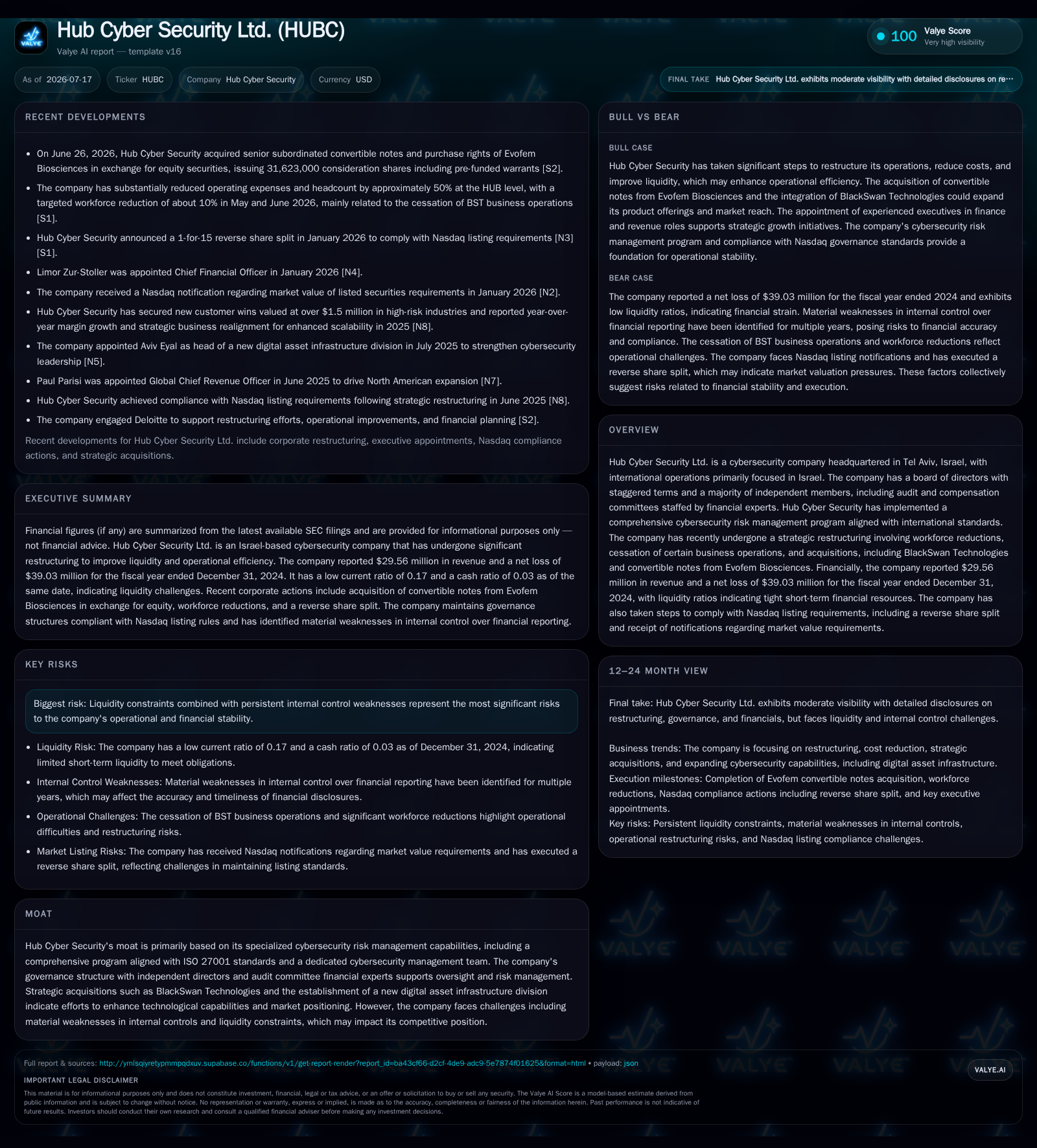
In its latest quarterly update, Hub Cyber Security Ltd. executed a pivotal acquisition of $49 million face value in Evofem Biosciences’ convertible notes through equity issuance, reflecting a strategic investment that preserves cash amid liquidity pressures. Concurrently, the company undertook substantial operational restructuring—cutting HUB-level headcount by approximately 50% and reducing external consultant reliance—to streamline costs and simplify its organizational structure. These efforts are supported by engagement with Deloitte for financial planning and governance improvements amid ongoing material internal control weaknesses. Hub Cyber Security’s core business centers on managed security services underpinned by ISO 27001-aligned cyber risk management frameworks, serving enterprise clients. However, integration setbacks from the impaired BST acquisition and cessation of that business segment highlight execution risks. Growth opportunities lie in expanding digital asset infrastructure security capabilities via acquisitions like BlackSwan Technologies. Financially, the company faces constrained liquidity with a current ratio near 0.17 and net losses exceeding $39 million as of 2024 year-end, limiting near-term investment flexibility. The Board’s active exploration of strategic alternatives underscores a focus on maximizing shareholder value while navigating operational and financial challenges.
Immediate Focus: Strategic Acquisition Supports Liquidity While Restructuring Advances
Hub Cyber Security Ltd. reported in its July 2026 quarterly filing a key strategic transaction acquiring approximately $49 million face value of senior subordinated convertible notes and purchase rights from Evofem Biosciences, Inc. This acquisition was settled entirely through the issuance of HUB equity securities, avoiding cash outflows amid tight liquidity conditions and positioning HUB for potential future upside tied to Evofem’s convertible instruments [S2]. The Evofem notes bear 8% annual interest, compound monthly, and are convertible into Evofem common stock at a low conversion price, potentially granting HUB significant equity exposure if conversion limits are lifted and shareholder approvals obtained [S2].
Concurrently, HUB has implemented a comprehensive restructuring plan focused on operational simplification and cost containment. This includes a roughly 50% reduction in HUB-level headcount and elimination of many external consultants and contractors, reflecting a sharp focus on reducing operating expenses to improve operating leverage [S2]. The company engaged Deloitte to assist with restructuring execution, financial planning, and governance enhancements, particularly to address previously disclosed material weaknesses in internal controls over financial reporting [S2]. These governance challenges remain a material risk factor, with remediation progress critical to restoring investor confidence and ensuring compliance with Nasdaq and SEC standards [S1].
Business Model: Managed Security Services Anchored by ISO 27001 Compliance
Hub Cyber Security operates primarily as a managed security service provider (MSSP), delivering cybersecurity risk management programs aligned with ISO 27001 standards. This framework underpins its enterprise-focused offerings, which include continuous threat detection, incident response, vulnerability assessments, and security operations center (SOC) services designed to meet stringent regulatory and compliance requirements [S1]. Revenue is generated predominantly through recurring managed services contracts, with key operating metrics including contract renewal rates, average contract length, and customer retention—critical indicators of recurring revenue stability and growth potential.
The company also supplements its MSSP offerings with cybersecurity consulting and software solutions, integrating endpoint protection, network security, and security information and event management (SIEM) capabilities. This diversified portfolio aims to address evolving cyber threats across multiple attack surfaces, including cloud environments and digital asset infrastructures.
Integration Risks Evident From BST Acquisition Impairment
Hub’s inorganic growth strategy has faced significant execution challenges, exemplified by the January 2025 acquisition of BST, a secured data fabric business intended to expand HUB’s technology stack [S1]. Despite a $41.6 million purchase price, the acquisition failed to meet strategic objectives due to financial difficulties and development setbacks. This led to a full impairment of BST’s technology assets by the end of 2025 and cessation of BST operations in mid-2026, including termination of its main commercial contract and workforce reductions [S1, S2].
This outcome highlights the integration risks inherent in cybersecurity acquisitions, where aligning technology platforms, migrating customer contracts, and harmonizing organizational cultures can strain resources and delay realization of synergies. Such setbacks can adversely impact ARR growth, gross margins, and client retention if not managed effectively.
Governance Strengths Offset By Material Control Weaknesses
Hub Cyber Security maintains a governance structure with a majority of independent directors and an audit committee staffed by financial experts as defined by Nasdaq rules, aligning with industry best practices for oversight [S1]. The board’s active role in overseeing restructuring and strategic alternatives reflects a commitment to strengthening corporate governance.
However, the company continues to face unresolved material weaknesses in internal controls over financial reporting, which pose risks to the accuracy and timeliness of financial disclosures [S1]. Deloitte’s engagement to support remediation efforts is a positive step, but the effectiveness of these controls remains a key watchpoint. Failure to remediate could impair regulatory compliance and investor trust, potentially affecting access to capital markets.
Growth Prospects Linked to Digital Asset Infrastructure Security Expansion
Despite operational and financial headwinds, Hub is pursuing growth opportunities in the emerging digital asset infrastructure security market, driven by increasing blockchain adoption and tokenization trends [S1, S2]. The acquisition of BlackSwan Technologies enhances HUB’s capabilities in securing digital assets beyond traditional network and endpoint protections, positioning the company to capture demand from enterprises and financial institutions seeking specialized security solutions for blockchain environments.
This strategic pivot aligns with broader industry trends emphasizing zero trust architectures, encryption, and advanced threat detection tailored to decentralized and tokenized asset classes. Success in this niche could diversify HUB’s revenue base and improve ARR growth, although execution risks remain given the nascent nature of this market.
Operational Trade-offs: Cost Reductions Versus Innovation Capacity
The substantial reduction in headcount and external consultants improves short-term cost structure and operating leverage but may constrain HUB’s capacity for innovation and service quality [S2]. In cybersecurity, maintaining competitive differentiation requires sustained investment in R&D, threat intelligence, and skilled security operations personnel. The headcount cut of approximately 50% at the HUB level raises concerns about potential impacts on these critical functions.
Reduced R&D spend and operational bandwidth could slow development of new capabilities, delay integration of acquired technologies, and affect customer satisfaction metrics such as time to detect and respond to threats. Monitoring gross margin trends and client renewal rates will be essential to assess whether cost savings translate into sustainable profitability without eroding service quality.
Key Performance Indicators and Monitoring Points
Several KPIs will be instrumental in evaluating Hub Cyber Security’s recovery trajectory and strategic execution:
- Managed Security Services Contract Renewal Rates: Reflecting customer retention and recurring revenue stability.
- Annual Recurring Revenue (ARR) Trends: Indicating growth or contraction in managed services subscriptions.
- Progress on Internal Control Remediation: Signaling governance improvements and regulatory compliance.
- Integration Success of Acquisitions: Particularly BlackSwan Technologies, measured by technology deployment and contribution to revenue.
- Operating Margins and Gross Margins: Assessing efficiency gains from restructuring.
- R&D Spend as Percentage of Revenue: Gauging innovation investment relative to peers.
- Liquidity Metrics: Including current ratio and cash burn rates, critical given tight balance sheet constraints.
Financial Profile Discussion: Liquidity Challenges Restrict Near-Term Flexibility
As of December 31, 2024, Hub Cyber Security reported revenues of approximately $29.56 million and net losses exceeding $39 million, underscoring ongoing profitability challenges within its current business model [F1]. The balance sheet reveals acute liquidity constraints, with current assets of about $18.4 million against current liabilities near $106 million, resulting in a current ratio of approximately 0.17—signaling significant short-term funding gaps [F1].
The equity-based acquisition of Evofem Notes helps preserve cash but does not alleviate the underlying liquidity pressure. The company’s capital-intensive cybersecurity operations, particularly in R&D and managed services delivery, require steady investment to maintain competitiveness. Restricted free cash flow limits HUB’s ability to fund growth initiatives or absorb unexpected operational shocks.
The Board’s ongoing exploration of strategic alternatives, including potential asset divestitures or capital raises, reflects efforts to strengthen the balance sheet and enhance shareholder value [S2]. The outcome of these initiatives will materially influence HUB’s capacity to invest in innovation and expand its managed security services footprint.
Conclusion
Hub Cyber Security’s recent equity-financed acquisition and aggressive restructuring represent pragmatic responses to significant liquidity and operational challenges. The company’s core managed security services business, anchored by ISO 27001-aligned cyber risk management frameworks, remains a foundational asset. However, integration setbacks from the BST acquisition and ongoing internal control weaknesses highlight execution risks.
Growth prospects in digital asset infrastructure security offer a promising avenue but require successful integration and sustained innovation investment. Monitoring contract renewal rates, governance remediation progress, margin trends, and liquidity metrics will be critical to assessing HUB’s path toward operational stability and strategic repositioning.
Disclaimer: This analysis is for informational purposes only and does not constitute investment advice. All financial and operational data are sourced from Hub Cyber Security Ltd.’s filings as cited.
Disclaimer: This is research-only, informational analysis and not investment advice. It may include AI-generated interpretation and general industry context. Always verify important details using primary sources.

Comments