
Travelers’ Underwriting Resilience and Capital Strategy Bolster Growth Amid Rising Catastrophe Risks
TRV’s Q2 2026 results demonstrate continued underwriting discipline and robust capital management strategies to mitigate intensifying catastrophe exposures while leveraging investment income for sustained profitability.
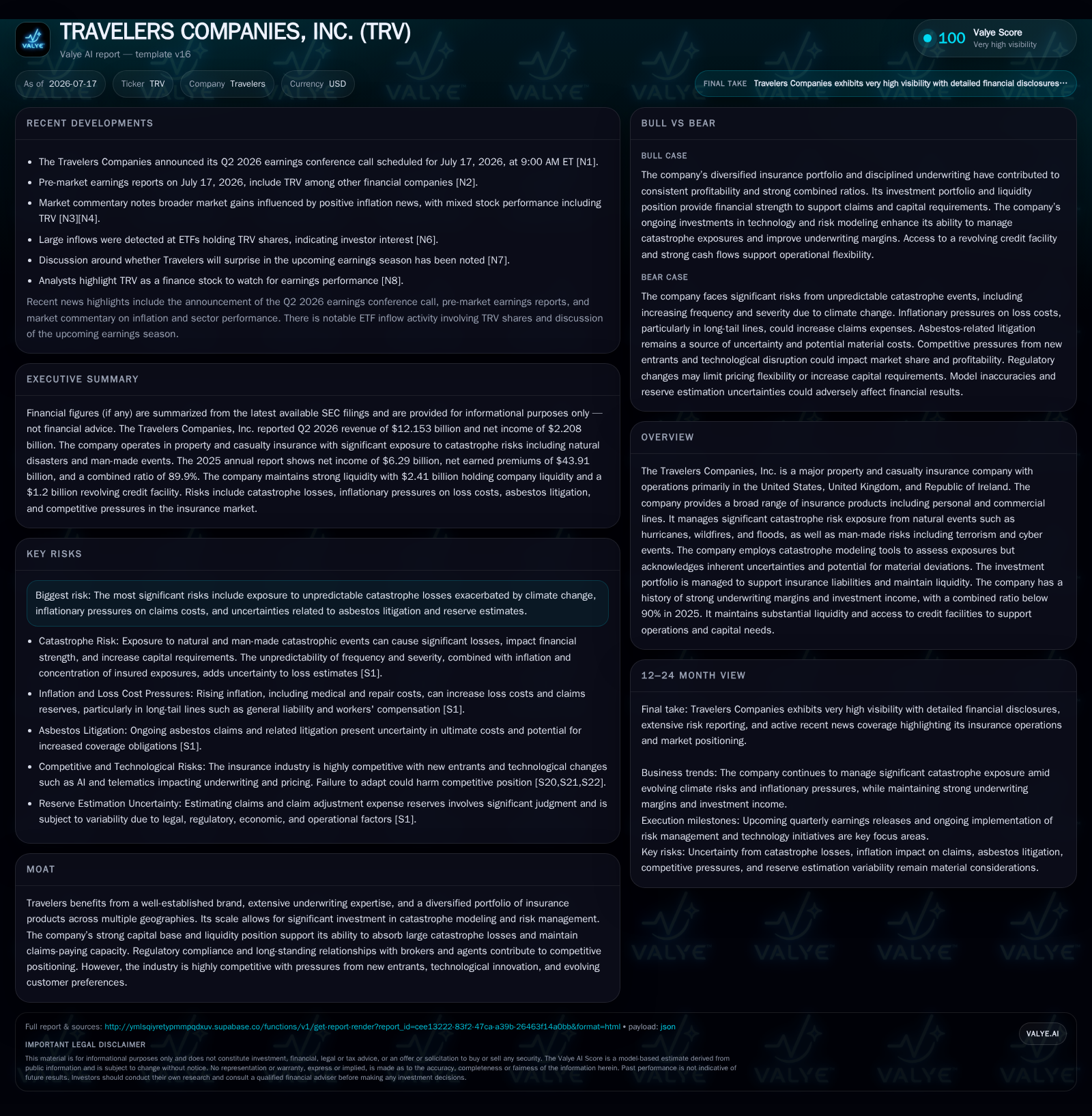
The Travelers Companies, Inc. reported in its Q2 2026 10-Q an ongoing strong underwriting performance despite increasing catastrophe losses, reflecting disciplined pricing and claims management. The firm’s diversified portfolio across personal and commercial lines combined with prudent reinsurance purchasing and advanced catastrophe modeling supports operating stability amid climate-driven volatility. Travelers’ significant policyholder surplus and liquidity position underpin flexible capital allocation including continued share repurchases and dividends. Key risks remain from inflationary claim costs, climate change exacerbating catastrophe frequency/severity, and uncertainties in asbestos-related reserves, all warranting close monitoring via combined ratio trends and reserve adequacy metrics.
Q2 2026 Operating Update Highlights Underwriting Discipline during Elevated Catastrophe Exposure
The Travelers Companies, Inc. reported solid underwriting performance in its Q2 2026 10-Q, maintaining disciplined risk selection and pricing despite elevated catastrophe losses and inflationary pressures on claims frequency and severity [S2][S3]. The company’s combined ratio remained within its historical underwriting profitability range, reflecting effective claims management and expense control that preserved underwriting margins. Net earned premiums showed growth driven by both personal and commercial lines, supporting stable revenue streams amid a challenging loss environment shaped by intensified natural and man-made catastrophes [S2][S3].
Travelers’ transparent disclosure of catastrophe losses highlights the operational impact of increasing climate-driven events such as hurricanes, wildfires, and severe convective storms. While catastrophe modeling tools are integrated into risk assessment frameworks, the company acknowledges inherent uncertainties in predicting event frequency and severity, particularly as climate change accelerates volatility in loss patterns [S1][S2]. This evolving risk landscape introduces both short-term earnings variability and longer-term strategic challenges for maintaining underwriting profitability.
Integrated Risk Management: Catastrophe Modeling and Reinsurance Strategy
To mitigate the financial impact of rising catastrophe exposure, Travelers employs sophisticated catastrophe modeling that estimates potential losses across its diversified geographic footprint, including the U.S., Canada, U.K., Ireland, and Brazil [S1][S18]. These models inform underwriting limits and reinsurance purchasing decisions, although the company notes that assumptions embedded in these models carry estimation risk, especially for emerging lines such as cyber insurance where historical loss data is limited [S1].
Reinsurance programs are a critical component of Travelers’ risk transfer strategy, designed to cap peak losses and smooth underwriting results. By ceding portions of catastrophe risk to reinsurers, Travelers preserves underwriting capacity and stabilizes earnings despite episodic large loss events [S1]. The interplay between quantitative catastrophe modeling and market-based reinsurance solutions underpins the company’s adaptive risk management approach amid uncertain climate and market conditions.
Diversified Revenue Base Across Personal and Commercial Lines
Travelers generates revenue primarily through premiums written on a balanced portfolio of personal lines—including auto and homeowners insurance—and commercial lines such as property and liability coverage for businesses [S1][S18]. This product diversification across multiple geographies reduces concentration risk and dampens the impact of localized catastrophic events or regulatory shifts.
Policyholder retention rates and renewal premiums are key operating metrics supporting revenue stability, as recurring premiums from existing customers provide predictable cash flow. Travelers actively manages underwriting selection and pricing adjustments in response to inflationary claims trends and evolving risk exposures, maintaining underwriting discipline to protect margin integrity [S1][S18]. Geographic diversification further mitigates regulatory and economic risks unique to individual markets.
Competitive Positioning and Market Dynamics
Travelers leverages a well-established brand and extensive broker and agent distribution networks, which are vital in the property and casualty insurance sector where trust and service quality influence customer acquisition and retention [S1]. Its scale enables significant investment in proprietary underwriting technologies and catastrophe analytics, providing a competitive advantage over smaller insurers.
The company operates in a competitive landscape alongside peers such as Chubb, Allstate, and Berkshire Hathaway Insurance Group, each with distinct strategic focuses ranging from global diversification to niche personal auto insurance. Emerging competitors employing innovative digital distribution and advanced data analytics pose additional challenges, prompting Travelers to invest selectively in growth areas like cyber insurance and technology-driven underwriting enhancements [S1].
Growth Drivers: Emerging Risks, Urbanization, and Technological Innovation
Key growth opportunities for Travelers include expansion into emerging risk categories such as cyber insurance, which presents a rapidly growing but model-uncertain market segment [S1]. Urbanization trends increase insured asset values, particularly in commercial property lines, driving premium growth potential. Additionally, evolving regulatory mandates are expanding insurance coverage requirements, particularly in personal lines.
Technological advancements in underwriting and claims processing—such as machine learning algorithms and automation—enhance pricing accuracy and operational efficiency, improving underwriting margins and claims cycle times [S1]. International market penetration, especially in regions with increasing private insurance adoption, also offers avenues for premium growth.
Risks and Monitoring: Inflation, Climate Change, and Reserve Adequacy
Travelers faces headwinds from inflation-driven increases in claims costs, including repair and replacement expenses that elevate loss severity and frequency, adversely impacting loss ratios [S1][S2]. Climate change introduces unpredictability in catastrophe frequency and severity, challenging the accuracy of catastrophe models and underwriting assumptions.
Legacy asbestos-related liabilities remain a source of reserve uncertainty due to ongoing litigation risks, necessitating vigilant monitoring of claims reserves adequacy [S1][S2]. Regulatory developments and potential shifts in insurance frameworks add further complexity to risk management and capital planning
Key performance indicators to watch include combined ratio trends, which reflect underwriting profitability; loss reserve adequacy metrics, critical for assessing future claims liabilities; policy retention rates, indicating customer loyalty and premium stability; and policyholder surplus levels, which measure capital strength and capacity to absorb losses [S1][S2]
Financial Position: Liquidity, Capital Strength, and Shareholder Returns
As of December 31, 2025, Travelers maintained liquidity exceeding internal targets designed to cover annual pre-tax interest expense and dividends, with cash and short-term investments totaling $2.41 billion [S4][S6]. The company replaced its prior revolving credit facility with a $1.2 billion five-year credit line, enhancing financial flexibility and reducing refinancing risk [S16].
In conclusion, Travelers Companies demonstrates operational resilience through disciplined underwriting, advanced catastrophe risk management, and prudent capital stewardship. These factors collectively position the company to navigate evolving industry challenges including climate-driven catastrophe risks, inflationary claims pressures, and emerging insurance market dynamics.
Disclaimer: This is research-only, informational analysis and not investment advice. It may include AI-generated interpretation and general industry context. Always verify important details using primary sources.

Comments