
GE Aerospace Strengthens Profitability Through Commercial Services Growth and LEAP Production Ramp
Robust aftermarket services and ongoing LEAP engine production ramp underpin GE Aerospace’s recent financial performance and competitive positioning.
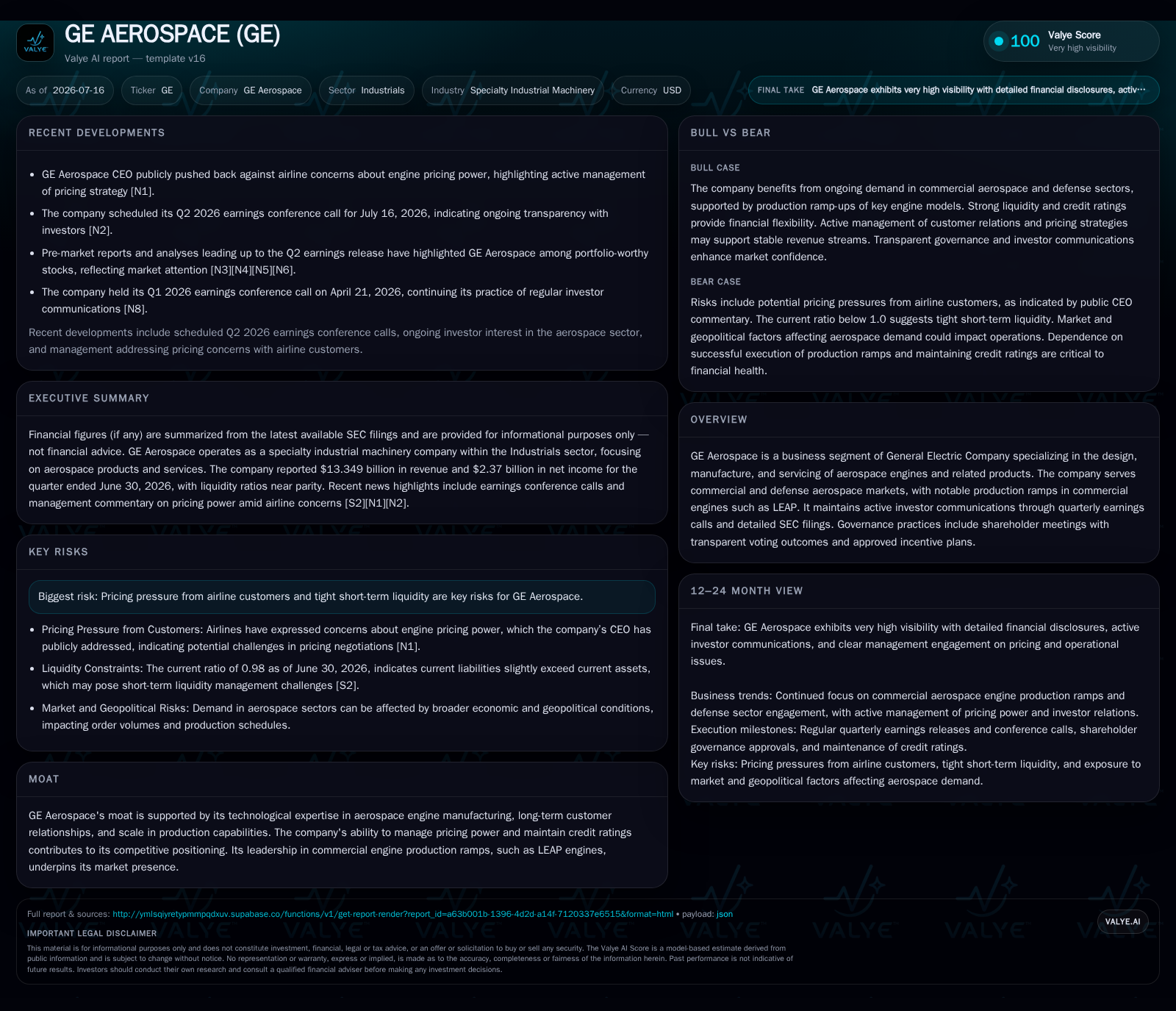
GE Aerospace’s Q2 2026 results demonstrate solid revenue and earnings beats driven by expanding commercial aftermarket services and continued production ramp-up of LEAP engines, a key commercial turbofan model. The company’s business model balances cyclical new engine sales with stable long-term service revenues, though pricing pressure from airline customers and liquidity constraints during production peaks remain key risks. Maintaining credit ratings amid capital-intensive operations supports financing flexibility, while strategic investments in technology underpin its competitive moat in aerospace engine manufacturing.
Recent Operating Update
In the second quarter ended June 30, 2026, GE Aerospace delivered better-than-expected financial results characterized by strong growth in commercial aftermarket services revenue and steady momentum in LEAP engine production ramp-up [S2][N1]. The company reported substantial segment profit improvements driven by elevated volume of engine units delivered to commercial airline OEMs, complemented by an expanding installed base generating maintenance, repair, and overhaul (MRO) service contracts. This dual revenue stream shows the archetypical aerospace engine OEM model where initial engine sales are capital intensive and lumpy but followed by steady aftermarket service cash flows that boost overall margin stability [S2][S1].
The LEAP turbofan engine program remains a focal point; rising production volumes are boosting top-line but also testing near-term liquidity due to high working capital needs linked to supply chain integration complexities [S2][S3]. This underscores common industry dynamics whereby operating cash flow temporarily dips during production scale-up phases before normalizing as economies of scale materialize. The company’s ability to manage this dynamic while meeting customer delivery schedules will be a critical near-term execution factor
Business Model Specificity
GE Aerospace operates primarily as an original equipment manufacturer (OEM) of aerospace propulsion systems serving both commercial and defense aerospace markets. Revenue generation is split between new engine deliveries and aftermarket services comprising MRO tasks bundled in long-term service agreements (LTSAs). Customers include large commercial airlines seeking fuel-efficient, emission-compliant upgrades—reflected in GE’s focus on next-generation turbofan engines like LEAP—and government defense contractors procuring bespoke military propulsion solutions.
The monetization model uses negotiated sales contracts for new engines priced per unit based on thrust rating and custom engineering factors [S1]. Aftermarket revenue derives from servicing installed fleets under multi-year contracts incentivizing high renewal rates. This mix serves as a natural hedge against cyclical new aircraft orders volatility by anchoring part of revenues in recurring service fees. However, pricing power is tempered by the oligopolistic nature of airline customers who aggressively negotiate discounts given competitive pressures and operating cost sensitivities
Channels include direct OEM sales to major aircraft manufacturers such as Airbus and Boeing plus aftermarket service delivery through regional maintenance centers. The scale GE commands allows substantial leverage with suppliers but also requires careful supply chain management due to significant components sourcing complexity.
Industry Structure and Competitive Position
The aerospace engine manufacturing industry is technologically intensive with substantial barriers such as certification hurdles for new engine models and advanced R&D investment requirements. The global market is dominated by a small number of key OEMs: GE Aerospace competes alongside Rolls-Royce Holdings plc, Pratt & Whitney (Raytheon Technologies), Safran S.A., Honeywell Aerospace, and MTU Aero Engines.
GE Aerospace’s moat rests on established technological expertise evidenced by its leadership in turbofan design (e.g., LEAP) combined with scale advantages enabling competitive pricing. Its long-term customer relationships facilitate cross-selling of LTSAs which stabilize cash flows. While its peer group shares similar product cycles, GE’s aggressive production ramp strategy sets the pace but involves operational risks inherent in rapid capacity increases.
Growth Drivers
Key growth drivers include:
- Global increases in air travel demand post-pandemic boosting aircraft order volumes.
- Fleet modernization programs driving replacement cycles favoring more fuel-efficient engines like LEAP tuned for tighter emissions standards.
- Expansion of aftermarket MRO services supported by LTSAs provides recurring revenue growth beyond initial engine sale spikes.
- Defense aerospace budgets supporting tailored propulsion contracts here provide diversification advantage.
- Technological innovation efforts focused on fuel efficiency improvements reinforce market demand.
Risks and Constraints
GE Aerospace faces multiple risks including:
- Persistent pricing pressure from airline customers limits margin expansion potential especially amid competitive bidding dynamics.
- Regulatory challenges related to emerging environmental emissions standards may require costly redesigns impacting future R&D budgets.
- Defense contract exposure subjects the business to geopolitical headwinds influencing spending unpredictability.
- Technological obsolescence risk if competitors advance next-gen propulsion faster.
Monitoring KPIs like backlog size, service renewal rates, effective capacity utilization, and engine reliability metrics will be crucial risk indicators going forward [S1][S4]
What to Watch Next
Upcoming milestones that will confirm or challenge current trends include:
- Quarterly updates on LEAP engine delivery volumes signaling success or delays in production scaling.
- Aftermarket service contract renewal rates indicating customer satisfaction and revenue visibility.
- Management commentary on pricing negotiations reflecting airline sector dynamics.
- Indicators of supply chain stability or disruptions directly impacting capacity utilization metrics.
- Regulatory developments pertaining to emissions affecting product certification timelines.
Explicit guidance revisions or order backlog disclosures in subsequent quarterly reports offer tangible markers for tracking operational execution [N1][S3]
Financial Profile Discussion
As of June 30, 2026, GE Aerospace's current assets stood at approximately $39.7 billion against current liabilities near $40.4 billion yielding a current ratio just below parity at 0.98 indicating tight working capital management constrained during production ramp-ups [F1]. Total debt outstanding approximates $57.4 billion with net debt around $14.1 billion after cash adjustments reflecting significant leverage consistent with capital-intensive industrial operations of this scale [F1]. The company benefits from investment-grade credit ratings—Moody's at A3 and Standard & Poor's at A-—which provide access to competitively priced debt markets critical for funding R&D investments and capacity expansions without excessive financing cost strain [S25].
Profit margins improved notably in recent periods driven by better commercial services mix offsetting some pricing pressure effects [N1]. Free cash flow timing remains lumpy correlating with LEAP program ramp-up phases where receivables growth temporarily outpaces collections requiring careful treasury oversight. Capital allocation decisions including shareholder-approved amended long-term incentive plans indicate disciplined governance focused on aligning rewards with sustained operational improvement [S16].
Overall financial health appears resilient though contingent upon successful navigation of growth-related working capital demands and external risk factors discussed above.
This analysis synthesizes publicly available regulatory filings alongside recent earnings commentary to evaluate GE Aerospace’s operating environment within the aerospace engine manufacturing industry without offering investment advice or forecasts.
Disclaimer: This is research-only, informational analysis and not investment advice. It may include AI-generated interpretation and general industry context. Always verify important details using primary sources.

Comments