
Frequency Electronics Advances Backlog and R&D Amid Government-Dependent Precision Timing Markets
Frequency Electronics reports a robust backlog surge and sustained R&D investment, highlighting its niche in government-driven precision timing and navigation hardware.
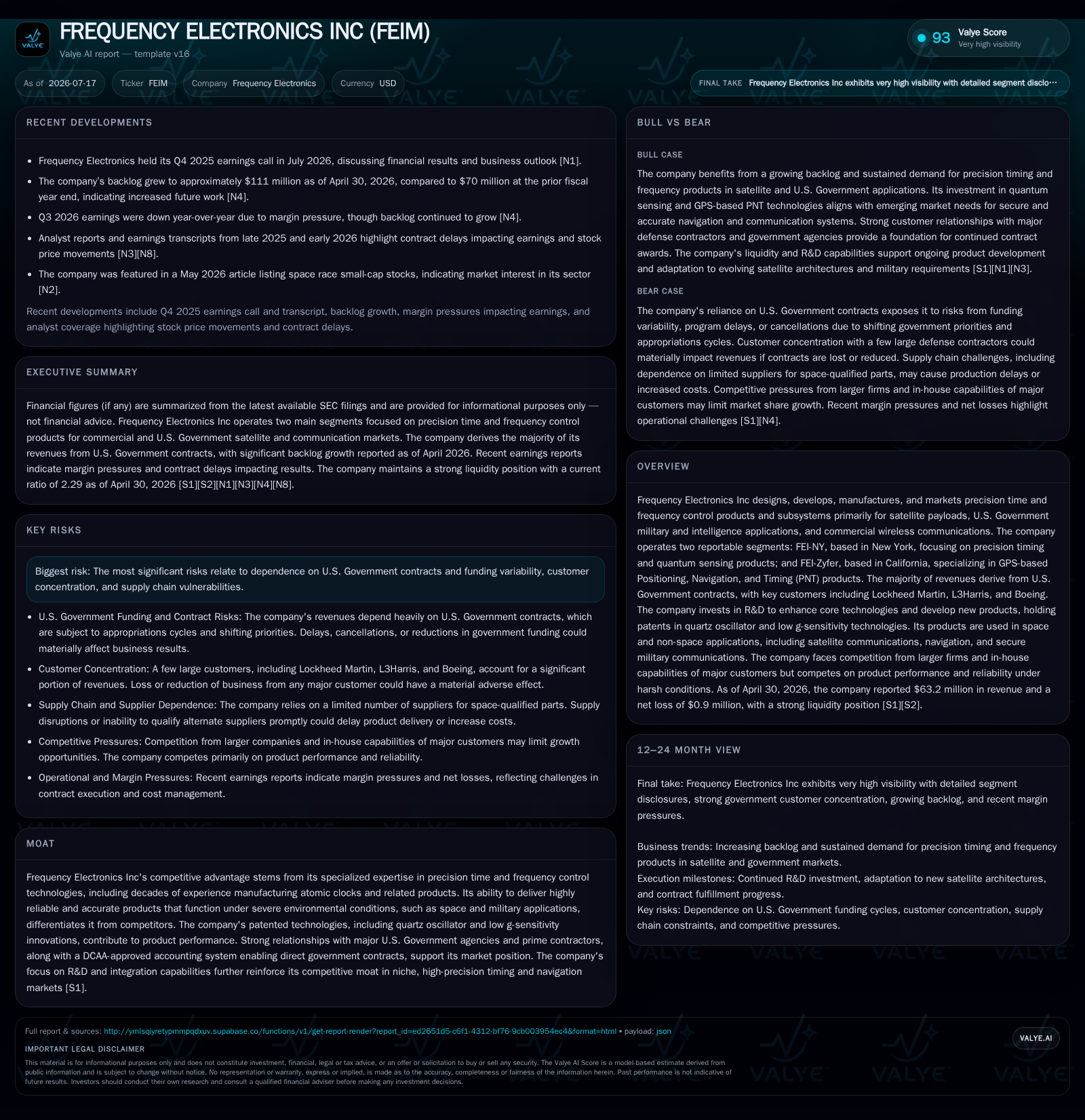
In its latest quarterly filing ending April 30, 2026, Frequency Electronics Inc (FEIM) demonstrated a significant increase in backlog to $111 million from $70 million year-over-year, reflecting strong demand visibility primarily from U.S. Government contracts. The company maintains dual segments specializing in precision timing for satellite payloads and GPS-based navigation products, with about three-quarters of revenues driven by its New York segment focused on satellite applications. Despite ongoing supply chain challenges and concentrated customer exposure, FEIM’s specialized patented technologies and continuous R&D into quantum sensing position it well within the precision timing industry, though reliance on defense budgets and fixed-price contracts remain key risks. Financially, the firm reported modest operating losses amid revenue growth and holds a solid liquidity position with a current ratio above 2.
Recent Operating Update: Strengthening Backlog Signals Revenue Visibility
The lack of material changes in reported risk factors since the prior annual filing implies that operational uncertainties remain consistent with prior disclosures related to government spending variability and supply chain dependencies [S2][S7]. Additionally, a recent revolving credit facility agreement enhances liquidity options as part of corporate financing flexibility [S23][S29].
Business Model: Dual-Segment Focus on Precision Timing Hardware for Government Markets
Frequency Electronics functions through two reportable segments aligned by geography and product specialization: FEI-NY based in Long Island, New York, supplying precision time generation, synchronization products including atomic clocks, quartz oscillators, and quantum sensors; and FEI-Zyfer in California focusing on GPS-based Positioning, Navigation, and Timing (PNT) products integrating proprietary high-precision clocks with GNSS systems [S1][S10][S27].
FEI-NY accounts for approximately 72% of consolidated revenues incorporating sales to commercial satellite programs as well as U.S. Department of War customers across ground systems and mobile military platforms [S1][S27]. Products include oven-controlled quartz crystal oscillators widely used in satellite communication links along with space-qualified assemblies such as power converters critical for payload operations [S27]. The segment has also recently ventured into quantum sensing markets leveraging its atomic clock physics core technologies through magnetometers and compact Rydberg sensors targeting both commercial expansions and defense-related applications—a compelling adjacent growth vector given the newness yet technological continuity of these products [S1][S4][S27].
FEI-Zyfer generates roughly a third of consolidated sales focused almost exclusively (>95%) on U.S [S18]. Government customers concerned with secure GPS signal reception including counters to jamming or spoofing threats important for C5ISR tactical systems. This segment’s high-reliability ruggedized clocks combined with specialized software illustrate the strategic integration of timing hardware solutions that extend FEIM’s core competencies into navigation subsystems embedded in intelligence-gathering platforms
Revenue recognition hinges primarily on government programs procured under fixed-price or cost-plus contracts either directly with agencies or via subcontracts from prime contractors such as Lockheed Martin or Boeing—underscoring the importance of government procurement processes as strategic sales channels rather than purely open commercial markets [S1][S18][S19]. These contracts entail long development cycles accompanied by product qualification stringent enough for space environment certification including radiation tolerance and mechanical shock resistance—key barriers limiting commoditization.
Industry Structure and Competitive Position
The precision timing hardware industry serves satellite communications providers, defense/intelligence agencies, aerospace system integrators, and commercial wireless network operators requiring certified time/frequency sources such as atomic clocks or GPS receivers integrated into complex subsystems. Frequency Electronics competes alongside historical peers like former Symmetricom (now part Microchip Technology), Trimble Inc., Honeywell Aerospace navigation divisions, Oscilloquartz (ADVA), plus government-oriented defense primes like L3Harris Technologies that compete mainly in larger system categories rather than pure oscillator components.
FEIM distinguishes itself via decades-long specialization in manufacturing highly reliable quartz oscillators and atomic clocks proven under harsh environmental conditions including low gravity, temperature extremes, vibration, radiation exposure typical in satellite payloads. Patented innovations in oscillator design minimizing acceleration sensitivity underpin this differentiation while strong direct contract access through DCAA-approved accounting systems enable prime relationships beyond typical subcontractor roles [S1][S19].
In the non-space sector focusing on wireless network infrastructure synchronization or electronic warfare markets supporting secure communications employed by the Department of War customer base, FEIM faces competition from larger semiconductor-focused firms like Microchip Technology or Mercury Systems but maintains edge through integration know-how bridging hardware manufacturing with tailored subsystem solutions including embedded software for signal integrity enhancement [S19].
Growth Drivers
Demand for accurate timing modules is anticipated to benefit structurally from:
- Expansion of satellite constellations (LEO/MEO) driving replacement cycles for master clock assemblies delivered by FEI-NY.
- U.S. Government initiatives modernizing defense communications networks requiring improved robustness against GPS spoofing or jamming where FEI-Zyfer offerings are critical.
- Emerging quantum sensing applications exploiting physical principles underlying atomic clocks allowing entry into magnetometry or quantum antennae markets leveraging existing proprietary platform technology.
- Persistent contract wins fueled by technological trust accumulated over decades evidenced by increasing backlog levels.
- Collaborations receiving customer co-investment enabling accelerated innovation without losing IP ownership bolster competitive positioning especially in new market adjacencies.
These drivers will manifest through KPIs such as contract win rates on tenders specific to U.S. military procurements; percentage backlog fill ratio; escalating R&D expense aligned with new product introductions; yield improvement reducing unit costs; and expansion into international end-users albeit currently limited (~9% foreign sales) indicating scope for global market penetration over time [S1][F1]
Risks / Watchpoints / Growth Constraints
Critical risks remain substantial dependency on U.S. Government funding pathways which are inherently volatile subject to political considerations impacting program renewals or allocations potentially causing order book fluctuations despite current large backlog coverage [S2][S7]. This customer concentration risk is accentuated by reliance on few prime contractors acting as intermediaries limiting direct end-customer diversification.
Supply chain vulnerabilities arise primarily because many components must meet strict space-grade qualification criteria limiting alternate sourcing options; delays could cascade into deadline slippages incurring financial penalties particularly under fixed-price contracts bearing cost overrun risks solely on FEIM [S4].
The capital-intensive nature mandates steady R&D commitment coupled with ability to innovate ahead of obsolescence especially around next-generation timing technologies including quantum sensors—a field younger than classical oscillator tech posing integration challenges but also growth opportunities if effectively monetized [S4][S27]. Pricing pressure inherent in fixed-price contracts restricts margin expansion necessitating ongoing manufacturing process improvements.
Cybersecurity risks pertain due to sensitive government contracting involved in classified projects requiring stringent IT governance which management addresses but remains an execution watchpoint considering evolving threats documented at Board oversight level reflecting material risk management importance [S1].
What To Watch Next
Key monitoring points comprise:
- Quarterly backlog updates confirming contract renewals or cancellations influencing revenue visibility beyond fiscal year end.
- Execution milestones related to new quantum sensing product rollouts validating expansion strategy outside traditional oscillator lines.
- Supply chain adaptation outcomes particularly qualification timelines for alternate parts impacting delivery schedules.
- Changes in U.S. defense procurement budgets or regulatory shifts affecting contract awards relevant to FEIM’s niche.
- Financial progress towards achieving positive operating income reflecting operational leverage despite upfront R&D spend.
- Customer diversification trends or increased foreign sales percentages signaling successful global market entry attempts.
Financial Profile Discussion
Balance sheet strength is illustrated by a current ratio around 2.29 driven by $47.98 million current assets against $20.98 million current liabilities providing liquidity cushion amidst working capital needs [F1]. Cash & equivalents stand at approximately $1.6 million while net debt is near $4.4 million based on available total debt figures suggesting manageable leverage though refinancing activities continue via recently arranged revolving credit facilities improving financial flexibility for ongoing capital commitments especially R&D initiatives correlated with growth targets [F1][S23][S29].
Margins exhibit constraints consistent with industry peers balancing high specialization requirements against fixed-price contractual frameworks; margin recovery will hinge on improved production yields, pricing negotiations particularly within government contracting frameworks featuring both fixed-price/cost-plus models, and successful commercialization of adjacent technologies such as quantum sensing hardware that may command premium valuations.
This analysis synthesizes publicly reported SEC filings up to July 2026 regarding Frequency Electronics Inc without offering investment advice or price forecasts. It leverages an industry framework contextualizing precision timing equipment manufacturing alongside detailed company disclosures concerning segment strategy, backlog composition, customer dependencies, patent moats, operating risks including supply chain resilience, cybersecurity governance oversight, and financial standing relevant for internal buy-side analytical usage.
Disclaimer: This is research-only, informational analysis and not investment advice. It may include AI-generated interpretation and general industry context. Always verify important details using primary sources.

Comments