
Artificial Intelligence Technology Solutions’ Subscription Model Scales as Autonomous Security Platform Expands
AITX reports stable revenue with modest deployment growth amid intensifying financial pressures and strategic investments in autonomous security products.
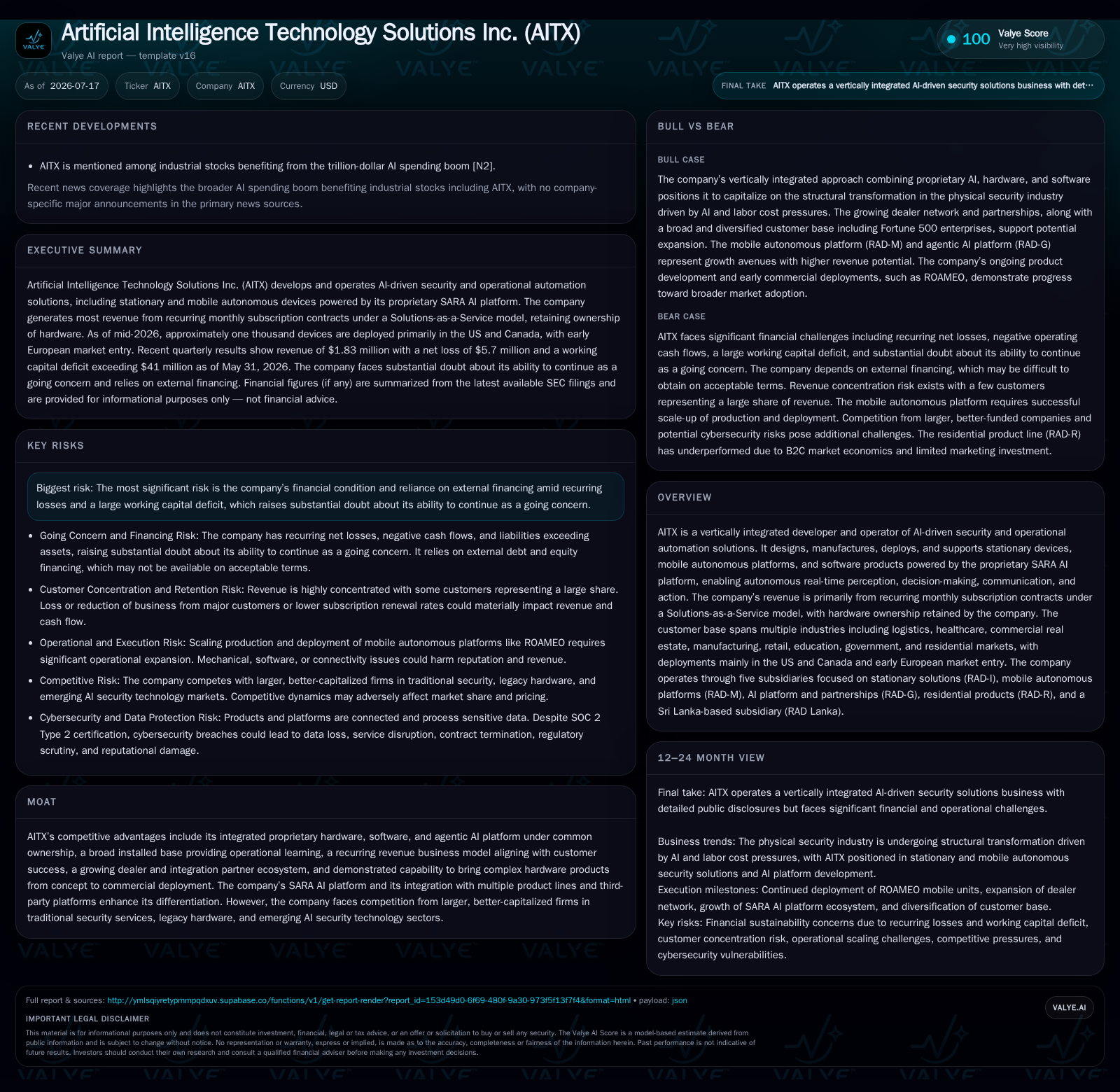
Artificial Intelligence Technology Solutions Inc. (AITX) continues to advance its integrated autonomous security solutions powered by the proprietary SARA AI platform, focusing on subscription-based revenue from stationary and mobile devices. The latest quarter shows a nearly flat revenue profile with incremental diversification of the customer base and early signs of scaling new mobile product rollouts. However, recurring operating losses and a severe working capital deficit underscore ongoing financial sustainability challenges. The company’s strategic emphasis remains on expanding its dealer network and entering GDPR-compliant European markets to underpin long-term growth.
Latest Quarterly Execution Highlights: Revenue Dynamics and Deployment Scale Growth
Gross profit contracted marginally by nearly $50k yet maintained a solid margin level near 65%, a typical ratio for companies balancing hardware-centric deployments supporting software-driven services under subscription contracts [S7]. Product mix changes contributed to margin fluctuations, consistent with planned phased rollouts of newer high-capital mobile platforms alongside existing stationary devices.
On the expense side, operating costs fell by about 12%, primarily due to reductions in software development outlays reflecting a transition toward product maturity for core offerings. Meanwhile, other expenses soared over $1.5 million year-over-year largely attributable to increased interest expense stemming from higher debt-related amortization and compounding interest on loans payable [S4]. The net loss expanded by approximately $1.12 million to over $5.7 million, underscoring persistent operating leverage constraints despite aggressive cost management.
Additionally, cash balances remain critically low at around $95k as of quarter-end, with accounts receivable nearing $975k and substantial inventory held in device parts valued at approximately $1.38 million [S9]
Proprietary Technology Stack: Enabling Real-Time Autonomous Security Solutions via SARA AI
AITX’s core technological advantage resides in its agentic AI platform named SARA (Speaking Autonomous Responsive Agent), which integrates tightly across proprietary hardware-software stacks spanning both stationary units (RAD-I series) and emerging mobile autonomous robots (RAD-M series) [S1]. This architecture allows deployed devices to perceive their environment through advanced machine vision—including facial recognition capabilities—make autonomous decisions, communicate status or escalate alerts, and take actions without continuous human intervention.
This real-time, closed-loop autonomy differentiates AITX within a fragmented security landscape typically dominated by manual labor or static surveillance hardware lacking intelligent automation layers. By retaining ownership of hardware assets embedded with the SARA platform, AITX captures more downstream value via recurring monthly subscriptions as opposed to mere one-time hardware sales or conventional service contracts. This vertical integration provides control over updates, performance optimization, and scalability potential critical to competing against standalone SaaS providers or traditional physical security firms advancing digital transformation efforts.
By engineering both platforms internally—from silicon level sensing components through cloud-based AI orchestration—AITX mitigates supply chain dependencies common in this industry segment while enhancing its intellectual property moat linked to response accuracy metrics essential for client trust and regulatory acceptance.
Competitive Landscape: Differentiation Amid Legacy Players and Emerging Autonomous Robot Providers
AITX operates at the intersection of several converging competitive spheres including traditional security services companies transitioning toward AI-enabled solutions (exemplified by firms like ADT), niche autonomous robotic system manufacturers such as Knightscope or Cobalt Robotics focusing solely on mobility platforms, and pure-play SaaS vendors offering cloud-based security management tools.
While larger incumbents benefit from established customer relationships and scale economies in human guard deployment logistics, their legacy operational models offer limited automation sophistication compared to agentic AI approaches advancing recognition accuracy and autonomous intervention timing. Conversely, peers specializing exclusively in mobile robots face challenges with comprehensive stationary solution coverage or lack fully integrated backend cloud architectures enabling seamless multi-device orchestration across large enterprise sites.
AITX's retention of hardware ownership under its Solutions-as-a-Service model stabilizes recurring subscription revenue streams enhancing predictability—a key competitive advantage against firms relying heavily on outright equipment sales or one-off licensing deals which yield revenue volatility. However, scaling production capacity remains critical for unlocking further margin expansion which currently is constrained by low batch manufacturing volumes characteristic of early-stage hardware startups.
Growth Drivers: Expanding Dealer Network and European Market Entry Within SaaS Frameworks
The company’s business strategy emphasizes enlarging its authorized dealer network which serves as multipliers in geographic reach deployment and customer acquisition beyond internal sales force limits. This ecosystem development plays into modular subscription contract sales enabling localized installation expertise combined with centralized remote monitoring.
Furthermore, AITX plans operational market entry into the European Union via formation of RAD Europe subsidiary during fiscal year 2027—a move designed for strict compliance with GDPR privacy regulations crucial for deploying facial recognition technologies legally across EU jurisdictions [S1]. Such regulatory foresight helps mitigate material barriers typically faced by AI-driven security solution providers expanding internationally.
Complementing these sales channel expansions is continued rollout of capital-intensive autonomous mobile units such as ROAMEO vehicles which commenced commercial billing activity post-May 2026 but anticipate gradual volume scaling given inherent production complexities. Incremental revenues from these new product introductions diversify AITX’s portfolio exposure beyond well-established stationary device lines thereby targeting higher top-line ceilings long term while maintaining upward gross margin leverage opportunities as manufacturing scale improves.
Forward-Looking Service Enhancements: New Product Pipeline & Operational Automation Advances
Management guidance reflects intentions to introduce additional models in the stationary solutions category during fiscal 2027 that build upon existing RAD-I deployments with enhanced features enabled by evolved SARA agentic AI capabilities [S1]. These innovations aim at deeper automation not merely replicating human guard functionalities but transcending them through predictive analytics combined with immediate autonomous actionable responses.
The operational automation trajectory also involves embedding layered decision hierarchies allowing devices to independently prioritize detection events based on context sensitivity—advancing beyond reactive surveillance toward preemptive risk mitigation paradigms integral to Industry 4.0 security transformations now underway across key end markets such as logistics hubs, healthcare complexes, manufacturing facilities, retail centers, commercial properties, government installations, educational institutions, and residential communities.
Risk Factors: Financial Sustainability Challenges, Customer Adoption, and Regulatory Environment
Despite promising technological differentiation and structured growth levers, AITX faces substantial risks notably financial viability highlighted by a working capital deficit surpassing $41 million at May 31st coupled with negligible cash reserves just under $100k—all pointing toward acute liquidity strain dependent on near-term capital raises or debt restructuring initiatives [F1], [S9]. Absent sustained infusion of external funding sources or rapid margins expansion driven by scalable revenue climbs risk material non-continuance scenarios remain present.
Customer adoption hurdles persist as entrenched reliance on human security guards resists swift displacement despite rising labor cost pressures; scaling acceptance among sectors accustomed to manual intervention requires demonstration of reliable AI detection accuracy balanced against regulatory constraints governing facial recognition usage restricting data processing rights especially in privacy-sensitive regions such as Europe [S1], industry knowledge layer.
Legal liabilities linked with autonomous device operations create exposure vectors unique relative to purely software-based solutions including potential litigation risks around false positives/negatives impacting safety outcomes necessitating robust field validation protocols alongside insurance safeguards.
Financial Profile Discussion: Liquidity Constraints Amid Revenue Expansion Efforts
Cash flow statements reveal persistent negative operational cash consumption ($2.76 million) although somewhat offset by financing activities previously generating cash inflows approximating similar levels mostly via share issuances net of costs plus loan draws indicating temporary liquidity bridging mechanisms rather than sustainable organic free cash generation paths so far established [S8], [S9].
Reduced R&D spending signals cautious optimization balancing between maturation of certain products versus resource allocation maintaining cadence on development-heavy mobile systems vital for anticipated long-term growth curves implying tightened budget discipline under cash flow constraints yet risking slower innovation velocity if access to incremental capital falters.
What To Watch Next: Operational Milestones, Dealer Ecosystem Growth, and Profitability Pathway
Key execution markers include quarterly assessments of deployment scale metrics reflecting installed device counts growing sustainably across both stationary (RAD-I) and mobile (ROAMEO/ RAD-M) platforms alongside percentage trending improvements in monthly recurring revenue facilitating increased subscription gross margins targeted above 75% eventually post scale efficiencies realization described in management disclosures [S1]
Expansion rates within authorized dealer networks provide lead indicators on distribution reach efficiency crucial for geographically dispersed adoption particularly following RAD Europe establishment calibrated against European regulatory compliance benchmarks reasonably expected throughout upcoming fiscal quarters enabling accelerated cross-border sales flows.
Profitability trajectory monitoring should probe continuing reductions in net losses through tightened operating expenses coupled with demonstrated positive contribution margin segments like RAD-I standalone business which management posits as potentially cash flow positive when isolated—the latter forming a foundational baseline validating scalable economics even before full ramp-up of more capital-demanding product lines occurs.
Any reversal signs such as escalating churn rates on subscriptions or deteriorating credit conditions limiting borrowing capacity would pose downside challenges warranting close investor scrutiny while positive feedback loops from successful early deployments generating referenceable outcomes would strengthen thesis support regarding longer-term viability prospects amidst industry transition headwinds.
This analysis draws exclusively from filed regulatory disclosures up through July 17th, 2026 without speculative forward projections unsupported directly by sourced evidence nor investment research views. It aims at informed understanding of Artificial Intelligence Technology Solutions Inc.’s evolving business fundamentals within the dynamic AI-driven security automation sector highlighting operational progress amidst substantive financial restructuring needs.
Disclaimer: This is research-only, informational analysis and not investment advice. It may include AI-generated interpretation and general industry context. Always verify important details using primary sources.

Comments