
Snow Rothschild Acquisition’s IPO Raises $226M with Governance Challenges Highlighted
Newly public SPAC Snow Rothschild Acquisition Corp. begins capital deployment phase amid internal control concerns and trade policy risks.
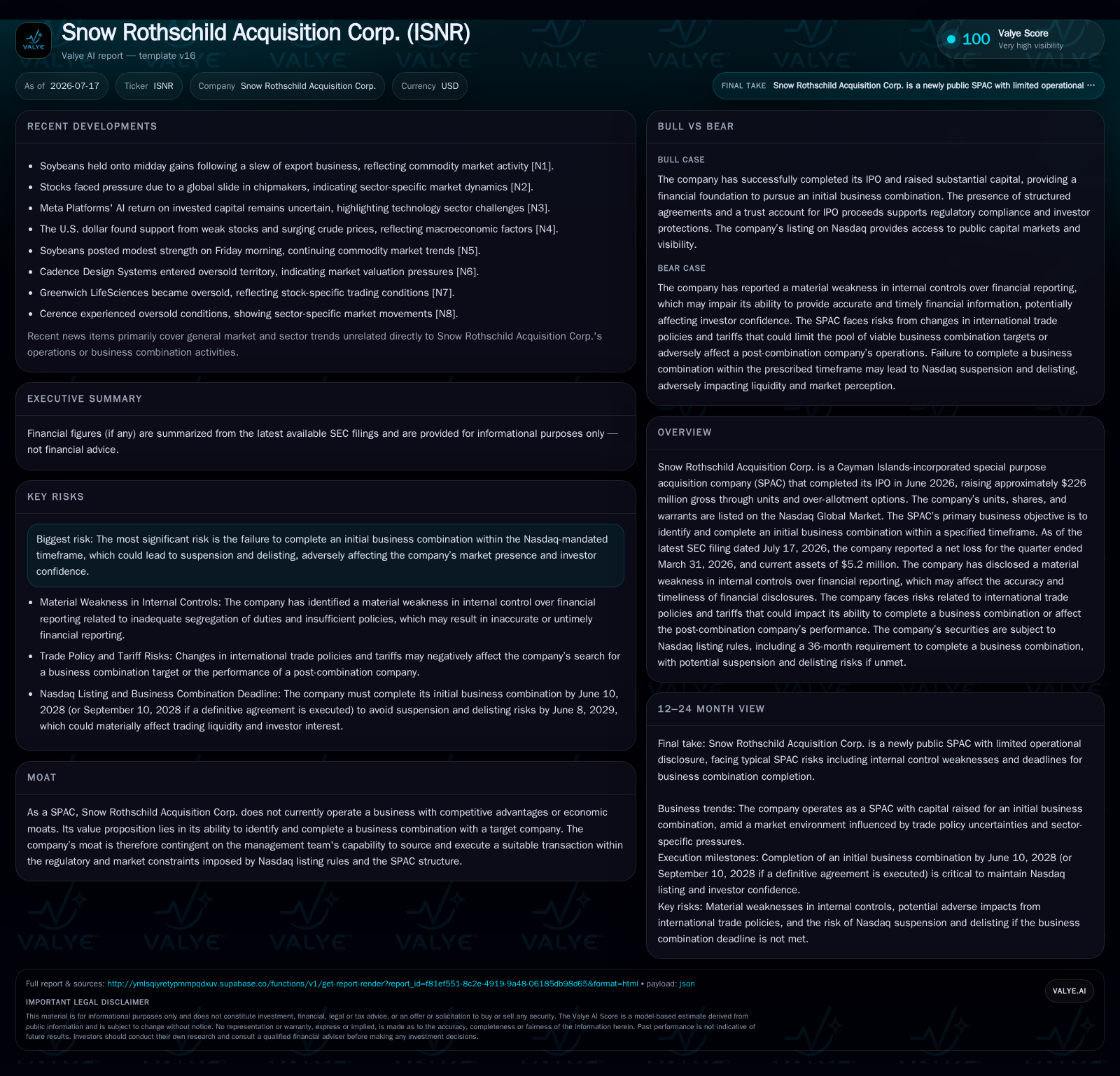
Snow Rothschild Acquisition Corp. completed its IPO in June 2026, raising $226 million through units and over-allotment options, positioning itself to pursue a target acquisition within the Nasdaq-mandated timeframe. The company disclosed a material weakness in internal controls over financial reporting, signaling potential risks to financial transparency and timely disclosures. Further, evolving international trade policies represent an external risk that may complicate target search and post-merger operations. As a SPAC with no intrinsic operating business, value depends heavily on management's ability to identify and consummate a suitable business combination before critical deadlines.
Recent Operating Update: IPO Completion and Material Control Weakness
Snow Rothschild Acquisition Corp., a Cayman Islands-incorporated special purpose acquisition company (SPAC), completed its initial public offering (IPO) in June 2026, raising approximately $200 million from the sale of 20 million units at $10.00 per unit, supplemented by an additional $26 million from the partial exercise of an over-allotment option totaling 2.6 million units. This brings total gross proceeds to roughly $226 million before underwriting commissions [S3][S5][S6][S7]. Each unit consists of one Class A ordinary share and one-half of a redeemable warrant exercisable at $11.50 per share [S3]. Concurrently, the Sponsor acquired 2.25 million private placement warrants at $1.00 each, exercisable on similar terms as the public warrants, creating potential dilution contingent on future warrant exercises [S13].
All IPO proceeds were placed into a U.S.-based trust account managed by Continental Stock Transfer & Trust Company, ensuring capital preservation pending completion of an initial business combination or liquidation, consistent with standard SPAC fiduciary structures [S5][S9]. As of March 31, 2026, the company reported current assets of approximately $5.2 million held outside the trust account to cover operating expenses. The net loss for the quarter was $50,718, reflecting administrative costs typical of the pre-merger phase without active operations [F1]. These expenses primarily include legal, accounting, audit fees, and management costs.
Business Model: SPAC Capital Vehicle with Sponsor-Driven Acquisition Mandate
Snow Rothschild Acquisition Corp. operates as a financial intermediary designed to facilitate private companies' access to public markets through a de-SPAC transaction—a merger or acquisition using the SPAC’s publicly listed shares rather than a traditional IPO. The company generates value primarily through sponsor promote structures realized post-merger and through warrant exercises that can provide additional capital but also cause equity dilution.
Investors purchase units combining shares and warrants, with redemption rights allowing them to exit prior to deal completion if dissatisfied with the proposed target or market conditions. Redemption activity directly affects the cash available in the trust account for the business combination, influencing deal size and structure.
To date, Snow Rothschild has not announced any acquisition targets. Its value proposition depends heavily on the management team's ability to source and close an attractive target within Nasdaq-mandated deadlines. The capital structure, including redeemable warrants exercisable at $11.50 (approximately a 15% premium over the unit price), incentivizes shareholder retention and provides potential capital inflows if exercised when share prices exceed the strike price.
Industry Structure and Competitive Position
Snow Rothschild operates within the broader SPAC industry, characterized by numerous vehicles competing to identify mid-market private companies suitable for public transition outside the traditional IPO process. SPACs function upstream in the capital markets ecosystem as facilitators of private-to-public transitions but face inherent timing risks due to regulatory deadlines.
Compared to marquee SPACs such as Pershing Square Tontine Holdings and Churchill Capital Corp, which benefit from high-profile sponsors with extensive deal track records and robust governance frameworks, Snow Rothschild's competitive differentiation will depend on the management team's experience and deal sourcing capabilities. Currently, limited public information is available regarding the management team's track record [S8][S13].
The disclosed material weakness in internal controls contrasts with peers that emphasize strong financial governance prior to deal execution, potentially influencing investor perception and the company's ability to negotiate confidently with prospective targets.
Growth Drivers
Snow Rothschild's growth prospects hinge on successfully completing an initial business combination within the Nasdaq-mandated deadline of June 10, 2028, extendable by three months under specific conditions if a definitive agreement is signed timely [S16][S18]. Completion of a de-SPAC transaction would unlock sponsor promote realization and potential share price appreciation tied to the combined entity's performance.
Investor appetite for alternative listing vehicles remains robust under favorable capital market conditions, providing opportunities to acquire companies seeking streamlined public market access. Innovations in sponsor incentives aim to better align management interests with shareholders compared to earlier SPAC generations.
However, evolving international trade policies present headwinds. Recent U.S. tariff increases and reciprocal foreign measures introduce uncertainties that may limit the availability of attractive acquisition targets or adversely affect post-merger operational performance, particularly for companies with significant import-export exposure [S19].
Key growth levers include:
- Efficient identification and due diligence of potential targets
- Maintaining compliance with Nasdaq listing rules to avoid delisting risks
- Navigating regulatory and geopolitical challenges impacting target sectors
- Leveraging sponsor and management networks for deal origination
- Addressing internal control weaknesses to sustain investor confidence
Risks and Watchpoints
Failure to complete a qualifying initial business combination within the prescribed timeframe will trigger mandatory liquidation, returning funds held in trust (less allowable expenses) to shareholders and resulting in delisting and loss of market presence [S16][S18]
The material weakness in internal controls presents reputational and operational risks, including potential delays or inaccuracies in financial reporting that could invite regulatory scrutiny or trading suspensions if not promptly remediated [S2]. Addressing these deficiencies may require investment in personnel and enhanced policies.
Dilution risks arise from both redemption rights exercised by public shareholders, which reduce available cash for acquisitions, and from sponsor and underwriter warrants exercisable at $11.50, potentially increasing the share count post-merger [S3][S13]. Balancing redemption rates and warrant dilution is critical to preserving shareholder value.
Additional risks include:
- Market volatility impacting share price performance after de-SPAC transactions
- Potential conflicts between sponsor incentives to complete deals and public shareholder interests in transaction quality
- Liquidity constraints if redemption rates spike unexpectedly
- Compliance with evolving Nasdaq disclosure and governance standards
What to Watch Next
Key indicators of progress and risk mitigation include:
- Announcements of letters of intent, definitive agreements, or binding transaction updates demonstrating deal pipeline momentum
- Management disclosures on remediation progress of internal control weaknesses
- Quarterly filings detailing cash balances outside the trust account and operating expense trends
- Redemption rates reported in proxy materials or shareholder votes related to transaction approvals or deadline extensions
- Share price performance relative to peer de-SPAC transactions
- Sponsor-related financing activities such as warrant exercises or new private placements
- Regulatory developments affecting tariffs and trade policies impacting target sectors
- Audit committee and governance updates reflecting oversight of financial controls
Confirmation of strategic momentum would be signaled by binding transaction announcements within the next 12 to 18 months and successful remediation of control deficiencies, which would support investor confidence.
Financial Profile Discussion
As of March 31, 2026, Snow Rothschild held approximately $5.2 million in current assets outside the trust account, primarily to cover working capital needs, while the majority of IPO proceeds remain secured in the trust account under strict fiduciary terms ensuring principal protection pending a business combination or liquidation [F1][S5][S9]. The company reported a net loss of $50,718 for the quarter, consistent with typical administrative expenses incurred during the pre-merger phase [F1].
No debt instruments are outstanding, resulting in minimal leverage exposure [S3][S13]. Dilution risk is primarily linked to publicly traded warrants exercisable at $11.50, contingent on favorable equity pricing post-merger, which could increase the share count and impact residual equity structure [S3][S13].
Managing remediation costs related to internal control weaknesses prudently will be important to avoid excessive depletion of working capital before completing the business combination phase, where operating cash flows may become more material.
This analysis synthesizes publicly disclosed SEC filings, including recent quarterly results, alongside fundamental understanding of special purpose acquisition companies’ operating frameworks. It does not constitute investment advice or forecasts regarding targeted combinations.
Disclaimer: This is research-only, informational analysis and not investment advice. It may include AI-generated interpretation and general industry context. Always verify important details using primary sources.

Comments