
CULP INC Confronts Tariff Volatility and Supply Chain Shifts Amid Strategic Restructuring
The latest quarterly and annual filings reveal Culp's ongoing efforts to stabilize margins and streamline operations against tariff-induced cost pressures and offshore supply chain complexities.
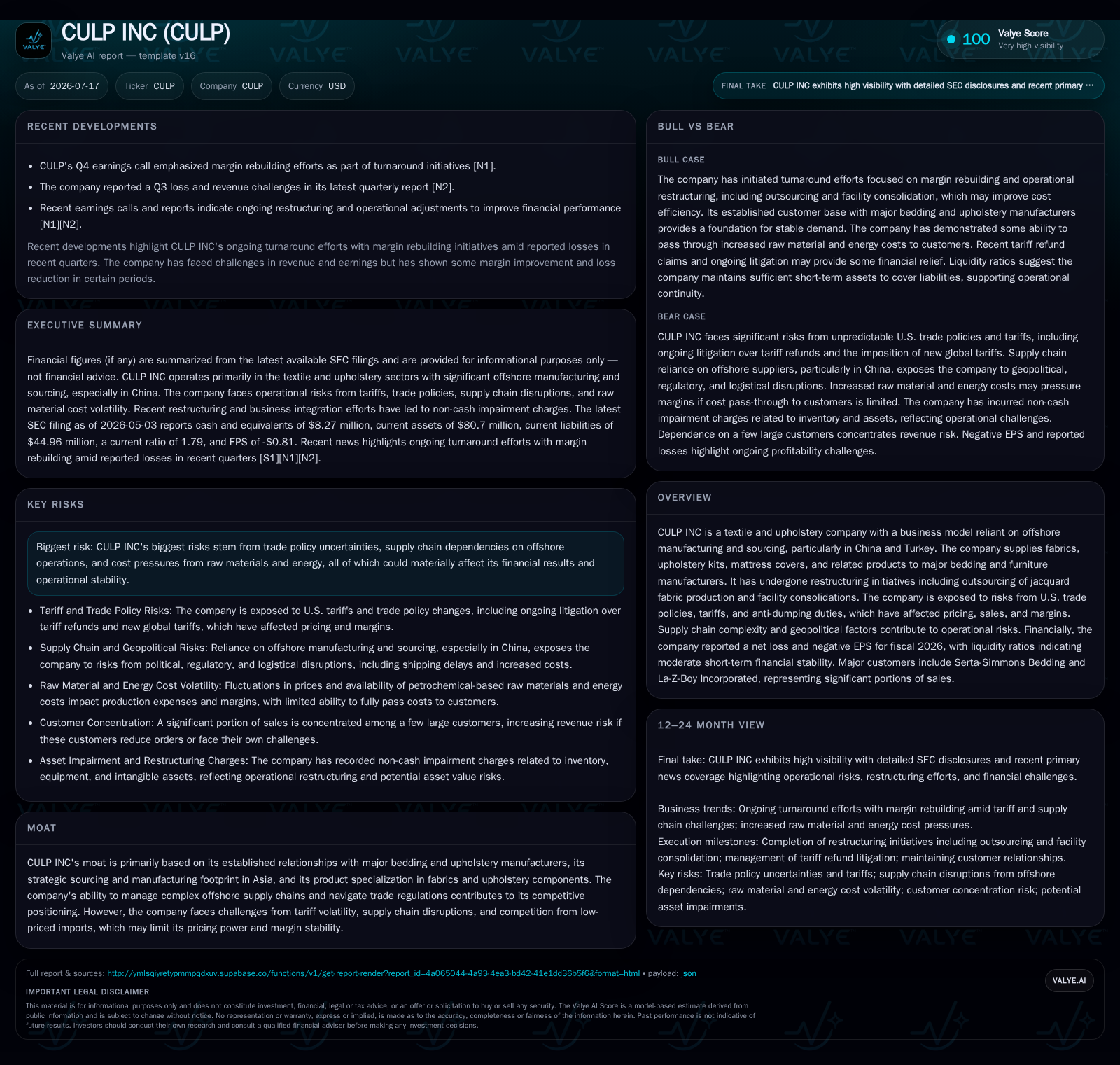
CULP INC, a midstream textile and upholstery supplier primarily to bedding and furniture manufacturers, faces continued margin challenges driven by tariff volatility and energy price fluctuations even as it completes a strategic transformation to integrate bedding and upholstery segments. The company relies heavily on offshore manufacturing in China, Turkey, and Vietnam for fabrics and mattress components, making trade policy shifts material risks. Ongoing restructuring, including facility consolidations in North America and expanded sourcing offices in Asia, aims to improve operational efficiency and supply chain resilience. Despite these moves, customer concentration risk persists with major clients like Serta-Simmons Bedding and La-Z-Boy. Financially, Culp reported an operating loss in fiscal 2026 but maintains moderate liquidity with a current ratio near 1.8 and manageable net debt.
Recent Operating Update
CULP INC’s latest quarterly filing as of March 13, 2026 ([S2]) confirms completion of its strategic transformation announced in April 2025 aimed at integrating its bedding and upholstery segments into a unified operational model. This involved consolidating manufacturing sites—closing the Quebec knitting/weaving facility while relocating operations to Stokesdale, North Carolina—and merging distribution activities from leased North Carolina sites into owned premises. Additionally, mattress cover production in Haiti was consolidated into a single building to reduce overheads. The company's apparel upholstery operations continue across Stokesdale (U.S.), Shanghai (China), and notably Vietnam through Culp Fabrics Vietnam Limited, which opened an office/showroom enhancing sourcing diversification.
Shortly thereafter, the July 1, 2026 Form 8-K reiterates financial results for the fiscal year ended May 3, 2026 ([S3]). Despite restructuring efforts aimed at efficiency gains, Culp faced persistent headwinds stemming primarily from volatile U.S. trade policies resulting in tariff impositions on imported textiles under statutes subject to ongoing legal challenge. The February 2026 Supreme Court decision struck down tariffs enacted under the IEEPA but was followed immediately by new global tariffs under different authority. Culp has filed claims for refunding approximately $7 million paid under now-invalidated tariffs; full receipt was recorded in Q1 fiscal 2027 though litigation continues around retention rights of such refunds.
This dynamic tariff environment compelled the company to increase product prices but met resistance as customers faced their own market pressures. Consequently, gross margins were squeezed during rising production costs worsened by sharp spikes in energy expenses during the latter part of fiscal 2026 ([S1]). The uncertain regulatory landscape complicates both enterprise cost forecasting and customer negotiations.
Business Model
CULP INC operates as a midstream textile manufacturer and strategic fabric sourcer specializing in upholstery fabrics, mattress covers, jacquard fabrics, and value-added upholstery kits sold primarily to major bedding manufacturers (e.g., Serta-Simmons Bedding) and furniture producers (e.g., La-Z-Boy Incorporated). The company’s business is structured around sourcing raw or semi-finished textile products offshore—in China, Turkey for jacquard fabrics—and finishing or assembling these components domestically or nearshore (North Carolina) before delivery to customers.
Revenue depends largely on order volume from these industrial customers under negotiated contracts which are influenced by fabric quality demands, end-market trends in residential/commercial furniture demand, pricing pass-through capability amid input cost volatility, and capacity utilization of manufacturing facilities. Profitability hinges on tight supply chain management given exposure to fluctuating raw material prices (cotton blends), labor rates overseas growing due to wage inflation pressures ([S1]), tariffs affecting landed cost inputs, energy usage spikes especially for weaving/finishing processes ([S1]), plus inventory turnover efficiency.
Product specialization—particularly in jacquard fabric technology—and longstanding customer relationships act as competitive moats providing some pricing leverage despite intense competition from lower-cost textile importers globally. Nonetheless, the company’s heavy reliance on a handful of large clients magnifies revenue risk should those relationships falter.
Industry Structure & Competitive Position
The textile manufacturing sector serving upholstery and bedding markets is capital intensive with significant operational complexity due to global sourcing demands balancing quality control against cost containment. Within this context, Culp shares industry characteristics with vertically integrated peers like Mohawk Industries who combine fabric production with downstream flooring products or Leggett & Platt that operate upstream component sourcing at scale.
CULP’s offshore siting in China—with expansion into Vietnam—and use of Turkish suppliers align with common industry strategies seeking access to skilled labor pools at competitive rates while managing geopolitical trade risks via geographic diversification.
Compared with fully integrated competitors that may own yarn/dyeing facilities or finished goods assembly plants abroad directly controlling end-to-end logistics chains, Culp leans more heavily into outsourcing portions of its value chain (e.g., weaving transitioned fully to sourcing partners). This reduces fixed asset burden but can constrain margin improvement if cost pass-through ability wanes amid tariff escalations or competitive pricing pressure.
Its ongoing restructuring—including the shuttering of leased U.S. distribution premises—is consistent with peers streamlining operations post-pandemic supply-chain disruptions aiming for higher capacity utilization ratios at fewer sites.
Growth Drivers
Several factors underpin growth opportunities:
- Demand Expansion: Increases in residential furnishing spend coupled with growth in hospitality/commercial furniture boosts demand for high-quality upholstery fabrics and mattress covers.
- Strategic Sourcing Footprint: Establishing offices like the Vietnam showroom expands access to diversified Asian suppliers enhancing supply stability critical amid geopolitical tensions.
- Product Innovation: Continued investment in specialized jacquard fabrics caters to premium market segments potentially improving average selling prices.
- Operational Efficiency: Completion of segment integration aims at overhead reduction driving margin recovery despite top-line pressures.
- Reshoring/Facility Consolidation: Aligning domestic capacity closer improves lead times benefiting customers sensitive to just-in-time inventory models.
Monitoring order backlog levels post-integration will be crucial confirmatory KPIs reflecting successful customer adoption of new production footprints [N1]
Risks & Constraints
Key risks centered on:
- Tariff & Trade Policy Uncertainty: The unpredictable U.S. trade environment materially affects material input costs; sudden tariffs or reciprocal duties can disrupt planning.[S1]
- Supply Chain Complexity/Risk: Dependence on Chinese manufacturing exposes Culp to geopolitical tensions; diversification while beneficial introduces complexity.[S1]
- Raw Material & Energy Cost Volatility: Sharp increases in cotton prices or oil-based energy inflate production expenses reducing gross margins if cost pass-through is incomplete.[S1]
- Customer Concentration: Heavy reliance on few large clients raises vulnerability from any contract losses or order slowdowns.[S1]
- Labor Cost Inflation Overseas: Wage increases abroad could erode offshore cost advantages undermining competitive positioning.[S1]
- Competitive Pressure: Low-cost imports challenge pricing power necessitating continuous product differentiation or operational excellence.[S1]
- Restructuring Execution Risk: Cost savings depend on smooth facility transitions; missteps could raise expenses transiently or damage customer service.[S1]
These factors require vigilant working capital management given receivables cycles typically extended by industrial customers combined with inventory holding linked to long lead times overseas.
What To Watch Next
For validation points ahead:
- Quarterly earnings updates reflecting gross margin trajectory post restructuring completion indicate pricing power restoration or ongoing cost pressure impact.
- Order book depth and renewal rates among top customers Serta-Simmons Bedding / La-Z-Boy will signal retention strength amidst market turbulence.
- Progress in tariff litigation outcomes potentially influencing cash flow via refunded duties.
- Further diversification progress across Asian sourcing footprint including Vietnam office development demonstrating reduced China dependency performance metrics.
- Inventory turnover improvement tied to lead time reductions following facility consolidation plans execution.
- Any upward movement in energy cost exposure requiring revised pricing strategies or hedging approaches.
Industry peers’ disclosed results about similar reshoring or sourcing portfolio adjustments can provide comparative context vis-à-vis Culp’s execution effectiveness.
Financial Profile Discussion
CULP reported an operating loss of approximately $7.2 million for fiscal 2026 ending May 3 ([F1]), continuing a period of margin compression influenced heavily by elevated tariffs and raw material/energy costs detailed above ([S3]). Net sales declined compared to the prior year’s $213 million level reflecting both pricing headwinds limiting volume gains and intermittent customer demand softness ([F1],[S3]).
On the balance sheet front as of May 3, 2026 ([F1],[S2]), the company maintains:
- Cash & equivalents: $8.27 million
- Total current assets: ~$80.7 million
- Current liabilities: ~$44.9 million Resulting in a current ratio near 1.79 indicating moderate short-term liquidity cushion allowing operational flexibility despite ongoing restructuring outlays.
Total debt approximates $7 million with an estimated net cash position after factoring cash balances ([F1]) which reduces financial leverage concerns typical for capital-intensive textile manufacturers maintaining working capital-heavy operations.
This analysis synthesizes the latest SEC disclosures paired with industry context reflecting Culp Inc.’s current operational challenges dominated by tariff dynamics alongside structural actions undertaken toward margin restoration through business integration. The company operates within a complex global value chain prone to policy shocks yet leverages product specialization plus deep customer relationships as partial defenses against intensified competition.
The ability to navigate evolving trade environments while executing its reshaping program will be critical markers determining whether Culp can stabilize its earnings profile going forward.
Disclaimer: This is research-only, informational analysis and not investment advice. It may include AI-generated interpretation and general industry context. Always verify important details using primary sources.

Comments