
Winning Catering Group's Transition to a Shell Company Amid Asset Distribution and Planned Merger
The company has divested its real estate assets, becoming a shell entity pending a merger that will redefine its business focus.
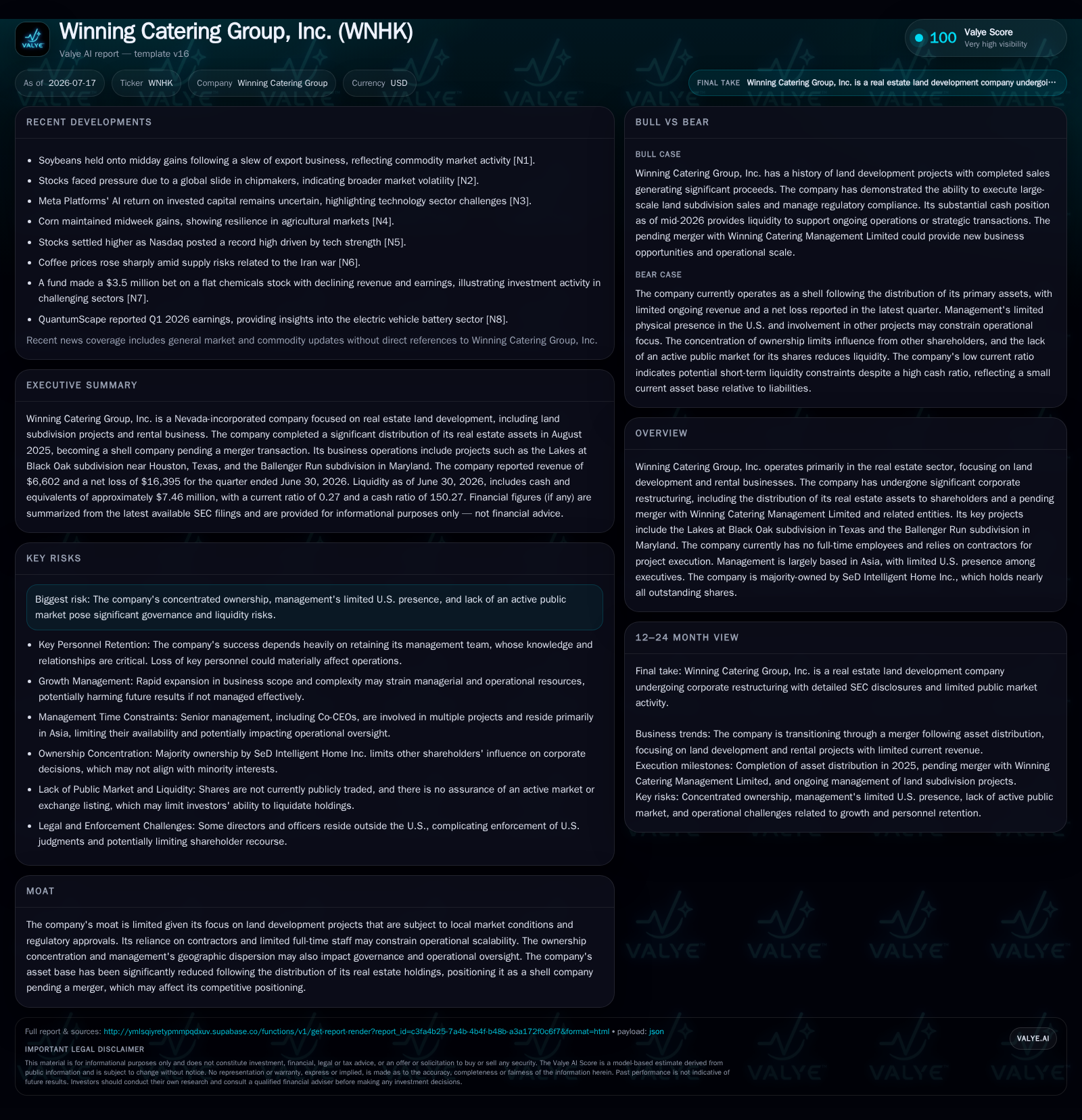
Winning Catering Group, Inc. completed a strategic restructuring by distributing nearly all its real estate assets to shareholders in August 2025, effectively converting into a shell company pending a reverse merger with Winning Catering Management Limited. Historically focused on land development projects in Texas and Maryland, the company now operates without full-time employees, relying on contractors, while management’s primary base in Asia introduces governance and oversight challenges. The upcoming merger will shift majority ownership to Winning Holdings Limited, signaling a new operational direction.
Recent Operating Update
This marks a strategic pivot from active land development toward preparing for new business operations through the merger agreement executed in May 2025 [S1]. Post-merger, Winning Holdings Limited is expected to hold approximately 80% ownership of the combined entity [S1]. This transaction aims to inject fresh operational capabilities and reposition Winning Catering’s business focus.
Business Model
Historically, Winning Catering operated primarily in residential land subdivision development with projects such as Lakes at Black Oak in Montgomery County, Texas and Ballenger Run in Frederick County, Maryland [S1], [S7]. Revenue generation depended largely on acquiring raw land parcels, securing zoning approvals, developing subdivisions, and selling individual lots under fixed-price contracts supplemented by community enhancement fees collected from buyers [S7]. The company also generated ancillary rental income through model home leases designed to showcase properties during construction phases – for example under lease and construction agreements with Davidson Homes LLC at Lakes at Black Oak where rental income was structured as a fixed percentage of construction costs plus contractor fees [S1], [S7].
Operationally, the firm maintained a lean internal workforce. As of December 31, 2024 it employed six full-time employees but by end-2025 had no full-time staff remaining, instead relying entirely on external contractors for project management and regulatory compliance tasks [S1], [S20]. This contractor-dependent model reduces fixed costs but introduces risks related to execution oversight especially given geographic dispersion.
Following the August 2025 asset distribution, Winning Catering ceased direct ownership of significant land holdings [S1]. The company now functions effectively as a holding or shell vehicle pending completion of the planned merger that will introduce new business activities
Industry Context and Competitive Positioning
Winning Catering’s original focus lies within residential land subdivision development—a capital-intensive sector requiring expertise in land acquisition costs management, regulatory approvals for zoning and environmental compliance, contractor coordination for construction phases, and marketing/sales execution to achieve desirable lot pre-sales uptake rates. Peers include large-scale homebuilders with integrated land acquisition such as D.R. Horton or Lennar Corporation as well as regional developers focusing on select markets.
Compared to these peers who often maintain robust internal teams for tighter margin control and risk mitigation, Winning Catering’s reliance on contractors combined with minimal internal staffing potentially increases execution risk around project timelines and cost overruns. Moreover, governance is complicated by management’s primary residence in Asia rather than proximate U.S. markets where projects are located (Texas/Maryland), limiting onsite oversight and responsiveness to local regulatory dynamics [S1], [S27].
Control is further concentrated with SeD Intelligent Home Inc., which owns virtually all outstanding shares pre-merger. This ownership concentration limits minority shareholder influence on corporate governance decisions including board composition or strategic direction [S24], [S27].
Growth Drivers Prior to Restructuring
Before transitioning into a shell entity, growth prospects were tied to typical real estate development drivers: accelerating lot sales uptake rates in suburban communities; obtaining timely municipal zoning approvals; leveraging favorable local housing demand trends; acquiring strategically located tracts suitable for subdivision; and generating incremental revenue from community enhancement fees embedded in sales contracts.
The Lakes at Black Oak subdivision demonstrated this capability by converting raw land into sellable residential lots generating multi-million dollar proceeds over multiple closings during 2023-2024 [S7]. Similarly, Ballenger Run near Frederick was approaching full build-out with all lots sold prior to the asset contribution event [S1].
However, these growth engines were effectively suspended following the August 2025 distribution when substantial assets exited the company’s balance sheet.
Risks and Watchpoints
Several risks arise from this transitional phase:
- Shell Company Status: Without operational assets or employees since August 2025 distribution until merger completion, sustaining enterprise value depends heavily on successful transaction closing and subsequent business injection.
- Ownership Concentration: Near-total control by SeD Intelligent Home Inc. restricts minority stockholder influence over strategic decisions or governance matters.
- Geographic Dispersion: Key executives residing overseas limit frequent site visits or local engagement with regulatory authorities critical for timely project execution.
- Staffing Void: Absence of full-time employees increases reliance on contractors whose performance variability may affect future integration or new operations.
- Regulatory Exposure: Past projects depended on complex zoning permits subject to delays; any re-entry into development would require renewed environmental compliance efforts.
- Market Liquidity: Shares currently lack an active trading market; shareholder liquidity remains constrained absent exchange listing or renewed investor interest post-merger announcement.
- Merger Execution Risk: Integration complexities may arise aligning legacy shell status with incoming operational mandates from Winning Group.
What To Watch Next
Key developments investors should monitor include:
- Closing timeline and terms of reverse merger with Winning Catering Management Limited that will reestablish operational activities and majority ownership by Winning Holdings Limited (~80%) [S1].
- Post-merger strategic plans regarding capital deployment priorities—whether re-engaging in real estate development or pivoting sectors.
- Any announcements regarding rehiring or expansion of internal staffing indicating return toward operating capacity.
- Updates on contractor engagements during transition period reflecting continuity or scale-down of project support.
- Regulatory filings disclosing new asset acquisitions or project pipelines post-merger signaling growth trajectory.
- Changes in board composition reflecting governance adjustments aligned with new shareholder base.
Financial Profile Discussion
Overall financial condition corroborates the company’s status as a non-operating shell entity pending new business infusion through the forthcoming merger.
Disclaimer: This is research-only, informational analysis and not investment advice. It may include AI-generated interpretation and general industry context. Always verify important details using primary sources.

Comments