
OKYO Pharma Advances Urcosimod with FDA Endorsement Amidst Financial and Clinical Milestones
Positive FDA feedback accelerates OKYO Pharma's path to Phase 3 pivotal trials while balance sheet and R&D dynamics shape near-term outlook.
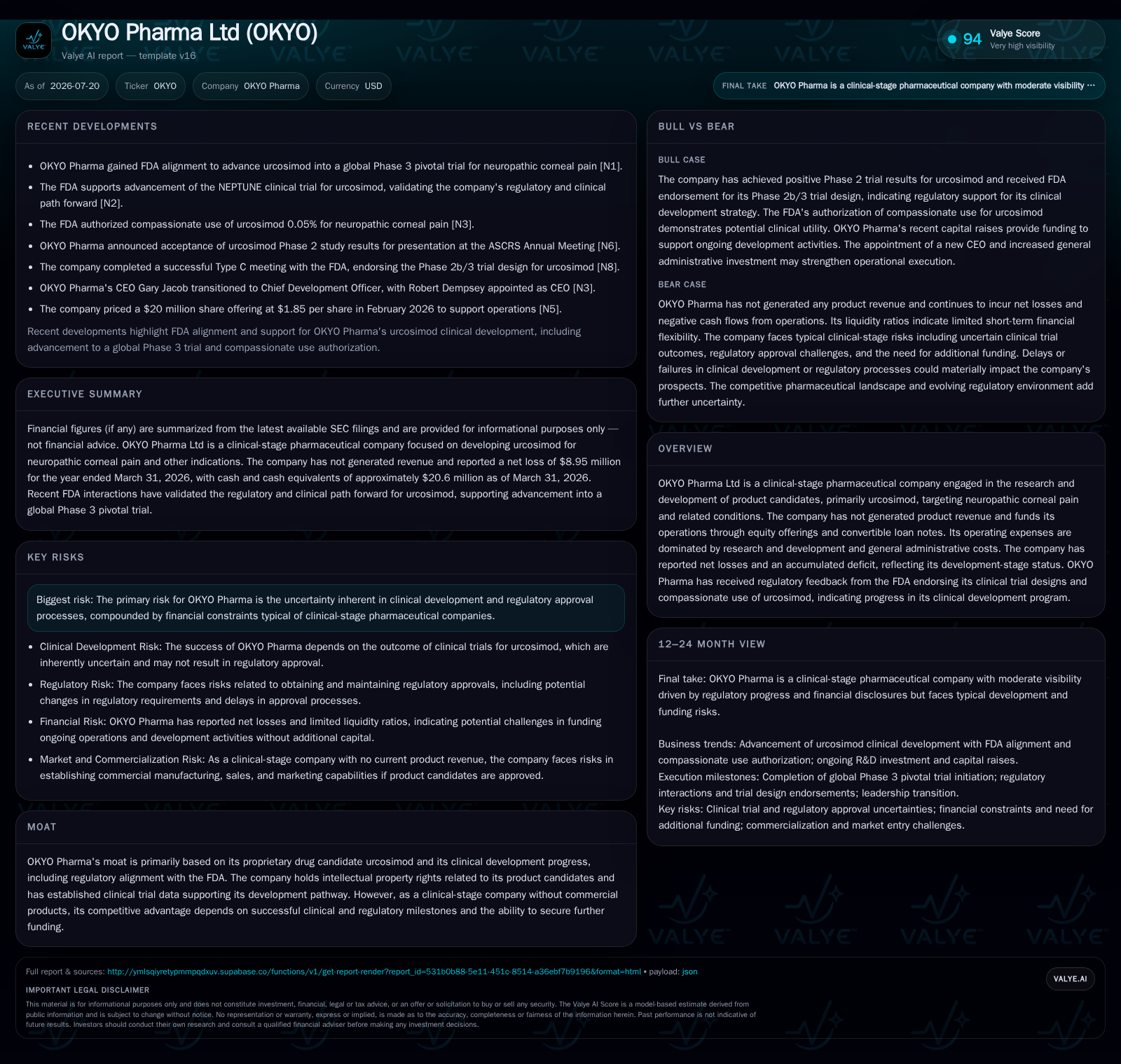
OKYO Pharma Ltd, a clinical-stage biopharmaceutical company focused on its lead candidate urcosimod for neuropathic corneal pain, recently secured favorable regulatory feedback from the FDA validating its clinical and regulatory approach. The company is progressing toward a global Phase 3 pivotal trial, reflecting advancement in its clinical pipeline. While operating losses persist and R&D costs have moderated after earlier heightened investment, OKYO’s cash position and recent equity raises provide runway supporting upcoming development activities. The company’s value proposition hinges on successful completion of late-stage trials and securing marketing approvals amid sector-standard clinical and funding risks.
Recent Operating Update
OKYO Pharma’s most recent filings revealed significant progress on its lead drug candidate urcosimod. In early July 2026, the company announced positive feedback from a U.S. FDA Type D meeting affirming that the agency supports the design and regulatory pathway of its planned global Phase 3 pivotal trial targeting neuropathic corneal pain (NCP) [S3][N1][N2]. This endorsement is crucial as it reduces regulatory uncertainty and validates OKYO’s strategic clinical development plan, signaling readiness for advanced-stage testing that could form the basis for future marketing approval applications. The company's July 20, 2026 quarterly filing reiterated this momentum while providing an updated corporate overview emphasizing ongoing clinical progression alongside financial stewardship [S2][S1].
This near-term milestone drives the company's transition from mid-stage proof-of-concept studies into large-scale confirmatory trials necessary for commercialization viability. Given that neuropathic corneal pain represents an underserved indication with limited approved treatments, successfully advancing urcosimod through these phases could create a differentiated market niche.
Business Model and Product Focus
OKYO Pharma operates as a clinical-stage biotechnology firm without current product revenue. Its business model centers on research and development (R&D) of proprietary therapeutic candidates—primarily urcosimod—targeting neuropathic corneal pain symptoms not adequately addressed by existing care options [S1]. Revenue generation is contingent upon successful regulatory approvals translating into commercial product launches. Until then, the company funds operations through equity financings, convertible loan notes, and potentially strategic partnerships or licensors.
Revenue mechanics are straightforward: without commercial products, income stems mainly from capital raises rather than product sales. R&D expenditures drive operating losses but are investments fueling long-term value creation if clinical milestones are met. Regulatory submissions require preparation of extensive data packages necessitating considerable financial resources for trial execution plus related manufacturing scale-up efforts.
Operating expenses bifurcate primarily into R&D costs and general & administrative overheads. R&D costs include fees paid to contract research organizations (CROs), contract manufacturing organizations (CMOs), investigative sites conducting trials, employee-related expenses tied to scientific personnel, compliance activities, facilities costs, as well as licensing fees for in-licensed intellectual property [S1][S12][S14]. Administrative costs encompass corporate governance functions such as legal services linked to capital raises, recruitment of executives needed to scale operations ahead of commercialization phases, share-based compensation expenses reflecting incentivization schemes for staff retention, and investor relations campaigns enhancing public profile post-IPO.
Industry Structure and Competitive Position
As a clinical-stage biotech entity positioned in the early-mid pharmaceutical development value chain segment, OKYO Pharma undertakes discovery through pivotal human trials but has not yet commercialized any medicines. Peers comprise other small-to-mid cap biotechs specializing in neuropathic pain or ophthalmology indications with drug candidates progressing toward FDA approval phases.
Regulatory alignment with the FDA is particularly critical here; securing clear guidance reduces trial redesign risk common among peers who often face protracted review cycles threatening timelines [S1]. The proprietary nature of urcosimod and associated patents forms a core part of OKYO's competitive moat. While differentiation depends heavily on successful late-stage efficacy/safety demonstration against both placebo-controlled baselines and standard-of-care comparators, this strong IP base offers some barrier against generic competition if marketing authorization ensues
Substitutes include alternative modalities addressing nerve pain symptoms but may lack focused action at corneal nerve pathways targeted by urcosimod's mechanism. However, market adoption post-launch will face hurdles typical in specialty indications: physician education efforts required to shift prescribing habits; payer acceptance pending health economics validations; manufacturing scale-up challenges ensuring quality supply; plus eventual competitive entrants.
Growth Drivers
The primary growth catalysts for OKYO Pharma revolve around successful progression through its clinical pipeline milestones:
- Completion of Phase 2/early human studies with robust safety/tolerance data enabling pFDA endorsement.
- Initiation and rapid enrollment into pivotal Phase 3 NEPTUNE trial targeting NCP patients globally.
- Positive interim/final efficacy readouts demonstrating meaningful symptom relief compared with current standards.
- Potential expansion into additional indications where neuropathic corneal pain is prevalent.
- Building out strategic alliances or licensing agreements to augment commercialization resources or widen geographic reach.
- Continued reinforcement of intellectual property portfolio through new patents or technology acquisitions.
- Scaling corporate infrastructure appropriately to support later-stage transactional complexity including manufacturing readiness.
Evidence thus far indicates the Company has contained recent R&D expense run rate after concluding higher-cost dry eye disease trials while redirecting focus on NCP-focused smaller sample size enrollments [S12][S14]. Regulatory dialogue confirming pivotal trial design invigorates prospects for accelerated development timelines [S3].
Risks and Watchpoints
OKYO faces several inherent risks typical of clinical-stage pharma companies:
- Clinical Development Risk: Late-stage failure or unanticipated safety issues during Phase 3 can abruptly halt progress despite prior positive signals.
- Regulatory Delays: Prolonged FDA review cycles or unexpected requirements could push timelines out substantially beyond investor expectations.
- Financial Sustainability: Despite recent capital raises netting over $25 million in fiscal year ended March 2026 [S21], ongoing cash burn exceeds operating inflows requiring further fundraises risking dilution or unfavorable terms.
- Patient Recruitment: Achieving target enrollment rates in specialized indications like NCP remains challenging impacting trial timing/costs.
- Manufacturing Scale-up: Transitioning from small-scale investigational batch production to regulated commercial supply involves technical hurdles potentially affecting launch readiness.
- Market Adoption Uncertainties: Post-approval uptake depends on efficacy relative to existing off-label practices plus reimbursement environment that continues evolving for novel orphan-like indications.
- Intellectual Property Risks: Potential disputes or expiration without timely innovation renewal could erode competitive barriers limiting revenue tail.
- Operational Scalability: Expansion in personnel and infrastructure places pressure on G&A expenses which have already increased materially with newly hired executives and elevated legal/public relations spend [S12].
Monitoring these risk factors will be essential alongside tracking trial enrollment speed, interim data availability timelines once initiated, cash runway sufficiency beyond fiscal projections encompassing both development outlays plus anticipated commercialization capabilities buildout [S10][S21][S29]
What To Watch Next
Critical upcoming events include:
- Official initiation date announcement of the global Phase 3 NEPTUNE study per FDA guidance.
- Interim readouts or safety updates revealing tolerability profile consistency with earlier stages.
- Additional regulatory interactions clarifying submission expectations potentially including accelerated pathways given unmet medical need designation possibilities.
- Quarterly financial updates disclosing net cash position trends post recent equity financing along with adjusted operational expense guidance reflecting scaling plans.
- Pipeline expansion news regarding new candidate asset disclosures or licensing deals broadening product diversity beyond urcosimod.
These milestones represent tangible markers validating execution capability towards transitioning OKYO from developmental stage toward potential commercial enterprise status with reduced regulatory risk premiums increasing strategic optionality around partnering/licensing structures fitted for globalization ambitions.
Financial Profile Discussion
Overall, OKYO’s financial framework suits a high-burn biotech ecosystem investing heavily ahead of key regulatory inflection points yet will require vigilant cash management combined with fundraising discipline until commercial revenues materialize significantly post-marketing approval events.
This analysis is based solely on publicly available SEC filings dated through July 20, 2026 as well as validated news releases without speculative commentary or investment advice.
Disclaimer: This is research-only, informational analysis and not investment advice. It may include AI-generated interpretation and general industry context. Always verify important details using primary sources.

Comments