
Jingbo Technology’s VIE Model and Regulatory Risks Shape Its Industrial Hardware Platform Growth Challenges
Jingbo Technology operates in China’s industrial hardware and tech solutions sector via a VIE structure amid liquidity pressures and evolving regulatory demands.
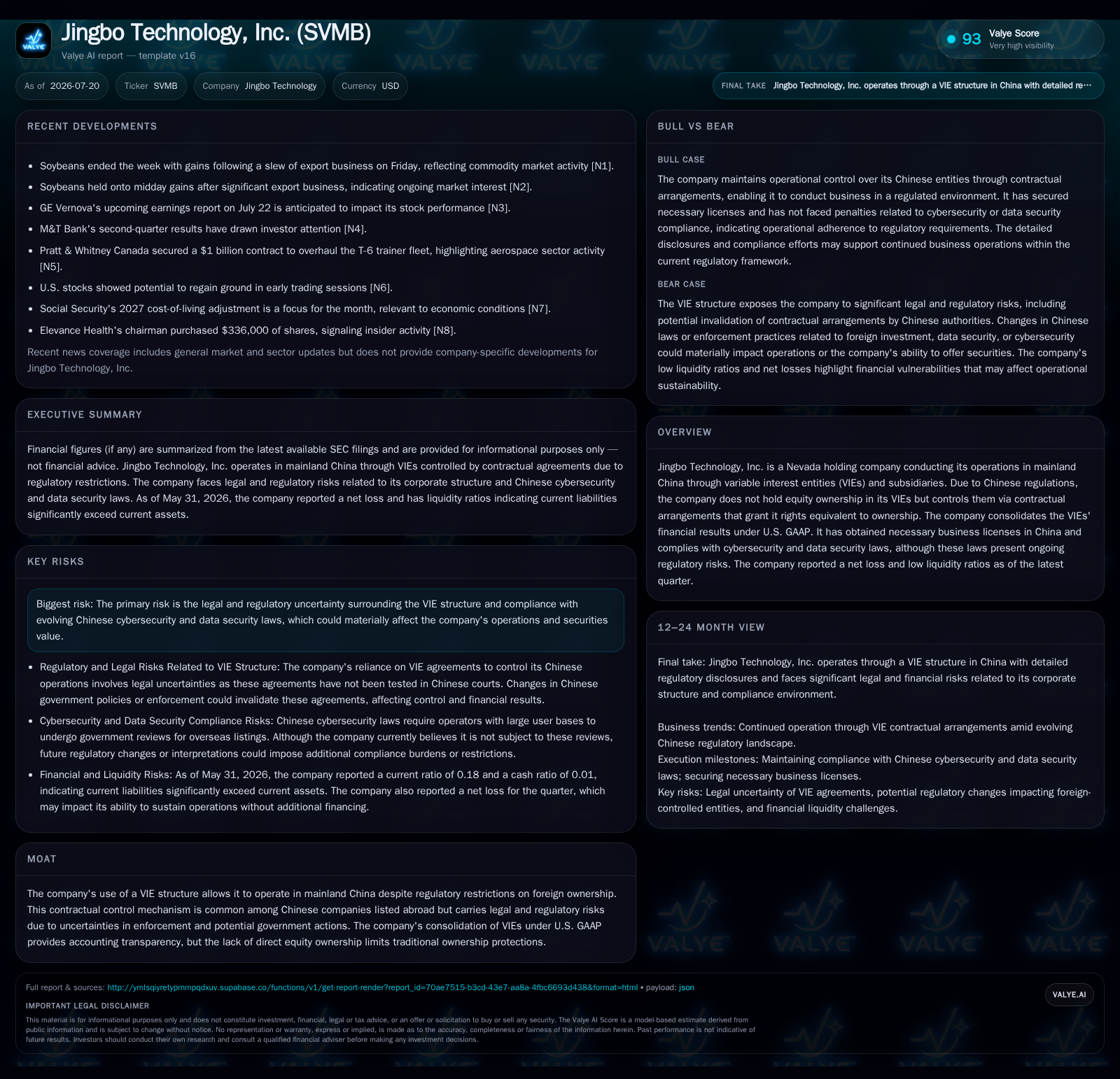
Jingbo Technology, Inc. leverages a variable interest entity (VIE) structure to conduct its technology platform services—including smart parking hardware integration and cloud software—in mainland China. While this model enables operation under China’s foreign ownership restrictions, it carries substantial regulatory risks that cloud the sustainability of the company’s operating control. Financially, Jingbo reports ongoing net losses and low liquidity, with a constrained current ratio of 0.18 highlighting cash flow pressures. The company’s revenue fundamentally depends on a mix of hardware sales and recurring service fees derived through contractual arrangements with its consolidated VIEs. Key industry drivers for growth include expanding smart city infrastructure and platform user base development, but these are challenged by the uncertain regulatory environment, compliance cost burdens, and capital constraints. Monitoring user contract renewal rates, software platform adoption, and Chinese regulatory enforcement actions will be critical to assessing future operational durability.
Recent Operating Update and Its Implications
Jingbo Technology’s latest quarterly filing dated July 20, 2026 [S2] confirms ongoing operational challenges marked by a net loss of approximately $6.7 million [F1] and an operating loss exceeding $6.5 million [F1]. These figures underscore the company’s continued unprofitability even as it pursues growth initiatives centered on smart parking technology platforms integrating hardware products with software services. The filing also reveals severe liquidity stress: cash reserves are about $107k against current liabilities above $12 million as of May 31, 2026 [F1], implying a dangerously low current ratio of 0.18 [F1]. This liquidity constraint limits near-term operational flexibility and capital allocation options.
Understanding this financial backdrop is critical because Jingbo relies heavily on its contractual control over mainland Chinese VIEs to generate revenue and conduct operations [S1]. Since it cannot directly own equity in its operating entities due to Chinese foreign ownership regulations for telecommunications-related businesses, Jingbo controls these entities via VIE agreements that grant economic benefits equivalent to ownership without formal shareholding [S1]. This complex arrangement allows it to consolidate VIE financials under U.S. GAAP but introduces legal risk given uncertainties around enforcement under Chinese law.
Business Model: Contractual Control Under VIEs Drives Revenue Mix
Jingbo operates primarily through two WFOEs (Wholly Foreign-Owned Enterprises) — Huixin WFOE and Keqiao WFOE — which hold contractual rights over multiple VIE entities specializing in smart parking technologies, cloud platforms, and hardware integration solutions [S1][S10]. Revenue streams comprise sales of parking lot hardware systems—such as cameras capable of license plate recognition—and the provision of cloud-based data platforms supporting high throughput processing capabilities reaching billions in data units [S1]. Alongside product sales, recurring fees arise from software licenses providing service access via proprietary platforms reportedly upgraded dynamically through one-key hot upgrades without requiring onsite hardware changes [S1]. This hybrid monetization model aligns with typical industrial hardware-tech solution archetypes where integrated physical products serve as entry points complementing higher-margin software platform subscriptions and maintenance contracts.
Importantly, Jingbo’s revenue generation depends heavily on the effectiveness of these VIE contractual arrangements since all operational income flows through mainland Chinese entities controlled not by direct equity but contractual rights [S1]. Should these contracts be challenged or rendered ineffective by regulatory shifts or shareholder actions within China, Jingbo would lose operational control and economic benefits—a principal risk factor intimately tied to its value proposition.
Industry Structure and Competitive Positioning
Jingbo competes within the expansive industrial hardware and technology solutions sector marked by players specializing in IoT-enabled devices, integrated software platforms for industrial automation, intelligent transportation projects, and cloud infrastructure services. Its niche focus on smart parking ecosystems positions it downstream in the value chain as both a system integrator deploying physical devices (e.g., license plate recognition cameras) paired with cloud service operators managing data processing capacity and analytics.
Peer companies range from domestic Chinese leaders like Hikvision and Dahua—large-scale providers of video surveillance equipment coupled with AI-powered analytics—to global conglomerates such as Honeywell or Siemens offering broader end-to-end automation suites that combine robust hardware portfolios with advanced digital operations management. Meanwhile, cloud platform providers including Alibaba Cloud or AWS underpin the infrastructure tier but do not directly compete at the device or application layer.
Jingbo faces competitive pressure due to scale disparities; Hikvision for example enjoys extensive market penetration backed by large R&D budgets supporting continuous product upgrades—a crucial advantage in fast-evolving IoT ecosystems. Moreover, Jingbo's reliance on third-party hardware interoperability arrangements rather than proprietary device manufacturing could challenge its differentiation unless offset by superior software ecosystem development or regional customer intimacy.
Growth Drivers: Smart City Expansion Meets Digital Transformation Trends
Industrial digitization trends favor companies like Jingbo offering integrated solutions combining physical infrastructure with software-enabled management. The rapid growth of smart city initiatives across China—including intelligent parking projects embedded into urban planning frameworks—constitutes a strategic growth vector for Jingbo’s offerings [S14]. Such projects demand scalable cloud data processing platforms capable of handling massive real-time feeds while providing user-friendly interfaces for parking lot operators, end consumers, and municipal regulators alike.
In addition to public infrastructure deployments, Jingbo aims to grow its platform user base by establishing digital marketplaces connecting parking lot users with merchants within an ecosystem that drives cross-utilization of resources—effectively converting users into digital assets [S14]. Incentive programs targeting regional agents alongside vertical integration attempts into joint-operated parking lots are designed to accelerate user acquisition while increasing contract length stability—a key industry KPI indicating recurring revenue predictability.
Furthermore, incremental innovations in IoT sensor accuracy and AI-powered recognition technologies elevate the appeal of integrated hardware-software solutions versus standalone devices or generic cloud services. However, sustaining growth will hinge not only on technological relevance but also on navigating regulatory complexity around cybersecurity compliance, data privacy, cross-border data flows governed under recent Chinese laws enacted since 2017 [S21][S26]
Risks And Constraints: Regulatory Uncertainty And Capital Limitations
While Jingbo’s VIE structure permits operations restricted by foreign investment caps in foreign-owned entities providing value-added telecommunications services (VATS) in China [S1], it inherently exposes the company to material legal risks. These stem from potential government reinterpretation or enforcement actions that could invalidate contractual controls over operating subsidiaries or impose penalties affecting business continuity [S21]. Compliance with evolving cybersecurity regulations amplifies these risks; breaches or misinterpretations could result in suspension or termination of key licenses essential for operating digital platforms reliant on personal information storage or transmission [S21][S26].
On the financial side, the firm faces acute liquidity pressure evidenced by a razor-thin current ratio (<0.2) indicating an inability to cover short-term liabilities with available current assets [F1]. Such imbalance restricts operational investments needed for timely product upgrades or marketing campaigns vital for customer acquisition cost (CAC) reduction—a critical KPI supporting scalable growth models in platform ecosystems. Historical total debt exceeding $32 million further constrains capital flexibility absent sufficient cash flow generation or external financing events [F1].
Finally, competitive dynamics necessitate continuous R&D expenditure to maintain technology relevance; failure to keep pace risks obsolescence swiftly given the rapid innovation cycles prevalent among top-tier industrial tech players globally. Geopolitical tensions adding cross-border uncertainty further complicate capital access paths through overseas listings given new CSRC filing requirements introduced recently under Trial Measures effective March 2023 [S22][S28]
What To Watch Next: Milestones And Indicators For Operational Viability
Critical upcoming milestones encompass monitoring Jingbo’s ability to improve liquidity ratios through enhanced cash flow management or new funding sources disclosed in future quarterly reports [S2][F1]. Progress on upgrading platform features that increase active users measured by average revenue per user (ARPU) alongside higher contract renewal rates could signal durability of recurring service streams essential for margin improvement.
Equally important is observing company disclosures regarding compliance status updates related to the CSRC Trial Administrative Measures governing overseas-listed Chinese companies; any delays or adverse notices might foreshadow forced operational restrictions impacting their listing status or fundraising capabilities [S22][S26][S28]
Tracking competitive positioning relative to peers—particularly any announcements relating to technology partnerships with major cloud operators or enhancements in license plate recognition accuracy—can reveal whether Jingbo is bridging capability gaps versus incumbents like Hikvision or global system integrators.
Financial Profile Discussion
Jingbo Technology’s latest financial snapshot reveals persistent losses impacting equity levels negatively alongside strained liquidity conditions posing immediate solvency concerns [F1][S2]. Cash & equivalents stand at roughly $107k as of May 31, 2026—a minimal buffer against current liabilities totaling approximately $12.3 million resulting in a precariously low current ratio at 0.18 [F1], signaling acute short-term payment risk.
The company holds total debt approximating $33 million based on best available data from January 2023 records reflecting historic leverage pressures that likely constrain new borrowing abilities absent asset disposals or equity raises [F1]. Negative operating income beyond $6.5 million emphasizes ongoing cash burn associated with scaling operations amidst regulatory compliance costs typical in this sector segment characterized by high upfront investments in R&D plus marketing support services.
Going forward, sustaining positive free cash flow conversion remains essential. Metrics such as gross margin turnaround driven by improved hardware/software mix alongside recurring revenue expansion would materially aid deleveraging efforts—a trend frequently witnessed among peer integrated tech providers recovering from early loss phases.
This analysis reflects publicly available SEC filings as of July 20, 2026[S1][S2] combined with sector knowledge relevant to China's regulated industrial technology landscape.
Disclaimer: This is research-only, informational analysis and not investment advice. It may include AI-generated interpretation and general industry context. Always verify important details using primary sources.

Comments