
AI Era Corp.’s Leadership Shift and Strategic Investments Amid Liquidity Challenges
Recent executive transitions and financing highlight operational risks as AI Era expands its AI-driven SaaS platform and media ecosystem.
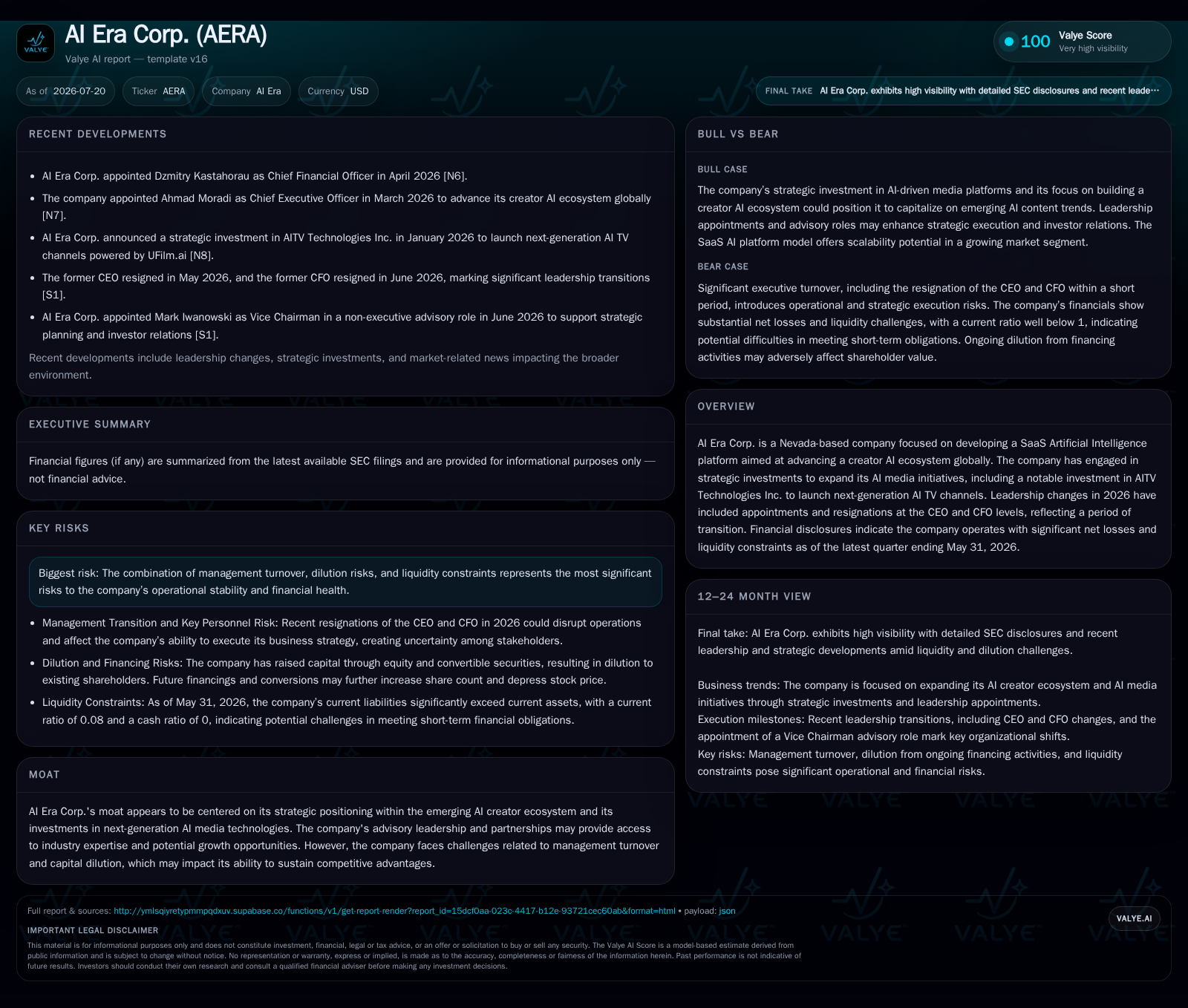
AI Era Corp. operates a cloud-based AI SaaS platform focused on empowering creator ecosystems with advanced content generation capabilities. The latest quarterly filing reveals significant executive turnover, including resignations of the CEO and CFO, creating near-term execution risks. Concurrently, the company is advancing strategic investments, such as in AITV Technologies, targeting next-generation AI TV channel development to broaden its platform ecosystem. Financially, AI Era faces severe liquidity constraints and a capital-intensive operating model with substantial dilution risks from ongoing convertible debt financing. Growth prospects hinge on successful management stabilization, ecosystem expansion, and improved capital structure.
Recent Operating Update
AI Era Corp.'s most recent quarterly filing for the period ending May 31, 2026, spotlights substantial leadership upheaval that materially affects near-term operational stability. The former CEO resigned on May 7, 2026, shortly followed by the CFO stepping down on June 3, 2026. These departures were noted without disclosed disagreements but present clear execution risk given their proximity and seniority [S2][S3]. To fill these vacancies amidst this transition, Chiyuan "Fred" Deng was appointed Interim CEO and CFO while continuing as President and sole director effective July 17, 2026 [S3]. This rapid reorganization signals urgency but also potential volatility in strategic decision-making.
Concurrent with leadership shifts, the company has actively pursued strategic investments to deepen its footprint in the emerging AI media content space. Notably, AI Era acquired significant equity interests in AITV Technologies Inc., a startup focused on launching next-generation AI-powered television channels globally. This investment fits into AI Era's broader ambition to foster an AI creator ecosystem combining software platform offerings with innovative media distribution channels powered by artificial intelligence algorithms [N3][S4].
Financial disclosures reveal acute liquidity strains: current liabilities stood at approximately $7.48 million versus current assets of roughly $0.58 million as of quarter-end—yielding a precariously low current ratio near 0.08 [F1]. This imbalance underscores imminent funding needs to sustain operations beyond short horizons.
Business Model
AI Era operates within the Software as a Service (SaaS) domain but differentiates itself through heavy integration of artificial intelligence targeted at creators developing digital content. The company’s SaaS offering is cloud-hosted and likely monetized via recurring subscription licenses augmented by usage-based fees reflecting consumption volumes or feature tiers—a standard revenue archetype in this segment. Its value proposition pivots on enabling scalable content generation augmented by proprietary AI models tailored toward interactive video and media applications.
Importantly, to extend the platform's reach beyond software licensing alone, AI Era has adopted an ecosystem strategy centered on strategic investments—such as those in AITV Technologies—to embed itself within adjacent markets like intelligent media production and distribution networks ([N3],[S4]). This hybrid model combines recurring software revenues with potential new income streams linked to AI-powered media ventures.
The company’s commercial model likely depends heavily on customer retention metrics (net retention rates), cross-selling AI modules or feature upgrades, and scaling active user seats—common KPIs that drive SaaS valuation yet remain undisclosed here [F1]. Capacity constraints are less relevant given cloud delivery; however, managing cloud infrastructure costs versus gross margin targets will be essential as usage scales.
Industry Structure and Competitive Position
AI Era sits at the platform layer within a fiercely competitive SaaS landscape that increasingly incorporates advanced artificial intelligence capabilities. Its peers range from pure-play SaaS AI platform providers facilitating content creation (e.g., emerging startups focusing on generative AI workflows) to more established enterprise vendors like Adobe or Salesforce broadening into AI-enhanced creative tools.
However, unlike broad enterprise software companies with entrenched ARR bases, AI Era’s emphasis on next-gen AI-driven media channels offers a potentially unique moat but also adds execution complexity outside conventional SaaS subscription dynamics. Its lack of disclosed ARR or retention metrics contrasts starkly with category leaders whose growth durability hinges on predictable recurring revenues and deep enterprise penetration.
Moreover, frequent management turnover exacerbates competitive pressure by impairing continuity crucial for innovation cycles inherent in software platforms reliant on evolving machine learning models. Liquidity constraints further limit ability to outspend or scale rapidly against better-capitalized incumbents [S2][S23]
Growth Drivers
Growth for AI Era derives from multiple vector paths aligned with broader industry tailwinds:
- Expanding adoption of AI-powered SaaS solutions across creator economies stimulates demand for scalable content-generation tools integrated within cloud platforms.
- Strategic investment partnerships enable geographic market expansion via innovative media products like AI TV channels that differentiate service offerings beyond vanilla SaaS licensing.
- Improvements in underlying AI model training techniques promise higher value delivered through enhanced content quality and user engagement.
- Rising global digital transformation initiatives push clients towards flexible subscription cloud solutions that eliminate on-premises dependencies.
- Network effects emerge as third-party creators join its ecosystem, potentially elevating monthly active users—though concrete engagement data is undisclosed.
These drivers collectively require execution discipline in scaling customer acquisition cost efficiencies (CAC) and shortening payback periods while enhancing net retention rates; however, no explicit public KPIs have been released so far [F1].[N3][S22]
Risks and Watchpoints
Key risks are tightly intertwined with management continuity challenges; executive departures introduce strategic execution uncertainty while shaking internal morale which could slow product rollout or ecosystem development [S23].
Capital structure risk looms large due to heavy reliance on convertible promissory notes issued at steep discounts (conversion at 80% of lowest trading prices) accompanied by interest accruing at ~10% annually—potentially accelerating dilution if conversions proceed [S19][S28]. Continuous equity issuance dilutes existing shareholders' stakes sharply and places downward pressure on share price due to supply increases.
Also critical are competitive pressures from larger tech incumbents investing heavily in comparable or superior generative AI SaaS platforms backed by more stable enterprises with established sales pipelines. Regulatory uncertainties around data privacy compliance related to automated content generation further add layers of complexity.
Execution risks extend to effective integration of strategic investments into the core platform ecosystem alongside timely delivery of innovative features underpinning customer acquisition and retention dynamics.
What to Watch Next
Investor focus should monitor key operational signals such as stabilization of the C-suite leadership team beyond interim appointments — specifically any announcements regarding permanent CEO/CFO hires that could restore strategic clarity [S3]. Tracking updates around deployment timelines for AITV Technologies’ next-gen TV channel projects will indicate whether strategic investments are converting into tangible revenue streams [N3]. Meanwhile, emergent disclosures of ARR growth rates, net retention rates, or reductions in customer churn would serve as concrete evidence of sustainable platform adoption gains.
On the financial front, watch for any refinancings or equity raises designed explicitly to improve near-term cash runway given existing coverage gaps between liabilities and liquid assets [F1]. Reduction in dilution intensity via renegotiated note terms or debt conversion balances would mitigate shareholder value erosion risks.
Financial Profile Discussion
As of May 31, 2026, AI Era presented precarious liquidity metrics: current assets approximated $577K against current liabilities over $7.48 million resulting in a woefully low current ratio (~0.08), flagging immediate working capital stress [F1]. The balance sheet reflects substantial short-term obligations unbalanced by readily available liquid resources—a classic sign of tight cash flow conditions threatening operational continuity absent fresh capital inflows.
Debt structure comprises multiple convertible promissory notes issued primarily during early 2026 totaling principal amounts ranging from roughly $50K to $150K each bearing 10% annual interest rates—with conversion rights at attractive discounts (80% floor pricing) [S19][S28]. This financing route reflects constrained traditional equity markets access albeit at high shareholder dilution risk if conversions execute fully while stimulating accumulated onerous interest burdens escalating effective cost of capital.
There is no reported operating income or positive net cash flow as recent filings underscore ongoing high burn typical for early-stage tech platforms investing aggressively in R&D and strategic expansions. Cash & equivalents stood at $20K end-2022 highlighting historical undercapitalization prior to these more recent fundraising rounds [F1].[N3]
In sum, financial health remains fragile pending capital market refinancing success alongside operational execution firming; cloud gross margins and eventual improvements in free cash flow conversion will be crucial future benchmarks beyond mere revenue growth figures which remain unpublished externally.
This analysis synthesizes publicly filed disclosures up to July 20, 2026. It does not constitute investment advice but aims to provide an informed perspective grounded in regulatory filings and sector context relevant to stakeholders assessing strategic direction within SaaS-based artificial intelligence platforms specializing in creator-driven ecosystems.
Disclaimer: This is research-only, informational analysis and not investment advice. It may include AI-generated interpretation and general industry context. Always verify important details using primary sources.

Comments