
Park Aerospace Accelerates Capacity and Innovation in Aerospace Composites
Park Aerospace reports robust Q1 2027 results reflecting strong demand for proprietary aerospace composites and strategic capacity expansion.
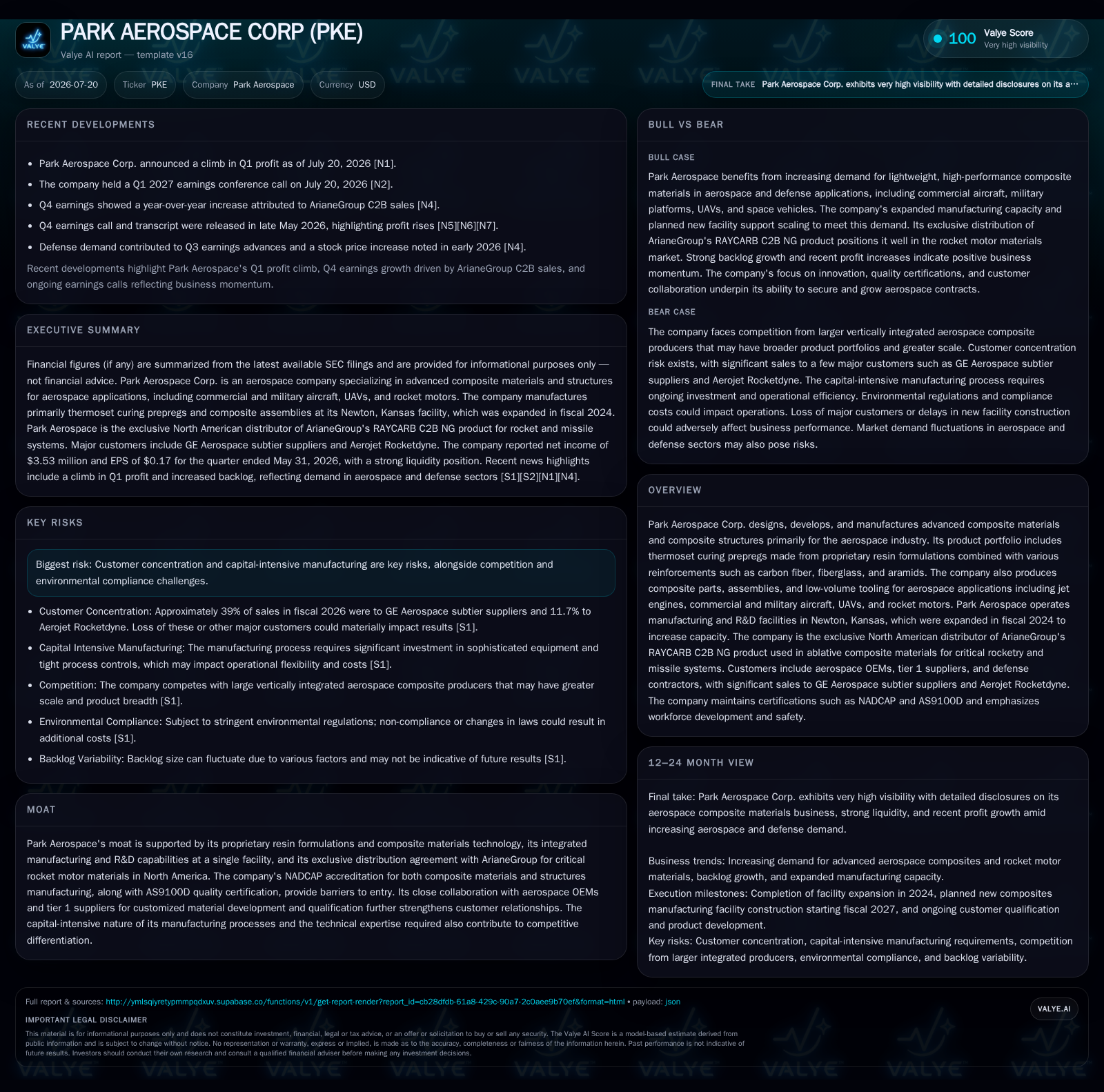
Park Aerospace Corp. posted a solid start to fiscal 2027 with operational momentum driven by increased demand for its proprietary advanced composite materials and structures serving aerospace OEMs and defense contractors. The company continues ramping up production capacity following its 2024 Newton, Kansas facility expansion and plans further investment in a new integrated composites plant expected to begin construction in fiscal 2027. Park benefits from exclusive North American distribution rights for ArianeGroup’s critical rocket motor ablative materials, NADCAP and AS9100D certifications that underpin quality and industry trust, and a customer base concentrated among leading aerospace engine and defense subcontractors. Key risks include customer concentration, capital intensity, and environmental compliance costs.
Recent Operating Update
Park Aerospace Corp. reported its fiscal 2027 first quarter results ending May 31, 2026, highlighting sustained operational momentum driven by strong demand for its proprietary aerospace composite materials and structures [S2], [S3]. The company’s backlog nearly doubled year-over-year to approximately $51.4 million in firm unfilled orders as of May 18, 2026, compared to $25.8 million the prior year, underscoring robust order intake and healthy demand visibility in aerospace markets [S10]. This backlog primarily comprises advanced composite materials, reflecting Park’s core product focus.
Operationally, Park is actively ramping production capacity following the completion of a major facility expansion in Newton, Kansas, in fiscal 2024. This expansion doubled manufacturing footprint and introduced enhanced hot-melt film and tape lines, upgraded resin mixing and delivery systems, expanded production and R&D laboratories, and additional freezer and storage capacity to support increased throughput [S1], [S21]. These upgrades improve manufacturing capacity utilization and production yield rates, key aerospace composites KPIs that influence delivery lead times and cost efficiency.
Further capacity growth is planned through construction of a new integrated composites manufacturing and development plant, targeting both commercial aircraft and defense composites markets [S1]. While the site is yet to be finalized, construction is expected to commence in fiscal 2027, signaling management’s commitment to capital investment aligned with anticipated aerospace production growth
Business Model Analysis
Park Aerospace operates as a specialized supplier of advanced composite materials and composite structures primarily to aerospace OEMs, tier 1 suppliers, and defense contractors. The company’s revenue model centers on selling proprietary thermoset curing prepregs formulated through in-house polymer chemistry expertise, combined with reinforcements such as PAN-based carbon fiber, E-glass fiberglass, aramids (including Kevlar® and Twaron®), quartz, polyester fabrics, and specialty synthetic materials tailored for both manual hand lay-up and automated fiber placement (AFP) manufacturing processes [S1], [S24].
In addition to raw composite materials, Park manufactures composite parts, assemblies, and low-volume tooling, including proprietary SigmaStrut™ and AlphaStrut™ product lines [S1]. These offerings serve prototype and development aircraft, special mission platforms, legacy military and civilian spares, and niche spacecraft applications, reflecting a diversified product portfolio within aerospace composites
Revenue generation depends heavily on long qualification and certification cycles typical of aerospace materials, including FAA-approved design allowables and NADCAP accreditation for both composite materials manufacturing and composite structures fabrication. These certifications underpin product performance consistency and customer trust, serving as significant barriers to entry and supporting premium pricing [S1], [S25].
Park also provides build-to-print manufacturing and collaborates closely with customers on custom material development, integrating resin formulation and coating technology with engineering design requirements to meet stringent mechanical and thermal specifications.
A notable strategic asset is Park’s exclusive North American distribution rights for ArianeGroup’s RAYCARB C2B® NG ablative composite products, used in rocket motors for space launch vehicles and missile systems. This niche market segment involves highly specialized thermal protection materials such as nozzles and heat shields, characterized by rigorous qualification and certification processes, which create a competitive moat beyond conventional aircraft composites [S1], [S26].
The business model’s capital intensity arises from fixed costs associated with specialized manufacturing equipment including resin mixing vessels, hot-melt coating lines, autoclaves for curing prepregs and composite structures, and ongoing R&D investments focused on next-generation resin systems. Margins benefit from proprietary technology and certifications but require efficient capacity utilization and production yield management to optimize profitability.
Industry Structure and Competitive Position
The aerospace advanced composites industry is marked by high technical barriers, requiring expertise in polymer chemistry, composite material formulation, and precision manufacturing processes. Strict quality standards such as NADCAP accreditation and AS9100D certification are critical for supplier qualification and ongoing customer approval. Capital expenditures for continuous process coating lines, autoclaves, and testing laboratories are substantial, emphasizing the importance of manufacturing scale and operational efficiency.
Park Aerospace positions itself as a midsized, technologically focused player specializing in upstream composite raw materials and downstream low-volume tooling and composite structures. Unlike large vertically integrated competitors such as Hexcel Corporation or Toray Industries, which produce raw carbon fiber and finished aerostructures at scale, Park concentrates on proprietary prepregs, specialty ablative materials, and composite assemblies tailored for niche aerospace applications.
Its customer base includes aerospace engine manufacturers and defense subcontractors, with GE Aerospace affiliates accounting for nearly 40% of sales and Aerojet Rocketdyne approximately 11.7%, highlighting significant customer concentration risk [S21]. This concentration reflects the long qualification cycles and supplier lock-in typical in aerospace supply chains but also exposes Park to potential volume fluctuations tied to a limited number of large customers.
Park’s NADCAP accreditation for both composite materials manufacturing and composite structures fabrication distinguishes it within the competitive set, as many peers hold only partial accreditations. Combined with exclusive distribution rights for ArianeGroup’s rocket motor ablative materials, Park maintains a differentiated product portfolio that spans commercial aerospace and defense space launch markets.
Growth Drivers
Several industry trends support Park Aerospace’s growth prospects:
- Global aerospace production recovery and expansion: Commercial aircraft manufacturing is gradually increasing post-pandemic, while defense budgets support modernization programs.
- Fuel efficiency and weight reduction mandates: Advanced composites enable lighter aircraft structures, reducing fuel consumption and emissions.
- Growth in UAV and special mission aircraft applications: Expanding drone markets require tailored composite materials suitable for AFP and hand lay-up.
- Expansion of space launch and missile defense markets: Increasing satellite launches and missile upgrades drive demand for ablative rocket motor materials.
- Technological advances in resin chemistry and manufacturing automation: Continuous R&D enhances material performance and production efficiency.
- Increased adoption of automated fiber placement: AFP reduces labor costs and improves repeatability, supporting scale economies despite capital investment.
Park’s ongoing capacity ramp at its expanded Newton facility and planned new plant construction align with these growth drivers, positioning the company to capture incremental orders and improve manufacturing throughput and yield.
Risks and Watchpoints
Key risks and operational watchpoints include:
- Customer concentration: Heavy reliance on a few large aerospace OEMs and defense contractors could lead to revenue volatility if procurement priorities shift.
- Capital intensity and execution risk: Large upfront investments in new manufacturing capacity require efficient ramp-up to avoid margin compression.
- Environmental and regulatory compliance: Handling of hazardous materials and evolving environmental regulations could increase operating costs [S4].
- Long qualification cycles: Extended FAA and customer certification processes delay revenue recognition for new materials and products.
- Supply chain vulnerabilities: Dependence on specialty raw materials such as PAN carbon fiber and aerospace-grade resins may expose Park to supply disruptions or price volatility [S24].
- Competitive pressures: Larger vertically integrated suppliers may leverage scale and integrated offerings to compete on price or bundled solutions [S23].
- Geopolitical and defense spending uncertainties: Changes in defense budgets or export controls could impact key customer segments.
Monitoring manufacturing capacity utilization, production yield rates, backlog conversion, and NADCAP/AS9100D audit outcomes will be critical to assessing operational execution and competitive positioning.
What To Watch Next
Important near-term milestones and indicators include:
- Quarterly updates on backlog conversion into revenue and shipment volumes as capacity ramps.
- Progress on site selection and construction commencement for the new integrated composites manufacturing facility in fiscal 2027 [S1].
- Diversification of customer base to mitigate concentration risk.
- Certification audit results reaffirming NADCAP and AS9100D accreditations.
- Developments in the ArianeGroup distribution partnership, including new rocket motor program engagements [S26].
- Macroeconomic trends affecting aerospace production forecasts and defense spending.
Financial Profile Discussion
As of May 31, 2026, Park Aerospace held cash and cash equivalents of approximately $80.48 million against current liabilities of about $7.13 million, resulting in a strong current ratio of approximately 15.29x, indicating robust liquidity to support ongoing operations and capital investments [F1]. Although the latest total debt figure dates back to February 2017 at $72 million, net debt is estimated negative, suggesting excess cash relative to outstanding obligations and providing financial flexibility for expansion.
The company’s capital expenditures related to facility expansions and equipment upgrades represent a significant use of cash but are aligned with strategic growth initiatives in aerospace composites manufacturing capacity and innovation.
This analysis aims to provide an integrated overview of Park Aerospace Corp.’s recent operational developments and strategic positioning within the aerospace advanced composites sector based on the latest SEC filings and industry context.
Disclaimer: This is research-only, informational analysis and not investment advice. It may include AI-generated interpretation and general industry context. Always verify important details using primary sources.

Comments