
MillerKnoll Strengthens Multi-Channel Growth amid Supply Chain and Leadership Transitions
Robust sales growth and margin expansion in fiscal 2026 reflect MillerKnoll’s innovation-led contract and retail strategies despite geopolitical and cost pressures.
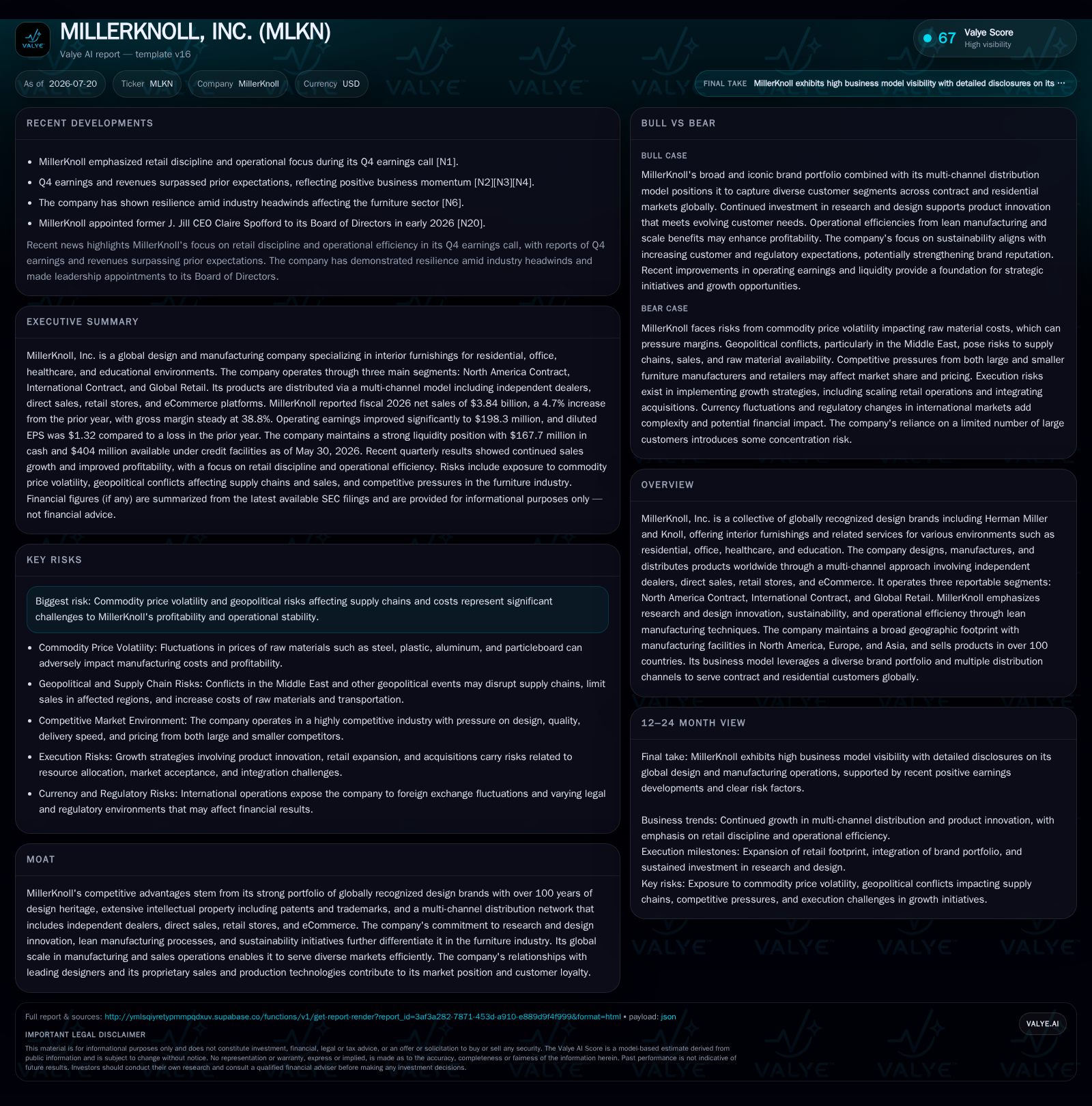
In its latest quarterly update ending February 2026, MillerKnoll reported a 5.8% net sales growth driven mainly by price increases and favorable currency impacts, accompanied by significant operating margin improvement as prior-year impairments ease. The company operates a diversified multi-brand, multi-channel business with strong design heritage across contract furniture and retail segments globally. Its lean manufacturing and order-driven production models support operational efficiency, yet risks from geopolitical tensions, commodity volatility, and executive transition loom. Continued emphasis on hybrid work trends, sustainability, and retail expansion underpin growth potential, while close monitoring of supply chain costs and leadership stability remains essential.
Recent Operating Update
MillerKnoll's third quarter of fiscal 2026 showcased resilient operational momentum with net sales reaching $926.6 million, marking a 5.8% increase compared to the same quarter last year [S2]. This top-line improvement was primarily driven by strategic price increases contributing approximately $23 million after discounting effects and favorable foreign currency translation adding about $17 million. Incremental volume gains also played a role, particularly in the Global Retail (+$5 million), International Contract (+$4 million), and North America Contract (+$2 million) segments [S2]. Importantly, organic sales growth—excluding currency effects—stood at a healthy 3.8%, highlighting enduring demand beyond exchange rate factors.
Operating earnings for the quarter more than doubled to $24.9 million up from the prior period loss, reflecting the absence of previous year impairment charges that had depressed earnings notably [S2]. Operating expenses fell by nearly $107 million compared to last year's quarter due largely to this reduction in non-cash charges, although incremental costs related to retail store expansion and compensation increased marginally.
Segment-wise, North America Contract delivered solid performance with reported net sales growing 4.4% (4.1% organically) while orders surged over 13%, signaling strengthened client engagement in its core office, healthcare, and education verticals [S2]. The International Contract segment grew reported sales by close to 8%, though organic sales were modestly down due to regional mix changes and pricing dynamics [S2]. The Global Retail segment advanced net sales by over 7%, supported by increased sales volumes during an extended retail network including Herman Miller and Design Within Reach stores globally [S2], [S1].
Business Model Dynamics
MillerKnoll operates as a global design collective managing a diverse portfolio of renowned brands such as Herman Miller®, Knoll®, Muuto®, HAY®, Holly Hunt®, among others that collectively embody more than a century of design heritage [S1]. The company designs, manufactures, and distributes interior furnishings spanning seating products, furniture systems, textiles, leather goods, felt products, home furnishings, and associated services tailored for residential, office, healthcare, and educational environments worldwide.
Its revenue is generated primarily through multiple channels: independent contract furniture dealerships serving office and commercial clients; direct customer sales; owned retail stores; independent retailers; catalog sales; and eCommerce platforms—which provide exposure across both contract furniture markets and lifestyle-driven retail segments [S1], [S16]. This multi-channel strategy creates diverse revenue streams balancing bulk B2B orders with direct-to-consumer approaches.
Underlying its manufacturing strategy is the MillerKnoll Performance System (MKPS), embracing lean manufacturing principles focused on minimizing inventory through order-driven production processes paired with variable cost structures via component sourcing from strategic suppliers while maintaining control over proprietary assembly operations [S1]. This model enhances inventory turns—a critical KPI in managing working capital—and enables operational agility amid fluctuating demand.
Research & development investments underscore the brand’s commitment to product innovation that addresses evolving needs such as ergonomic comfort, sustainability preferences, hybrid work solutions, and health-conscious design—a critical competitive differentiator given rising emphasis on wellness-focused environments.
Industry Structure & Competitive Position
Within the furniture design and manufacturing industry landscape—comprising contract furniture manufacturers like Steelcase or HNI Corporation; retail brands such as La-Z-Boy or Williams-Sonoma; as well as specialized textile suppliers—MillerKnoll occupies a distinctive niche defined by premium design pedigree combined with broad geographic reach across North America, Europe, Asia-Pacific, Latin America, and beyond.
Its competitive moat derives from rich intellectual property portfolios encompassing patents/trademarks tied to signature designs; longstanding relationships with acclaimed designers; globally integrated supply chains enabling flexible capacity deployment; established dealer networks; plus scalable retail presence that directly interfaces with end consumers [S1],.
This breadth imparts resilience against localized market disruptions but introduces complexity in management of channels especially under conditions of volatile raw material costs or geopolitical trade uncertainties. Tariff impositions have periodically pressured margins but are partly mitigated through targeted price actions reflective in recent reporting periods [S12], showcasing tactical pricing power without unusual discounting erosions.
Growth Drivers
Several macro trends converge favorably for MillerKnoll’s portfolio:
- The rise of flexible/hybrid work environments drives renewed demand for adaptable office furnishings—core to its contract segments—where order volumes grew double digits in recent quarters [S2].
- Consumer focus on home lifestyle upgrades fuels Global Retail growth supported by enhanced showroom footprints (93 stores including DWR) blending physical shopping experiences with digital channels for modern design enthusiasts [S1].
- Increasing prioritization of health-oriented ergonomic designs aligns with MillerKnoll’s innovation pipeline addressing wellbeing in workplaces and residences alike.
- Sustainability initiatives embedded in product development attract environmentally conscious customers increasingly influencing purchase decisions.
- International expansion into developing economies coupled with favorable currency movements offer potential upside for International Contract segment despite near-term challenges affecting organic growth rates.
These drivers reinforce ongoing investment appeal toward new product R&D spending ($122 million CAPEX FY2026), planned facility upgrades including showrooms/retail stores ($125-$135 million forecast for FY2027), along with further digital channel optimization aiming to capture eCommerce growth trajectories observed industry-wide [S1], [S16].
Risks & Watchpoints
Notable risks persist that require vigilant management:
- Geopolitical conflicts notably in the Middle East impact supply chain continuity raising raw material input costs linked to petroleum-based products used in multiple furniture components as well as transport/logistics expenses which may squeeze margins unpredictably [S19].
- Commodity price volatility continues to pose uncertainty around manufacturing cost forecasting challenging fixed-price contracts or dealer pricing frameworks.
- Leadership transition risks emerged recently with CEO departure mid-2026 potentially impacting strategic execution speed during sensitive phases of retail scaling and brand integration efforts. Maintaining executive team cohesion will be vital for sustaining momentum [S1], [S3].
- Consumer discretionary spending influences Global Retail results that remain susceptible to macroeconomic headwinds such as inflationary pressures driving consumer confidence fluctuations.
- Currency exchange fluctuations affect international revenue recognition patterns requiring hedging discipline.
- Inventory balancing acts inherent in order-driven production call for precision supply chain orchestration mitigating build-ups or shortages detrimental to working capital efficiency.
What To Watch Next
Key milestones include quarter-by-quarter tracking of net sales versus organic growth rates particularly within contract business units where hybrid work adoption is still evolving. Order book levels relative to backlog also signal near-term fulfillment prospects. Observing gross margin trends will illustrate how effectively tariff burdens are offset by pricing/mix strategies or operational gains.
Retail channel metrics such as same-store sales growth across DWR/Herman Miller outlets alongside online conversion improvements will indicate consumer engagement quality under current economic conditions.
Leadership succession announcements post Interim CEO appointment will be pivotal for investor sentiment regarding strategic continuity amidst integration synergies sought from prior acquisitions like Knoll.
Financial Profile Discussion
Liquidity remains solid with cash & equivalents totaling $167.7 million complemented by approximately $404 million available borrowing capacity under revolving credit facilities maturing in April 2030 providing substantial liquidity runway for ongoing investments or opportunistic needs without immediate refinancing pressure [F1], [S2].
Current assets of $1,137.2 million and current liabilities of $721.1 million imply a current ratio of approximately 1.58 as of May 30, 2026, supporting working capital management amid inventory churn demands typical for industry peers [F1]
This analysis synthesizes MillerKnoll’s latest quarterly results alongside industry positioning within furniture design/manufacturing sectors characterized by multi-brand portfolios serving complex B2B/B2C channels globally. While raising flags over external geopolitical risks and internal leadership changes warrant cautious observation going forward; underlying demand drivers rooted in workplace evolution alongside robust retail execution underline durable competitive fundamentals pivotal for medium-term value creation potential.
Disclaimer: This report is an informational analysis produced without endorsement or specific investment research views regarding MillerKnoll securities.
Disclaimer: This is research-only, informational analysis and not investment advice. It may include AI-generated interpretation and general industry context. Always verify important details using primary sources.

Comments