
Calix Advances AI-Powered Broadband Platform as Margins Adjust Amid Supply Variability
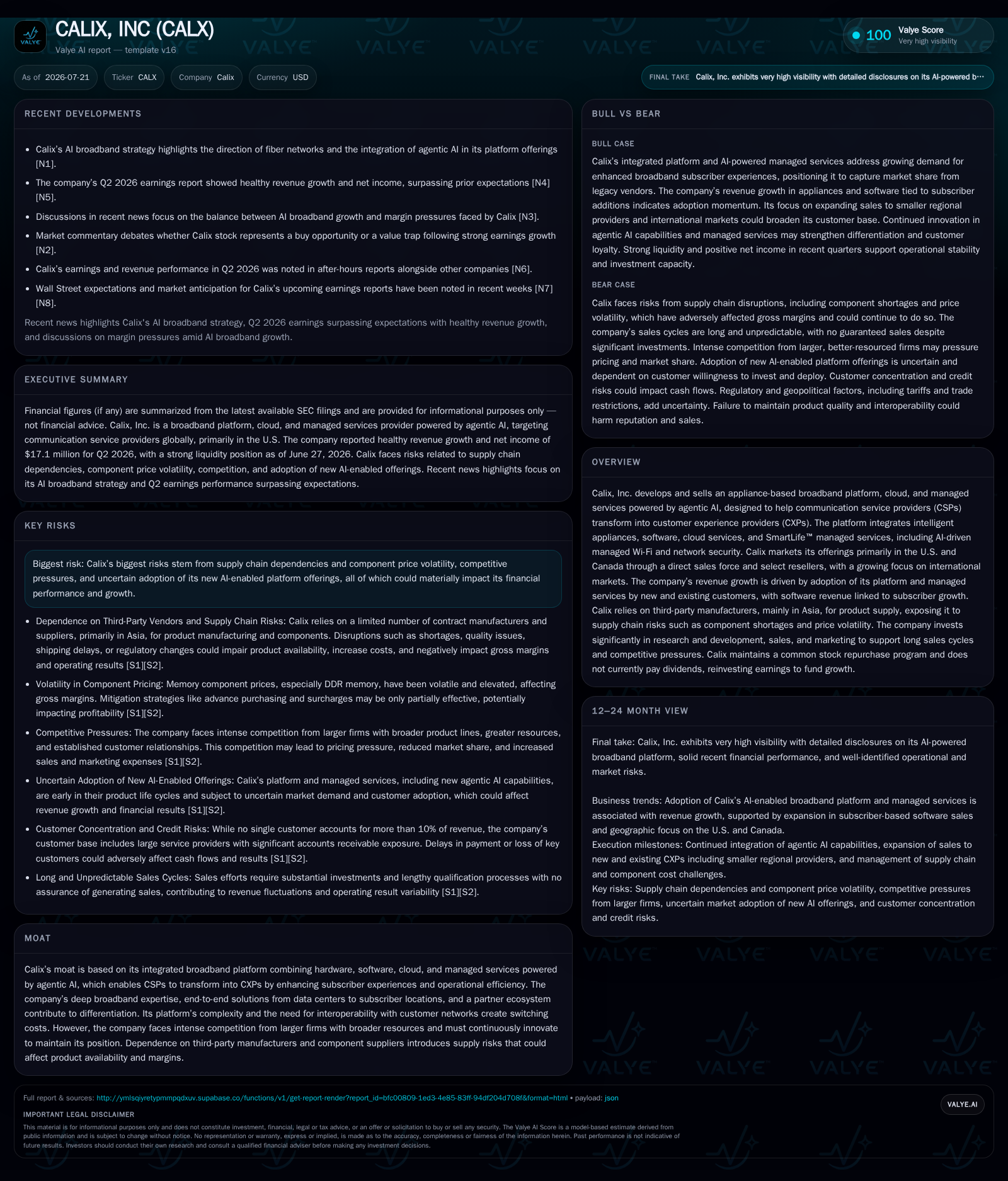
Calix’s Q2 2026 results highlight growing adoption of its integrated AI-enabled broadband platform alongside margin pressures driven by ongoing supply chain challenges.
In its latest quarterly filing, Calix showcased accelerating demand for its agentic AI-powered broadband platform and managed services from communication service providers transitioning to customer experience providers. This growth spurred healthy revenue momentum, particularly in recurring software and managed services linked to subscriber expansions. However, persistent component shortages and price volatility negatively affected hardware gross margins, a dynamic common in telecom network equipment manufacturing. Calix’s integrated platform, combining network appliances with cloud and managed services, reinforces switching costs and customer retention but requires continued innovation amid competitive pressures from larger players. The company’s liquidity remains solid, supporting ongoing R&D and operational investments amid challenging supply chain conditions.
Q2 2026 Adoption Momentum Driven by Agentic AI Broadband Platform
Calix, Inc. reported strong operational momentum in its second quarter ending June 27, 2026, highlighted by accelerating adoption of its integrated broadband platform enhanced with agentic AI capabilities tailored for communication service providers (CSPs) transitioning into customer experience providers (CXPs) [S2], [S3]. This platform combines network appliances with cloud-based software subscriptions and managed services, enabling CSPs to improve subscriber experience and operational efficiency. The quarter’s revenue growth was primarily driven by increased consumption of recurring software and managed services, which scale with the number of subscribers served by Calix’s CSP customers. This recurring revenue model, resembling SaaS economics, provides Calix with structural revenue durability distinct from the more cyclical hardware appliance sales [N3].
However, the company continues to face margin headwinds stemming from ongoing supply chain disruptions. Calix’s hardware segment, reliant on third-party manufacturers predominantly in Asia, experienced component shortages and price volatility that compressed gross margins. These supply constraints have slowed hardware revenue growth relative to software and services and increased cost of goods sold, a dynamic typical in the telecommunications network equipment sector [S2]. Monitoring supply chain stabilization and component cost trends will be critical to margin recovery.
Integrated Broadband Platform Business Model and Switching Costs
Calix’s business model centers on delivering an appliance-based broadband platform tightly integrated with cloud software and SmartLife™ managed services, including network security and managed Wi-Fi solutions powered by agentic AI [S1], [S2]. This integration creates interoperability complexity that generates significant switching costs, reducing churn risk among CSP customers who deploy the full platform stack. The platform’s value proposition extends beyond hardware infrastructure to transformative digital tools that enhance subscriber experience and network performance.
Revenue streams are diversified across upfront network appliance sales and recurring software subscriptions and managed service contracts, which are directly linked to active subscriber counts. This alignment incentivizes CSPs to expand subscriber bases and adopt higher service tiers, driving platform adoption rates and recurring revenue growth. Operating leverage arises as fixed R&D investments enable higher-margin software and service revenue growth without proportional increases in hardware production costs.
Key operating KPIs include platform adoption rate by CSPs, recurring revenue as a percentage of total revenue, average revenue per user (ARPU) for managed services, and customer retention rates reflecting switching cost effectiveness.
Competitive Positioning Amid Larger Telecom Equipment Vendors
Calix competes in a telecommunications network equipment market dominated by larger incumbents such as Cisco Systems and ADTRAN, which benefit from scale, broader product portfolios, and global reach [S1], [S2]. Calix differentiates itself through deep broadband platform integration and focused application of AI to improve customer experience and network management, targeting regional and mid-tier CSPs prioritizing operational efficiency and subscriber engagement.
While Calix’s technical complexity and platform interoperability create barriers to entry, competitive risks remain from well-resourced peers continuously innovating in AI, cloud, and network infrastructure. Sustaining differentiation requires ongoing investment in proprietary technology development and seamless integration capabilities within heterogeneous CSP network environments.
Growth Drivers: CSP Digital Transformation and Fiber Network Expansion
Calix’s growth is underpinned by macro trends including accelerating fiber network deployments by CSPs aiming to meet rising bandwidth demand and nationwide connectivity initiatives [N8]. The industry-wide shift of CSPs toward becoming CXPs fuels demand for platforms embedding agentic AI to automate customer support, optimize network performance proactively, and enhance managed Wi-Fi experiences.
This digital transformation drives subscriber growth, which in turn increases consumption of Calix’s software subscriptions and managed services, key contributors to recurring revenue. Additionally, ongoing 5G rollouts complement fiber infrastructure expansions, broadening Calix’s addressable market.
Risks: Supply Chain Dependencies, IP Litigation, and Cybersecurity
Calix faces significant risks from its dependence on third-party component suppliers concentrated in Asian manufacturing hubs, where semiconductor shortages and price volatility persist [S1], [S2]. These factors constrain hardware shipments and compress gross margins. Although Calix employs mitigation strategies such as inventory buffers and alternative sourcing, their effectiveness may be limited or temporary.
The company is also exposed to intellectual property litigation risks common in technology sectors, including patent infringement claims from non-practicing entities, which could result in costly settlements or licensing requirements [S5], [S21]. Cybersecurity threats targeting Calix’s products or third-party cloud infrastructure pose additional operational risks.
International expansion introduces geopolitical risks such as tariffs, export controls, and regulatory compliance challenges that could impact pricing competitiveness and market access.
Key Execution Metrics and Monitoring Points
Post-Q2, critical operational indicators to watch include:
- Growth trajectory of recurring software and managed services revenue relative to total revenue, indicating deeper platform penetration beyond hardware sales.
- Order backlog trends and supply chain lead times, which will reveal progress in alleviating component shortages and improving fulfillment.
- Innovation cadence in agentic AI features integrated into the broadband platform and managed Wi-Fi services, sustaining competitive differentiation.
- Customer retention rates and churn metrics reflecting the strength of switching costs and platform stickiness.
Tracking these KPIs will provide insight into Calix’s ability to capitalize on structural growth drivers and manage margin pressures effectively [S2], [N3].
Financial Position and Capital Allocation
As of June 27, 2026, Calix held $68.9 million in cash and equivalents with a current ratio of approximately 2.83, indicating solid short-term liquidity to support operations amid supply chain challenges [F1]. Gross margin trends reflected the expected divergence: hardware margins contracted due to elevated component costs, while software and managed services margins remained stable or improved, highlighting the strategic shift toward higher-margin recurring revenue streams [S2].
Calix does not currently pay dividends, opting to reinvest earnings into research and development to sustain rapid product innovation essential in the telecom network equipment sector [S4]. Capital allocation prioritizes flexibility to navigate external uncertainties while funding enhancements to AI capabilities and managed service offerings.
Cash flow generation remains stable but sensitive to working capital fluctuations driven by inventory management addressing supply delays, warranting ongoing scrutiny.
Note: This analysis is based on Calix’s latest quarterly (10-Q) and annual (10-K) SEC filings, supplemented by recent earnings disclosures, providing an operational and financial overview within the telecommunications network equipment industry context without investment research views.
Financial snapshot
As of 2026-06-27, Calix reported $68.9 million in cash and equivalents, current assets of $595 million, and current liabilities of $210 million, resulting in a current ratio of 2.83x [F1]
Disclaimer: This is research-only, informational analysis and not investment advice. It may include AI-generated interpretation and general industry context. Always verify important details using primary sources.

Comments