
Pegasystems’ AI-First Transformation Evident in Cloud Subscription Growth and Partner-Led Scaling
Pegasystems advances its enterprise AI workflow platform with growing subscription momentum and expanding partner implementations, while managing ongoing litigation risks and deferred revenue shifts.
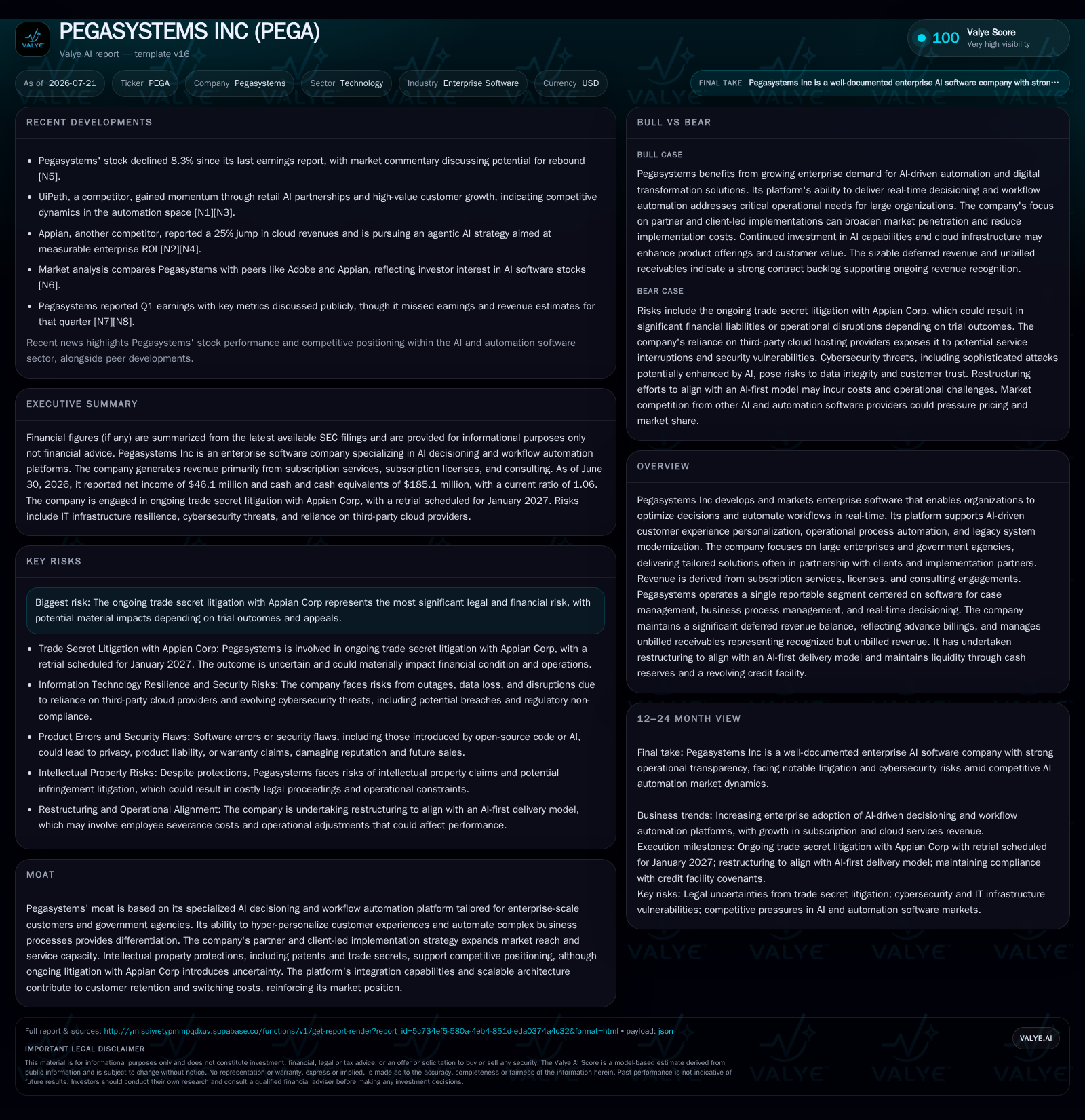
In its Q2 2026 filing, Pegasystems reported continued growth in subscription services, reflecting progress in its AI-driven SaaS transition, despite a notable decline in deferred revenue balances that signal evolving billing and recognition dynamics. The company leverages a partner ecosystem to scale complex implementations alongside consulting engagements, balancing recurring revenue expansion with near-term execution risks. Litigation with Appian Corp remains a material uncertainty but has seen recent procedural developments favorable to Pegasystems. The firm’s product suite centers on advanced workflow automation and customer experience personalization tailored for large enterprises and government agencies, positioning it well amid broader digital transformation trends.
Q2 Operating Dynamics Underpin AI-Driven Subscription Scale-Up Despite Deferred Revenue Contraction
This divergence underscores the complex interplay between billing timing, contract length, and recognition rules particularly relevant as Pegasystems transitions deeper into an AI-powered software-as-a-service (SaaS) model focused on cloud-hosted workflow automation and real-time decisioning platforms. Unlike traditional license sales where upfront cash dominates, SaaS shifts monetization towards recurring subscription fees tied to usage or time-bound contracts. Thus, quarterly deferred revenue can exhibit volatility depending on client onboarding schedules or renewal timing nuances.
On the licensing front, subscription licenses were relatively flat at approximately $82 million versus $81 million last year quarter, while consulting revenues dipped modestly to $50 million from $58 million [S18]. This pattern suggests the company's strategic emphasis is firmly on growing its recurring subscription base rather than transactional license sales or one-off consulting projects at this stage. Consulting remains essential but serves more as enabler for adoption rather than primary growth engine.
'Implementing at Scale': Partner Ecosystem's Role in Expanding Market Reach Amid Consulting Mix Evolution
Pegasystems relies heavily on its partner ecosystem alongside its consulting staff to implement complex enterprise solutions [S1]. The annual filing confirms that substantial consulting revenues derive from deploying new license deals and Pega Cloud arrangements managed both internally and via partners. This hybrid approach allows Pegasystems to scale delivery without proportionately increasing fixed headcount — critical when implementing technically demanding AI workflow platforms for large enterprises and government entities.
Implementation partners function as capacity multipliers extending service reach while mitigating bottlenecks related to specialized skills needed for customization or integration with legacy environments. However, the company flags risk if consulting personnel involvement diminishes materially, given their central role in managing these implementations [S1]. This reliance weighs on margins since consulting services are less predictable and typically carry lower gross margins than subscription software.
Operationally, monitoring consulting utilization rates alongside implementation project completion can provide insight into potential delivery bottlenecks or client adoption challenges. A decline in consulting could reflect successful partner transfer of skills or alternatively softness in new project starts requiring close scrutiny.
'Moat Maintenance': Trade Secret Litigation Risk Amidst Strong Intellectual Property Defenses and Integration Depth
A significant overhang for Pegasystems remains the ongoing trade secret litigation initiated by Appian Corp concerning alleged misappropriation of technology related to low-code BPM platforms [S1], [S15], [S21]. Earlier adverse rulings imposed a judgment north of $2 billion plus interest [S22], but subsequent appellate court decisions have reversed key elements of these findings ordering new trials specifically addressing trade secrets claims. The Supreme Court of Virginia affirmed reversal positions facilitating further proceedings scheduled for early 2027 [S15].
While litigation uncertainty persists—potentially impacting capital allocation or triggering financing needs—the company maintains strong confidence in its legal defenses grounded in proprietary AI decisioning algorithms, patents, trade secrets protections, and deep enterprise integration capabilities [S1]. Such intellectual property assets underpin customer switching costs by embedding Pegasystems’ solutions deeply within critical business process workflows.
Investors should watch procedural developments closely as prolonged trials commonly stretch across several years characteristic of high-stakes enterprise software patent disputes. Notably, this risk contrasts with peers such as UiPath or Microsoft which face less pronounced IP litigation over core AI-enabled automation technologies currently driving industry expansion.
Growing Enterprise Demand Anchors Product Innovation in Workflow Automation and Customer Experience Personalization
Pegasystems’ platform investment focuses on scalable architecture enabling real-time business process management coupled with AI-driven customer experience personalization [S1]. This dual capability addresses two intersecting enterprise pressures: operational excellence via workflow automation and differentiation through hyper-personalized customer engagement.
These features align with macro trends accelerating demand among large enterprises undergoing digital transformation initiatives aiming to modernize legacy systems without disruptive rip-and-replace strategies. Pegasystems supports this via modular cloud hosting options allowing phased modernization balanced against existing infrastructure investments.
The platform’s ability to rapidly prototype applications collaboratively using tools like Pega Blueprint further advances time-to-value metrics important for enterprise buyers seeking agility amid competitive markets. While no peer benchmarking is provided directly by the company, the emphasis fits broader industry patterns where AI augmentation increasingly supplements traditional BPM offerings across vendors.
Growth Prospects: Subscription Model Expansion Counterbalanced by Consulting Revenue Execution Risks
Renewed emphasis on subscription Annual Recurring Revenue (ARR) drives predictable cash flow models integral to Pegasystems’ valuation metrics. However, declining volumes in consulting services highlight operational execution complexities inherent when scaling bespoke implementations requiring expert personnel involvement [S1], [S2].
Deferred revenue trajectory acts as an early barometer of billing health; thus declines potentially signal near-term headwinds if partner-delivered implementations falter or client procurement cycles elongate. Conversely, successful ramp of subscription licenses fueled by cloud adoption could offset shortfalls but requires robust pipeline conversion efficiency backed by active sales engagement.
Regulatory compliance around data security and uptime also represents an implicit gating factor given increasing reliance on cloud-based mission-critical applications documented under cybersecurity risk disclosures [S1]. Consequently maintaining high availability SLAs alongside continuous R&D investment remains essential given competitive pressure from broad-based vendors like Microsoft or Salesforce.
Watching Points: Legal Developments, Deferred Revenue Trends, Adoption Milestones, and Renewal Rates Signal Momentum or Constraint Ahead
Key indicators that will illuminate PEGASYSTEMS’ trajectory include:
- Deferred revenue replenishment trends to reaffirm the sustainability of subscription billings.
- Subscription renewal rates reflecting customer satisfaction amid competitive alternatives.
- Implementation project completion rates measuring operational efficiency especially within partner-led models.
- Outcome timelines associated with Appian litigation including summary judgment motions due July-Sept 2026 and jury trial scheduled for November 2026 provide pivotal clarity on contingent liabilities.
- Pipeline conversion ratios signaling demand momentum for new AI-enabled workflow deployments [S3]
Monitoring these metrics quarterly offers transparency into whether Pegasystems can maintain growth velocity without margin-dilutive expansions or costly legal distractions.
Financial Profile Discussion: Latest Balance-Sheet Liquidity Supports Strategic Flexibility While Operating Investment Intensifies
As of June 30, 2026, Pegasystems held cash and equivalents totaling approximately $185 million against current liabilities around $719 million yielding a current ratio near 1.06 [F1], [S2], indicative of adequate liquidity but not excessive cushion characteristic of mature SaaS peers. Deferred revenue balances stood lower compared to year-end 2025 levels suggesting cautious near-term billing momentum [S2].
Operating expenses increased notably year-over-year driven largely by higher selling & marketing ($165M vs $147M) plus research & development ($84M vs $79M), aligning with intensified investments behind product innovation and market development efforts fundamental for sustaining AI-first SaaS positioning [S6].
Operating income declined sequentially reflecting elevated reinvestment cycle typical during strategic transformation phases.
In sum, the financial condition appears sufficient to support near-term growth initiatives including partner network expansion while prudently provisioning against litigation-related exposures that still carry material uncertainty but lack definitive loss estimates currently.
Disclaimer: This analysis is based exclusively on publicly available filings as of July 21, 2026. It does not constitute investment advice or forecasts but aims to provide an informed assessment of Pegasystems Inc’s operating status relative to its sector context.
Disclaimer: This is research-only, informational analysis and not investment advice. It may include AI-generated interpretation and general industry context. Always verify important details using primary sources.

Comments