
Baltic International USA: Shell Structure, Strategic Blank Slate, and the Realities of Acquisition-Driven Value Creation
With no operations, minimal assets, and a working capital deficit exceeding $5.3 million, Baltic International USA is a shell company seeking a business combination to unlock value. Its future hinges on sourcing and executing a credible acquisition, but intense competition, limited resources, and dilution risks cloud the path forward.
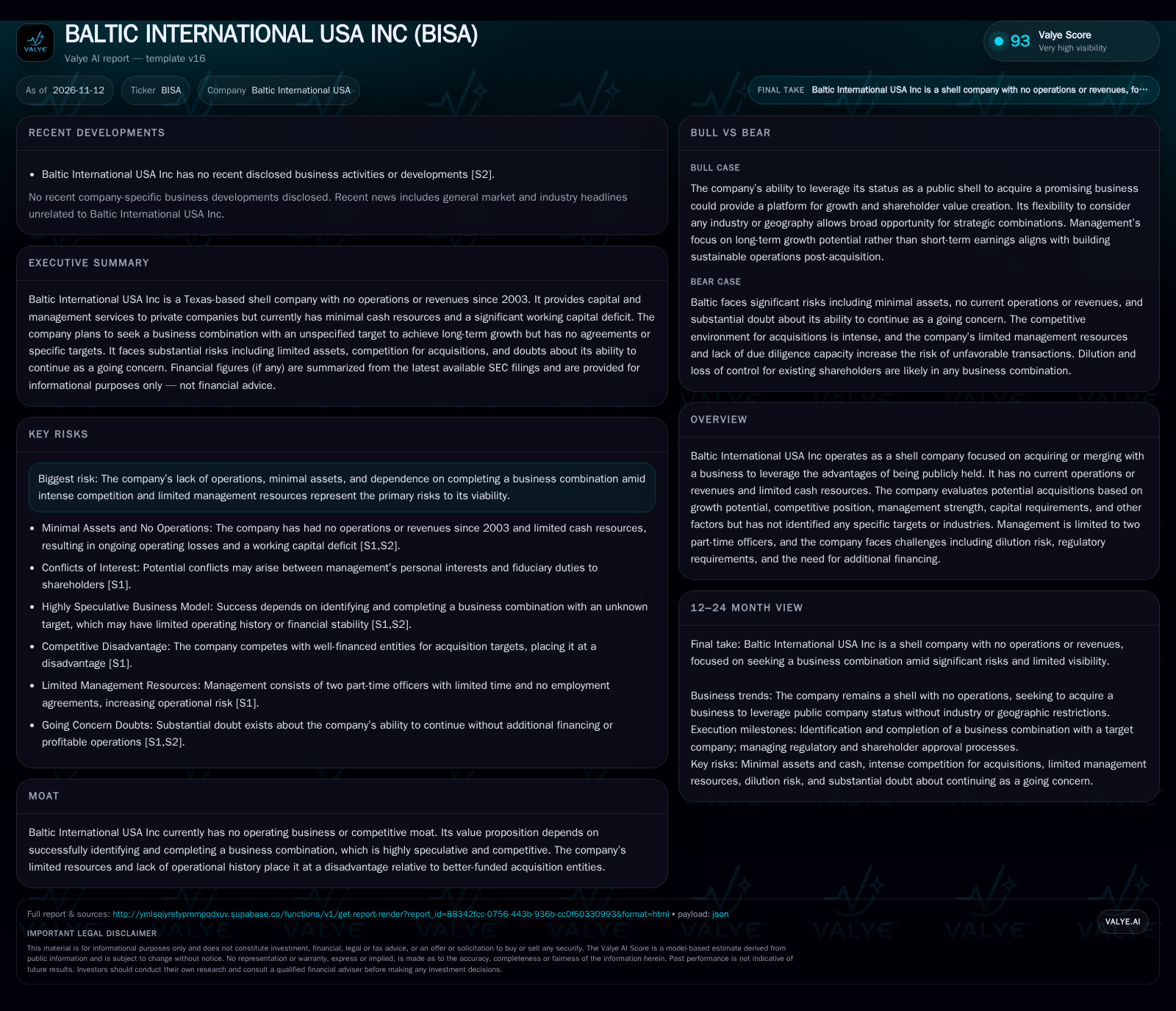
Baltic International USA Inc is a Texas-based shell company with no operations, negligible cash, and a substantial working capital deficit. The company's only stated objective is to acquire or merge with an operating business, but it has not identified a target, has no specific sector focus, and faces significant risks from its financial position and limited management. Success depends entirely on executing a business combination, which could create value but also carries major dilution and execution risks for current shareholders. [S1] [S2]
Baltic International USA Inc stands as a classic example of a pure shell company—devoid of operations, revenues, or meaningful assets, and with an accumulated deficit topping $19 million. Its stated mission is to identify and consummate a business combination, leveraging its public listing as a platform for a private company seeking access to capital markets. However, the company’s minimal resources, negative working capital, part-time management, and lack of deal flow raise fundamental questions about its ability to deliver value to current shareholders. Success hinges entirely on sourcing and closing a credible acquisition, but the environment for such deals is fiercely competitive and fraught with risks, particularly for thinly capitalized shells like Baltic.
Baltic’s Operating Void and Financial Constraints Set the Stage for a High-Stakes Pivot
As of November 2026, Baltic International USA Inc has no ongoing operations or revenue streams and has not conducted business for over two decades. The company’s cash position is precariously low at $2,976, with a working capital deficit of $5,315,378 as of September 30, 2026. Its accumulated operating deficit stands at $19,276,626. Management is limited to two part-time officers, and there are no full-time employees or active business activities. The company’s only articulated strategy is to seek a business combination, with no sector, size, or geographic limitations, but no targets or negotiations are underway. These facts position Baltic as a blank-slate shell, dependent on a future acquisition to establish any operating business or shareholder value. [S1] [S2]
How a Shell Company Can Unlock Value—And Why Most Don’t
Shell companies like Baltic International USA are structured to serve as vehicles for private businesses seeking a public listing. If a business combination is completed, the economics shift dramatically: the private target essentially ‘reverse merges’ into the shell, usually resulting in a change of control, substantial dilution of existing shareholders, and the injection of new management and business operations. The value creation mechanism is primarily the public-listing premium and potential access to public capital markets.
In practice, the economics for current Baltic shareholders are highly contingent: a successful acquisition could lead to an operating entity with growth potential, but the shell’s limited cash and large working capital deficit mean any deal will likely require issuing a substantial number of new shares—diluting current ownership. Absent operations, Baltic currently incurs only minimal expenses, but this also means there is no revenue to offset fixed costs or fund diligence, regulatory, or transaction-related expenses. The company’s ability to negotiate favorable terms is hampered by its lack of cash, ongoing losses, and absence of deal leverage.
If a deal materializes, the post-combination company’s economics will depend entirely on the acquired business’s fundamentals—revenue, margins, capital intensity, and competitive position. Until then, Baltic’s economics remain defined by burn, dilution risk, and the hope of a transformative transaction.
Fighting for Relevance: Baltic’s Position in the Crowded Shell and SPAC Landscape
Baltic International USA operates in a fiercely competitive segment: the universe of public shells and special purpose acquisition companies (SPACs) seeking private companies to acquire. Unlike well-capitalized SPACs, which typically raise hundreds of millions of dollars and have defined sponsor teams, Baltic brings neither capital nor high-profile backers to the table. Its only asset is its public listing, which is of limited scarcity in today’s market given the proliferation of comparable shells and alternative routes to public markets.
Potential acquisition targets increasingly have choices—traditional IPOs, direct listings, or higher-profile SPACs. Baltic’s lack of sector focus and minimal resources make it unlikely to attract high-quality targets unless those targets are unable to access capital elsewhere or value a public listing above capital infusion. The company faces additional headwinds from its uncertain listing status post-acquisition, as there is no guarantee that any combined entity would meet exchange requirements for ongoing listing or liquidity.
In this landscape, Baltic’s only plausible advantage is speed and flexibility, but these are undermined by its limited management capacity and lack of transaction readiness. The company’s competitive position is thus weak, defined less by moat and more by opportunism.
A Transformational Deal: What Success Would Require and How It Might Play Out
The bull case for Baltic International USA is simple but difficult: successfully sourcing and closing a business combination with a promising private company that desires public-market access. In this scenario, Baltic leverages its shell status to facilitate a reverse merger, the target injects new management, and the combined entity either attracts new financing or achieves operational growth post-transaction.
For this outcome to materialize, several conditions must align: (1) Baltic must identify a target that values the public listing more than the company’s lack of cash; (2) the transaction must be structured to incentivize both parties despite significant dilution to current shareholders; (3) the post-merger business must have enough credibility and growth potential to attract investors and potentially meet exchange listing standards. Evidence that would confirm this scenario includes the announcement of a definitive merger agreement with a credible operating business, disclosure of new financing commitments, and a post-transaction plan for operational ramp-up.
Falsification would occur if Baltic continues to report no progress on sourcing targets, fails to secure financing or regulatory approval, or if any proposed deal is with a distressed or subscale business lacking growth prospects.
The Most Likely Outcome: Extended Dormancy and Ongoing Dilution Risk
Given Baltic’s lack of cash, management bandwidth, and deal flow, the most plausible outcome is continued dormancy: the company remains a shell, incurring minimal but persistent operating losses, and periodically seeking but not closing any acquisition. Over time, the risk of further dilution rises as Baltic may need to issue shares or seek small infusions of capital simply to cover administrative costs.
This scenario is confirmed if future filings continue to show no business activity, no identified targets, and no progress on a combination. It may be partially falsified if management announces an actionable letter of intent, initiates due diligence with a specific target, or secures even minimal financing to support transaction efforts.
For existing shareholders, this base case means extended value stagnation, with the only potential upside coming from a low-probability, high-dilution transaction or a sudden change in market conditions that increases demand for public shells.
When the Shell Runs Dry: Scenarios for Value Erosion and Dissolution
The bear case is that Baltic’s minimal resources and ongoing losses ultimately lead to involuntary dissolution, delisting, or administrative suspension. With no operations and a growing working capital deficit, regulatory authorities or creditors could force action if the company is unable to maintain required filings or meet basic obligations.
This scenario would be confirmed by missed SEC filings, public notice of delisting, or formal steps toward liquidation. Another adverse outcome is that Baltic, under pressure, consummates a low-quality or distressed asset acquisition—potentially with an entity seeking a public listing to evade scrutiny or regulatory requirements. Such a deal could further dilute existing shareholders with little or no value creation, and in the worst case, invite regulatory or legal complications.
Falsification of this downside would require evidence of new capital infusions, credible acquisition targets, or a successful transaction that transforms the company’s financial profile.
Testing the Baltic Thesis: Events and Metrics That Would Signal a Real Inflection
Disclosure of a letter of intent, term sheet, or definitive agreement with a credible acquisition target would be the first real sign of progress.
Any evidence of new capital raised—either through equity issuance, debt, or strategic investment—would materially affect the company’s ability to pursue transactions.
A useful metric would be the number of active acquisition discussions or potential targets under review, if disclosed in future filings.
Changes in management structure, such as the appointment of full-time executives or directors with M&A experience, would signal greater operational readiness.
Progress or setbacks in maintaining exchange listing compliance, particularly if the company moves toward or away from meeting minimum listing standards, would impact future liquidity and deal attractiveness.
Material changes in the company’s working capital position (e.g., a narrowing deficit or cash infusion) would affect both runway and negotiating leverage.
Announcement of a completed business combination, including details on the target’s industry, size, and post-merger business plan, would be the ultimate inflection point for the thesis.
If disclosed, the terms of any proposed transaction—especially dilution, change of control, and post-merger capital structure—would be critical to assessing shareholder value impact.
Disclaimer: This is research-only, informational analysis and not investment advice. It may include AI-generated interpretation and general industry context. Always verify important details using primary sources.

Comments