
BioLargo: Proprietary Disinfection Tech Faces Capital and Scale Hurdles
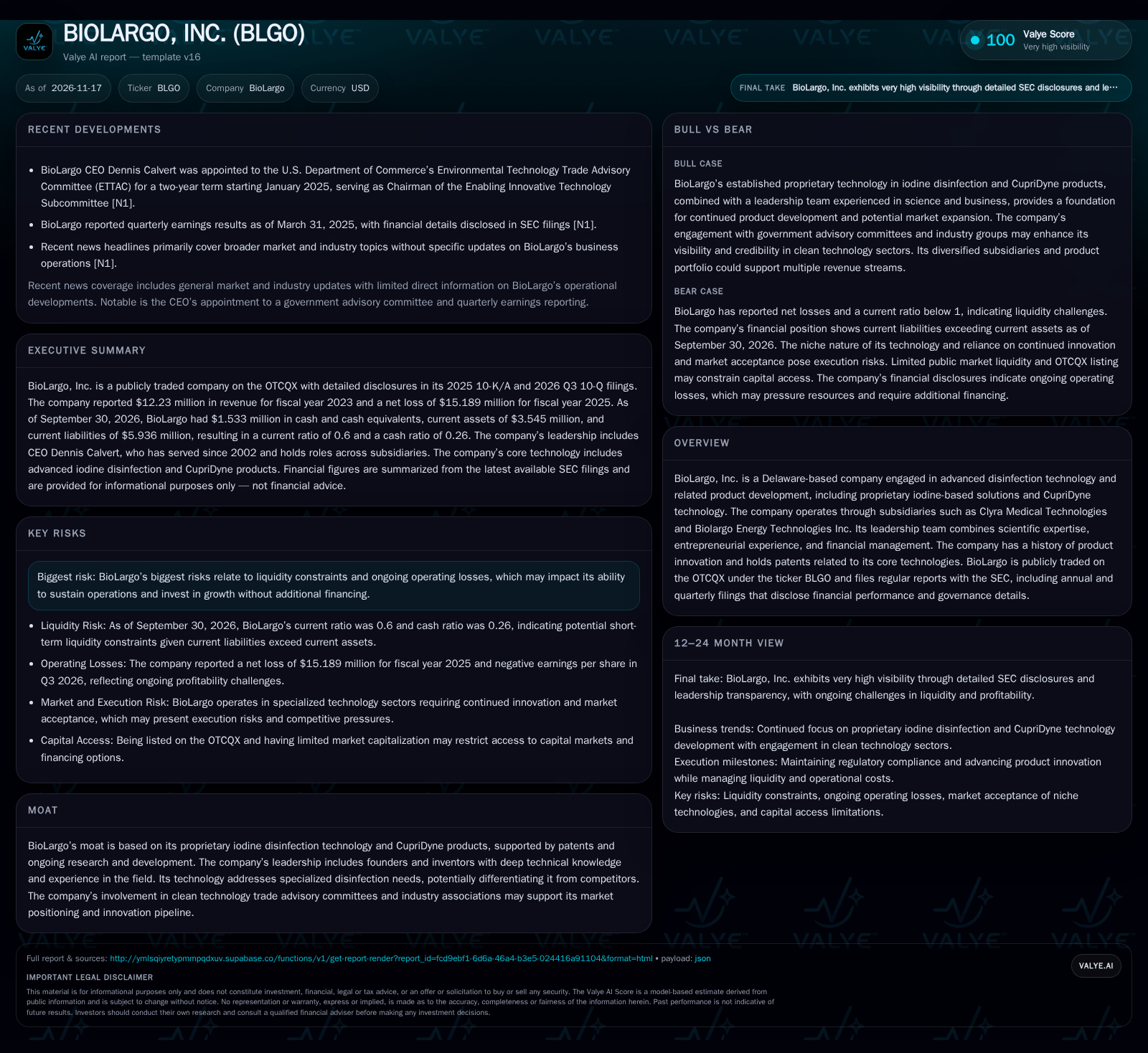
BioLargo’s patented iodine and CupriDyne technologies anchor its clean-tech ambitions, but persistent operating losses and a sub-1.0 current ratio underscore the urgency of commercial traction or new financing. The company’s multi-disciplinary leadership and industry engagement offer potential, yet execution risk remains acute as niche products seek broader market validation.
BioLargo’s 2023 revenue of $12.23 million and ongoing net losses highlight the tension between technological promise and financial strain. With a current ratio of 0.6 and only $1.53 million in cash as of September 2026, the company’s liquidity is under pressure. Success will depend on product adoption, cost containment, and access to new capital, as proprietary tech alone is not yet translating into profitability. [S2]
BioLargo, Inc. stands at a crossroads where its science-driven disinfection innovations—anchored by proprietary iodine and CupriDyne technologies—confront the realities of sustained operating losses and tightening liquidity. Despite a leadership team with deep scientific and entrepreneurial credentials and a portfolio of patented products, BioLargo’s financials depict a company still searching for scalable, profitable traction.
Recent Financial Metrics Highlight Urgency for Commercial Progress
BioLargo posted $12.23 million in revenue for fiscal 2023, yet the company remains unprofitable, recording a net loss of $15.19 million in 2025. As of September 30, 2026, cash and cash equivalents stood at $1.533 million, with current assets of $3.545 million against current liabilities of $5.936 million, resulting in a current ratio of 0.6 and a cash ratio of 0.26. Basic EPS for Q3 2026 was negative. The company reported cash and liquidity metrics for the period; these figures do not by themselves establish operating runway, investment capacity, financial flexibility, or financing capacity. [S1] [S2]
Commercialization Pathways and the Economics of Clean-Tech Innovation
BioLargo’s business model centers on the development and commercialization of patented iodine-based disinfection and CupriDyne technologies, primarily through its subsidiaries. The company’s economics depend on achieving significant product adoption in markets such as environmental remediation, industrial disinfection, and medical devices. These sectors often feature long sales cycles, regulatory hurdles, and a requirement for technical validation—factors that can delay revenue recognition and constrain near-term cash flow.
Pricing power in highly regulated niches is plausible if BioLargo’s technology offers clear efficacy or regulatory advantages. However, without clear evidence of recurring contracts or high-margin licensing, the company may face a mix of project-based revenues and lumpy cash flows. Fixed costs related to R&D, patent maintenance, and regulatory compliance are likely high relative to current revenue scale, amplifying operating leverage on the downside. Capital needs remain acute: the current balance sheet suggests that organic reinvestment is limited, and future growth or even continuity may require external financing or strategic partnerships.
In addition to the challenges of long sales cycles and regulatory approvals, BioLargo’s path to commercial viability depends critically on its ability to demonstrate cost-competitiveness relative to incumbent solutions. Even with superior efficacy or environmental benefits, if the total cost of ownership—including purchase price, installation, maintenance, and compliance costs—exceeds alternatives by a significant margin, adoption may remain limited to niche applications. Therefore, scaling manufacturing efficiency and optimizing supply chain logistics could materially affect margins and pricing flexibility. Furthermore, the company’s reliance on project-based revenues introduces volatility; establishing recurring revenue streams through service contracts, consumables, or licensing could smooth cash flow and improve valuation multiples.
Differentiation Through Patented Tech, But Commercial Moat Not Yet Proven
BioLargo’s core differentiation lies in its proprietary iodine disinfection and CupriDyne platforms, each supported by patent portfolios and years of R&D. These technologies target specialized problems in disinfection and odor control, potentially offering superior efficacy or environmental profiles compared to commodity chemical solutions. The leadership team’s scientific depth and industry engagement—exemplified by the CEO’s appointment to a U.S. Department of Commerce advisory committee—may enhance credibility and open doors to pilot projects or regulatory advocacy.
However, the company operates in fragmented and competitive markets where established chemical, industrial, and medical device players command distribution, regulatory familiarity, and procurement relationships. Substitution risk remains if buyers opt for lower-cost, incumbent technologies or if regulatory standards shift. The question is whether BioLargo can convert technical differentiation into sustainable commercial relationships that provide recurring, high-margin revenue and customer lock-in.
While patented technology can provide a barrier to entry, the durability of BioLargo’s competitive moat will depend on ongoing innovation and the ability to stay ahead of emerging substitutes. Competitors with greater scale might respond by developing similar iodine or copper-based chemistries or by leveraging alternative disinfection modalities such as UV or advanced oxidation processes. Additionally, regulatory environments can evolve, potentially lowering barriers for competitors or imposing new compliance costs. Thus, BioLargo’s sustained investment in R&D and proactive engagement with regulatory bodies are essential to maintain differentiation. Building strong customer relationships and demonstrating consistent performance in field conditions will also be key to converting technical advantages into commercial stickiness.
Breakthrough Adoption and Strategic Partnerships Catalyze Scale
A favorable scenario would see one or more of BioLargo’s core technologies achieve breakthrough adoption in a segment with high regulatory or customer pain points—such as medical device sterilization or industrial wastewater treatment. If the company secures multi-year contracts or licensing deals with large industry players, recurring revenue and margin expansion could follow. Strategic partnerships or pilot programs that validate efficacy and regulatory compliance would be key milestones.
Confirmation would come from sustained quarter-over-quarter revenue growth, disclosures of backlog or contracted pipeline, and successful capital raises or non-dilutive funding. If large customers publicly endorse the technology or if regulatory bodies reference BioLargo solutions in guidance, the company’s market position could shift rapidly.
Incremental Progress Amid Cost and Capital Constraints
The most plausible path is one of incremental adoption, with BioLargo gradually expanding its footprint in niche markets while managing costs tightly. Revenue growth may be modest, driven by new product launches, pilot wins, or regulatory approvals, but offset by ongoing R&D and SG&A expenses. Operating losses persist, but are potentially narrowed if the company can improve gross margins or secure small-scale licensing arrangements.
This scenario would be confirmed by flat to moderate revenue growth, ongoing negative but improving cash flows, and periodic small capital infusions. Absence of large-scale contracts or major partnerships would suggest continued execution risk and reliance on opportunistic financing.
Liquidity Shortfall Forces Restructuring or Strategic Alternatives
If BioLargo fails to accelerate revenue, reduce costs, or obtain new financing, its sub-1.0 current ratio and reported cash balance could result in a liquidity crunch. In this scenario, the company may be forced to curtail operations, delay R&D, or seek asset sales and strategic alternatives—including licensing out core technologies or restructuring through bankruptcy protection.
Indicators would include sharp sequential declines in cash, increased short-term borrowing, delayed vendor payments, or announcements of cost-cutting initiatives and management departures. If no major customer wins or capital raises are disclosed, the risk of going concern warnings or delisting from the OTCQX increases.
Milestones That Will Determine BioLargo’s Next Chapter
Quarterly revenue growth rates and the composition of revenue (recurring vs. project-based) would help test adoption and scaling progress, if disclosed.
Gross margin trends and cost structure evolution, especially as new products or contracts are rolled out, would clarify operating leverage.
Disclosures of multi-year contracts, backlog, or signed licensing agreements would signal improved revenue visibility and customer lock-in.
Announcements of successful capital raises, non-dilutive grants, or strategic investments would test the company’s ability to fund operations and growth.
Any regulatory approvals or endorsements for core technologies would validate product efficacy and expand addressable markets.
Evidence of customer concentration or expansion into new verticals/geographies would reveal both risk and opportunity.
Management commentary on cash runway, capital needs, or potential asset sales would illuminate near-term potential financial flexibility.
If disclosed, customer retention rates or renewal metrics for recurring products/services would help assess barriers to substitution.
Disclaimer: This is research-only, informational analysis and not investment advice. It may include AI-generated interpretation and general industry context. Always verify important details using primary sources.

Comments