
PodcastOne: Content Expansion and Revenue Growth Collide with Liquidity and Parent-Driven Constraints
PodcastOne has delivered record top-line growth through content and partnership initiatives but faces acute liquidity pressure, persistent losses, and operational restrictions stemming from LiveOne’s debt. The company’s path forward hinges on its ability to translate audience and content momentum into sustained profitability while managing financial risks imposed by its parent.
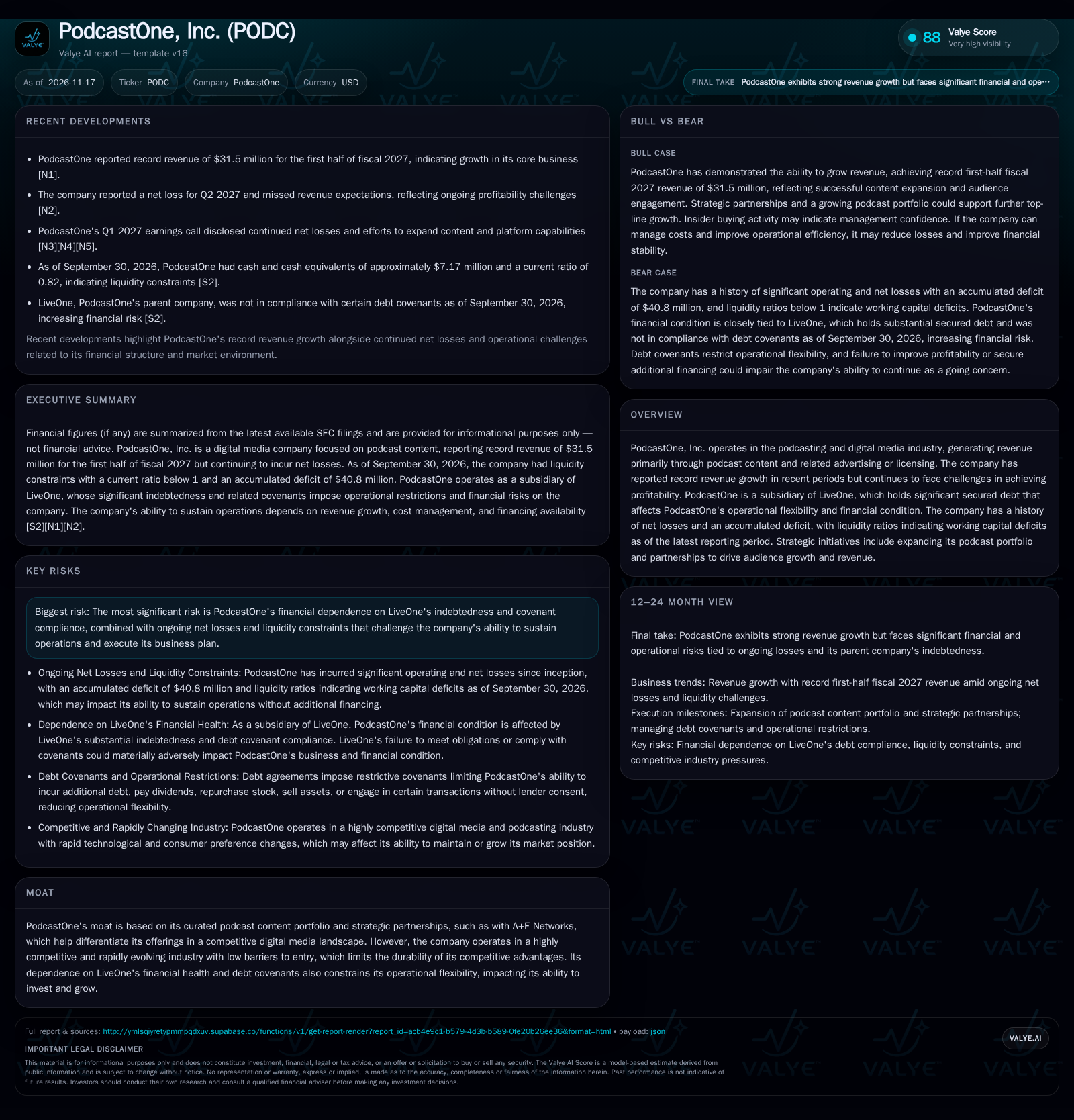
PodcastOne posted record first-half FY2027 revenue, reflecting successful content expansion and strategic partnerships. However, the company remains loss-making, with liquidity ratios below 1 and an accumulated deficit of $40.8 million. As a subsidiary of heavily indebted LiveOne, PodcastOne is subject to restrictive debt covenants and heightened financial risk. Its ability to achieve stability depends on growing revenue, cost discipline, and securing new financing or improved profitability. [S2] [N1]
With LiveOne’s own debt compliance issues looming large, PodcastOne’s ability to convert audience and content gains into lasting financial stability is deeply uncertain. The next chapters for PodcastOne will likely be shaped as much by capital and governance dynamics as by the evolution of its content strategy.
Liquidity Squeeze and Parent-Driven Restrictions Define the Near-Term Landscape
PodcastOne reported record revenue of $31.5 million for the first half of fiscal 2027, reflecting successful efforts to expand its content portfolio and audience reach [N1]. The company reported cash and liquidity metrics for the period; these figures do not by themselves establish operating runway, investment capacity, financial flexibility, or financing capacity. [S2] Net losses persist, with a six-month deficit of $479,000 and an accumulated deficit of $40.8 million [S2]. Critically, PodcastOne’s operational flexibility is sharply constrained by LiveOne’s significant debt, which is secured by PodcastOne’s assets and subject to restrictive covenants. LiveOne’s non-compliance with certain covenants as of September 30, 2026, further heightens risk for PodcastOne, as its ability to operate and invest is now closely tied to its parent’s financial health and lender negotiations [S2].
Revenue Model, Cost Structure, and the Elusive Path to Operating Leverage
PodcastOne generates revenue primarily from advertising and licensing related to its podcast content. The company’s business model relies on scaling audience engagement and monetizing it through ad sales, sponsorships, and potential licensing of popular content to third-party platforms. In theory, as download volume and listenership rise, incremental ad revenue should outpace the growth in content production and distribution costs—a classic pursuit of operating leverage.
However, the fixed cost base for premium content acquisition, talent contracts, production, and technology infrastructure is significant, especially as competition for marquee creators increases. The company’s history of persistent net losses and a $40.8 million accumulated deficit suggests that, to date, revenue growth has not yet delivered the scale economies or margin expansion needed for break-even. The capital intensity is further amplified by the need to continually invest in content and platform innovation to keep pace with rivals and evolving listener preferences.
This dynamic creates a cycle: content expansion can drive revenue, but only if the company can fund it, and only if incremental revenue meaningfully exceeds the cost of new content and platform development.
Content Differentiation and Partnerships: Defensible Niche or Commodity Trap?
PodcastOne’s competitive position rests on the breadth and quality of its curated podcast portfolio, bolstered by partnerships such as those with A+E Networks [N1]. In a crowded digital media landscape, exclusive or differentiated content is the primary lever for attracting both listeners and advertisers. The company’s ability to grow downloads and forge new distribution or content alliances offers some insulation against pure commodity competition.
However, barriers to entry in podcasting remain low, and established platforms (e.g., Spotify, Apple Podcasts, iHeartMedia) possess greater scale, data analytics, and cross-promotional power. PodcastOne’s partnership strategy may enable access to unique audiences and incremental ad inventory, but its bargaining power with top creators and advertisers is limited relative to larger peers. The risk is that content exclusivity can be expensive to acquire and fleeting, while audience loyalty is often shallow in the absence of platform-level switching costs or strong network effects.
The company’s dependence on LiveOne’s financial health further weakens its position: if capital is constrained, PodcastOne may be unable to compete for high-profile talent or invest in marketing at the levels required to sustain growth.
If Content Expansion and Partnerships Drive Profitable Scale
The most optimistic outcome for PodcastOne is that recent record revenue growth signals a sustainable inflection point, where platform and content investments begin to yield operating leverage. If the company can continue to expand its portfolio—through partnerships, exclusive deals, or organic audience growth—while keeping incremental costs in check, it could achieve break-even or even positive margins within the next several reporting periods.
Evidence that would confirm this scenario includes a narrowing of net losses or transition to net profitability, consistent growth in unique downloads/listeners, and the signing of additional content or distribution partnerships that materially expand the company’s audience reach. A reduction in the cost per incremental dollar of revenue (i.e., expanding gross margins) and the ability to fund content growth from internal cash flow, rather than external financing, would further validate the bull case. Insider buying, already observed, would be more meaningful if coupled with improving financial results [N1].
Incremental Revenue Gains Offset by Persistent Cost and Capital Pressures
The most plausible near-term scenario is one of continued revenue growth from content and partnership initiatives, but with ongoing net losses and persistent liquidity strain. Content expansion may drive top-line improvements, but rising costs for talent, production, and marketing—combined with competitive bidding for creator relationships—are likely to keep margins under pressure. Operational restrictions from LiveOne’s debt covenants further limit the company’s ability to invest freely or pivot strategically.
Confirmation of this scenario would come from sequential revenue growth that is offset by flat or worsening net losses, continued negative operating cash flow, and periodic disclosures of covenant-related operational constraints. If the company continues to require external financing to fund content or platform expansion, and if the parent’s financial health does not materially improve, PodcastOne may remain in a holding pattern: demonstrating audience and content momentum, but unable to achieve financial self-sufficiency.
Escalating Financial Strain and Parent-Driven Disruption
In the adverse scenario, the combination of liquidity constraints, ongoing net losses, and parent-level covenant breaches intensifies, resulting in operational disruptions or forced asset sales. If LiveOne’s lenders exercise rights over PodcastOne’s assets or impose stricter controls, the subsidiary’s ability to invest in content or meet obligations could be severely curtailed. This could lead to talent or audience attrition, loss of critical partnerships, or even a restructuring event.
Indicators confirming this scenario would include further deterioration in liquidity metrics, evidence of missed payments or delayed content launches, announcements of divestitures or asset sales under lender pressure, or the loss of key talent/partnerships. Material negative changes in parent-level (LiveOne) debt compliance or refinancing outcomes could cascade directly into PodcastOne’s operations.
Factors That Will Shape PodcastOne’s Financial and Strategic Trajectory
Quarterly trends in net losses and operating cash flow: sustained improvement would suggest progress toward break-even; persistent or worsening deficits would raise going-concern risk.
Growth in unique downloads, listener engagement, and advertising revenue—if disclosed, these would clarify whether content expansion is translating into monetizable audience scale.
Gross margin trends, particularly the cost per incremental dollar of revenue, which would reveal whether operating leverage is achievable.
The status of LiveOne’s debt covenant compliance and any changes to lender restrictions, as these directly affect PodcastOne’s operational flexibility and risk profile.
Announcements of new or expanded content partnerships, especially those with material revenue or audience impact.
Insider buying or selling activity, especially if correlated with major business developments.
Disclosures regarding additional financing, asset sales, or changes to capital structure, which could signal either relief or distress.
Disclaimer: This is research-only, informational analysis and not investment advice. It may include AI-generated interpretation and general industry context. Always verify important details using primary sources.

Comments