
PAID INC: Integrated Payment and Logistics Ambition Meets Margin Compression and Capital Demands
Revenue growth at PAID INC underscores the traction of its shipping and warehousing platforms, but persistent net losses and rising operating expenses highlight the challenge of scaling an integrated SMB solution profitably. The next phase will test whether expanded service breadth and network effects can offset margin compression and capital needs.
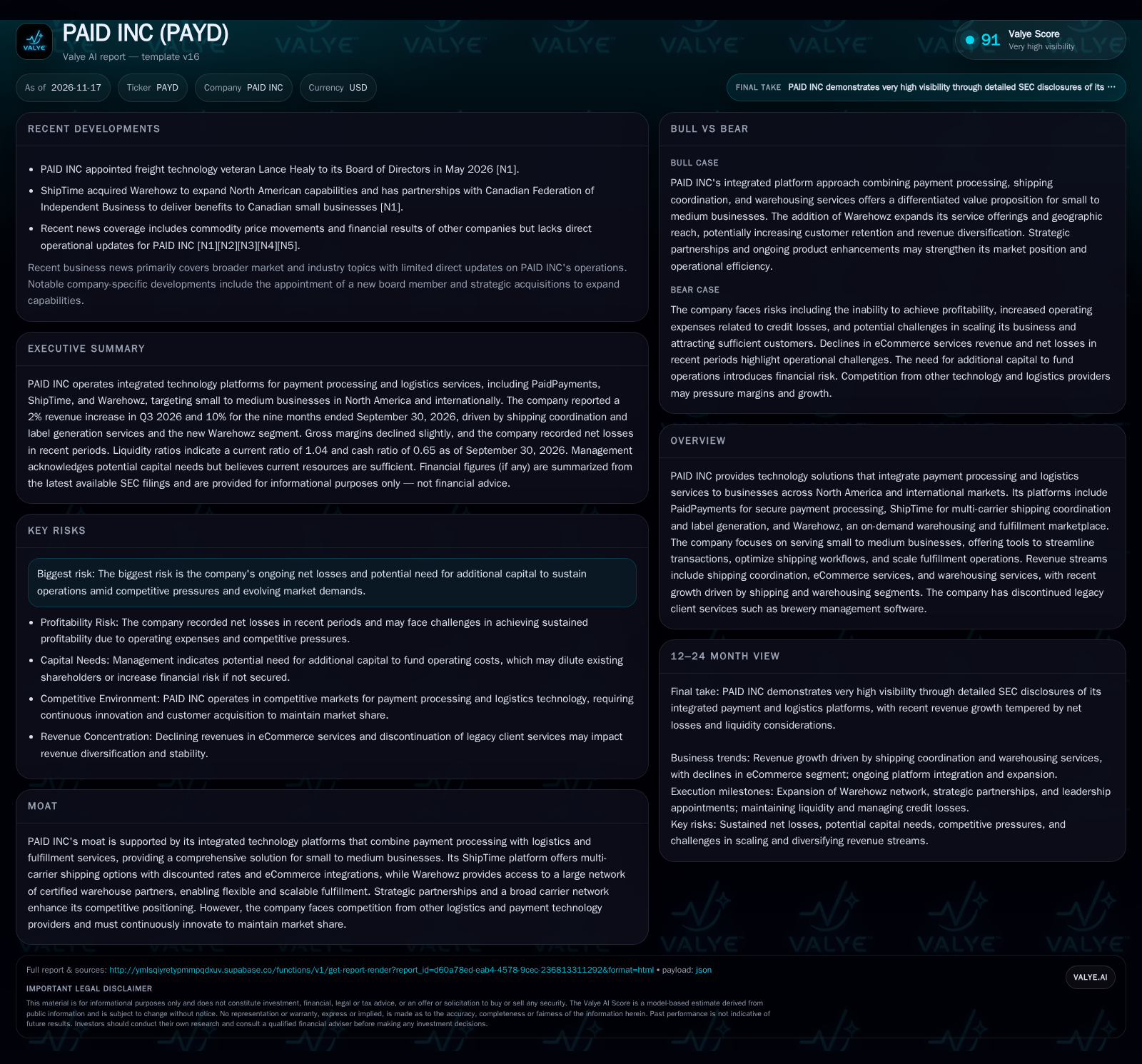
PAID INC reported 2% Q3 2026 revenue growth and 10% growth for the first nine months, driven by its ShipTime shipping platform and the new Warehowz warehousing marketplace. However, gross margins slipped to 21-22%, operating expenses rose on credit loss allowances, and the company posted a net loss for the quarter and year-to-date. Management notes current cash resources may suffice for 12 months but flags potential capital needs if growth or losses persist. The company is discontinuing legacy services to focus on core logistics and payments platforms, with competitive pressures and operating leverage key to its outlook. [S2]
PAID INC is pursuing a unified value proposition for small and medium businesses by integrating payment processing, logistics, and warehousing on a single technology backbone. This breadth has delivered moderate revenue growth in 2026, particularly as the company expands its ShipTime and Warehowz platforms. Yet, as net losses persist and operating costs rise, the question is whether scale, network effects, and service expansion can overcome margin pressure and capital requirements. The company’s next chapter hinges on converting its integrated platform into durable profitability while navigating a competitive and capital-intensive environment. [S2]
Recent Results Reflect Expansion and Margin Pressure
For the three months ended September 30, 2026, PAID INC reported total net revenues of $5.62 million, a 2% year-over-year increase, and 10% growth for the first nine months of 2026. Growth was led by shipping coordination, label generation, and the addition of Warehowz, an on-demand warehousing marketplace. [S2]
Gross margins declined to 22% in Q3 and 21% year-to-date, down from 23% in prior periods, pointing to ongoing cost and pricing pressures. [S2]
Operating expenses jumped 26% in Q3, driven largely by a credit loss allowance, resulting in a net loss of $287,556 for the quarter and $336,490 year-to-date. [S2]
The company reported cash and liquidity metrics for the period; these figures do not by themselves establish operating runway, investment capacity, financial flexibility, or financing capacity. [S2]
Integrated Platform Economics: Fixed Costs, Service Mix, and the Path to Scale
PAID INC’s business model depends on aggregating payment processing, shipping coordination, and warehousing services for SMBs, extracting value from transaction fees, service subscriptions (if offered), and possibly volume-based discounts through carrier and warehouse partner relationships. The ShipTime platform’s multi-carrier rate comparison and the Warehowz marketplace’s on-demand fulfillment both aim to monetize the complexity of logistics for small merchants, who lack scale individually.
The company’s cost structure likely features significant fixed technology and integration expenses, with variable costs tied to payment processing and shipping volumes. Gross margins in the low 20% range suggest that much of the revenue is passed through to carrier and fulfillment partners, with PAID INC retaining a relatively small take rate. This limits near-term operating leverage unless customer volumes rise sharply or higher-margin value-added services (such as insurance, audit, or premium integrations) gain traction.
Recent operating expense increases—particularly from credit loss allowances—highlight the risks of extending payment terms or holding receivables for a diverse SMB customer base. The need for continued investment in platform development, compliance, and customer acquisition also means capital requirements remain elevated, and the company’s ability to reach break-even likely depends on both scaling volume and improving service mix economics.
Competing for SMB Loyalty: Integrated Solution vs. Specialized Rivals
PAID INC faces intense competition across all its service lines. In payment processing, the company competes with both large-scale incumbents and fintech startups offering seamless onboarding, transparent pricing, and broad integrations. In logistics and shipping, multi-carrier platforms and direct carrier portals offer similar rate-comparison and label-generation features, while eCommerce platforms increasingly embed logistics services directly.
The Warehowz marketplace could provide differentiation by offering flexible, on-demand warehousing capacity—an area where national logistics providers may be less nimble. However, the success of this model depends on aggregating a critical mass of both warehouse partners and merchant customers, and on maintaining service reliability. The breadth of PAID INC’s integrated platform could be a moat if switching costs, workflow integration, or volume-based pricing advantages emerge, but these have not yet been established in the supplied evidence.
The company’s focus on small and medium businesses, particularly through Canadian association partnerships, offers a targeted channel but also exposes PAID INC to high customer churn and sensitivity to pricing. To defend its position, the company must continuously innovate, deepen integrations, and possibly bundle or cross-sell services to increase retention and average revenue per user.
Network Effects and Service Expansion Drive Operating Leverage
A favorable outcome for PAID INC would see the ShipTime and Warehowz platforms achieving critical mass, with growing transaction volumes enabling the company to negotiate better rates with carriers and warehouse partners. These savings could be shared with customers to drive further adoption, while the company retains more margin. If eCommerce integrations and value-added services such as branded tracking, insurance, and analytics gain traction, the service mix could shift toward higher-margin offerings.
Network effects—where more merchants attract more warehouse partners and vice versa—could create defensible scale economics, reducing customer acquisition costs and increasing switching frictions. Additional upside could come from embedding PAID INC’s logistics and payment capabilities into third-party platforms or marketplaces, expanding reach without proportional sales and marketing spend.
Evidence supporting this scenario would include accelerating revenue growth, rising gross margins, higher average revenue per customer, and declining operating expenses as a percentage of revenue. Demonstrated growth in Warehowz adoption and cross-platform usage would further validate the thesis.
Incremental Growth Offset by Persistent Margin and Capital Constraints
The most plausible near-term outcome is that PAID INC continues to deliver modest revenue growth driven by its shipping and warehousing platforms, but sees ongoing margin compression due to competitive pricing, high partner costs, and a challenging SMB customer base. Gross margins may remain in the low 20% range unless service mix or pricing power improves.
Operating expenses are likely to remain elevated due to platform investment and credit risk management, keeping the company near or below break-even. Cash resources, while recently improved, may prove insufficient if net losses persist, requiring additional capital or cost reductions. The discontinuation of legacy services and declining eCommerce revenues suggest that revenue diversification will be an ongoing challenge.
Confirmation of this scenario would come from continued low double-digit revenue growth, stable or declining gross margins, and periodic net losses, with management seeking bridge financing or alternative capital sources as necessary.
Profitability Eludes as Costs Outpace Growth and Capital Access Tightens
In a more adverse scenario, PAID INC’s revenue growth stalls as competitive offers erode its market share or pricing, while customer churn rises due to undifferentiated features or service issues. Gross margins could compress further if carrier or warehouse partner costs rise, or if discounting becomes necessary to retain customers.
Operating expenses may become increasingly burdensome if credit losses mount or if the company is forced to spend more to acquire and retain customers. If cash burn accelerates and external capital is unavailable or only available on dilutive terms, PAID INC could face liquidity stress, curtailing investment in platform development and threatening its ability to compete.
Signs of this scenario would include flat or declining revenues, shrinking gross margin, rising credit losses, negative net working capital, and management warnings about the adequacy of cash resources.
What Will Determine PAID INC’s Ability to Translate Growth into Profitability?
Sustained revenue growth rates for ShipTime and Warehowz platforms, especially sequential acceleration or deceleration, would help test the company’s ability to scale.
Trends in gross margin—particularly any improvement above the low 20% range—would indicate success in capturing more value or improving service mix.
Operating expense control, with emphasis on credit loss allowances and the efficiency of sales and marketing spend, will be crucial to approaching break-even.
Customer retention and churn rates, if disclosed, would clarify whether integrated platform adoption is improving stickiness among SMB clients.
Adoption and revenue contribution from value-added services such as insurance, analytics, or premium integrations would help assess margin expansion potential.
The pace of Warehowz network expansion—both in terms of warehouse partners and active merchant users—would signal the viability of the on-demand fulfillment model.
Disclosures or events related to external capital raising, bridge financing, or alternative funding arrangements would indicate the degree of potential financial flexibility or stress.
Evidence of deeper integration partnerships with eCommerce platforms or associations (if disclosed) could validate the channel strategy and broaden the addressable market.
Disclaimer: This is research-only, informational analysis and not investment advice. It may include AI-generated interpretation and general industry context. Always verify important details using primary sources.

Comments