
SolarMax Technology: Working Capital Strain Meets Niche Solar Expansion Ambition
SolarMax Technology, Inc., a Nasdaq-listed solar project developer, faces acute working capital challenges and persistent losses even as it pursues new verticals like cryptocurrency-powered solar installations. The company’s ability to convert revenue growth into operating leverage remains unproven, and near-term viability hinges on both execution and access to additional funding.
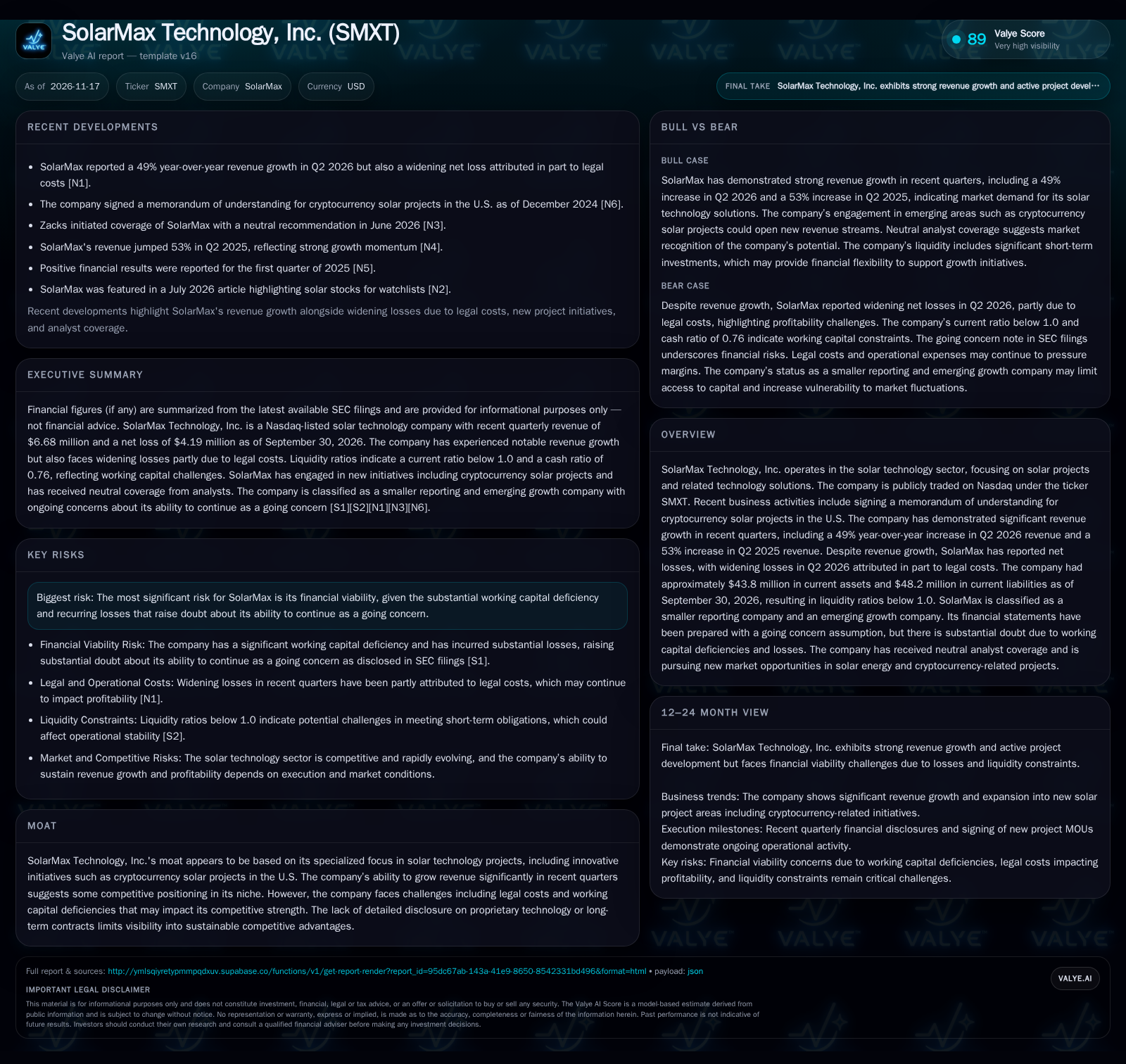
SolarMax Technology reported $6.68 million in revenue and a net loss of $4.19 million for the quarter ended September 30, 2026, with a current ratio of 0.91 and a cash ratio of 0.76. The company’s working capital deficiency and going concern warning underscore financial fragility, even as it pursues growth in specialized solar project segments, including the cryptocurrency sector. Sustainable progress will require both margin improvement and a credible path to liquidity relief. [S2] [N6]
SolarMax Technology, Inc. sits at a critical juncture: despite robust revenue growth in recent quarters, the company’s persistent losses and working capital shortfall have triggered a going concern warning. With cash and short-term investments totaling $36.6 million against current liabilities of $48.2 million, SolarMax is under pressure to translate its niche positioning in solar—and new bets in crypto-linked projects—into sustainable profitability. The company’s near-term trajectory will likely be determined by its ability to improve margins, secure additional funding, and demonstrate that recent growth is more than a temporary uptick.
Liquidity Deficiency and Revenue Growth: The Immediate Stakes for SolarMax
As of September 30, 2026, SolarMax Technology reported $6.68 million in quarterly revenue but posted a net loss of $4.19 million, with basic and diluted EPS at -$0.88 [S2]. The company’s current assets stood at $43.82 million, against current liabilities of $48.24 million, resulting in a current ratio of 0.91 and a cash ratio of 0.76 [S2]. These ratios fall below the standard threshold for short-term financial health, reinforcing the company’s own disclosure that substantial doubt exists regarding its ability to continue as a going concern [S1].
Operationally, SolarMax continues to target niche opportunities, most notably by signing a memorandum of understanding in December 2024 for U.S.-based cryptocurrency solar projects [N6]. While this signals an intent to capture new markets, the company’s working capital deficit and ongoing losses place immediate pressure on both execution and financing options.
How SolarMax’s Revenue Model Faces Margin Pressure and Capital Constraints
SolarMax’s core business centers on developing and deploying solar projects, with revenue likely derived from a mix of project development fees, equipment installation, and potentially ongoing service agreements. The company’s reported $6.68 million in quarterly revenue represents top-line momentum, but the accompanying net loss of $4.19 million indicates that fixed costs, legal expenses, or low gross margins are diluting the impact of revenue growth [S2] [N1].
Solar project development is typically capital-intensive, entailing upfront procurement, permitting, and installation expenses. If SolarMax is primarily a project developer rather than a long-term asset owner, revenue recognition could be lumpy and tied to project milestones, while margin visibility would be limited until scale is achieved. The company’s foray into cryptocurrency-linked solar projects may introduce new revenue mechanisms (e.g., power purchase agreements with crypto miners or joint ventures), but these models are inherently volatile and exposed to both energy and crypto market cycles.
With current liabilities exceeding current assets, SolarMax’s funding structure is under stress. Short-term investments ($35 million) offer a cushion, but without positive operating cash flow or access to additional capital, the company may be forced to adjust its project pipeline or pursue dilutive financing. Operating leverage is not yet visible: despite 49% revenue growth in Q2 2026, losses widened, suggesting that incremental revenue is not translating into profitability [N1].
Specialization in Niche Solar: Competitive Potential Versus Structural Weakness
SolarMax’s competitive positioning appears anchored in its willingness to serve specialized segments, such as cryptocurrency-related solar installations, which many larger solar EPCs and utilities may avoid due to volatility or reputational risk [N6]. This focus could allow SolarMax to command higher margins or secure projects less accessible to mainstream competitors—if the company can execute and withstand the sector’s swings.
However, the lack of evidence for proprietary technology, long-term contracts, or ecosystem lock-in limits the visibility into any durable competitive moat. In the broader solar value chain, SolarMax competes with local installers, national project developers, and vertically integrated energy companies, many of which have lower cost of capital and better access to project finance. If SolarMax’s growth is driven primarily by opportunistic or one-off projects, customer retention and recurring revenue could remain elusive.
The company’s classification as a smaller reporting and emerging growth company may further constrain its bargaining power with suppliers and customers, and limit its ability to invest in R&D or sales infrastructure at scale [S1].
Unlocking Margin Expansion Through Project Execution and New Vertical Success
The most favorable scenario for SolarMax involves translating its recent revenue growth into consistent cash generation by achieving scale and project execution efficiency. If the company can complete and monetize a pipeline of higher-margin projects—particularly in the cryptocurrency vertical, where demand for renewable energy is acute—operating leverage could improve, and recurring business (e.g., service contracts or power sales) could materialize.
Confirmation of this scenario would require evidence of: (a) successful completion and revenue recognition from new project types, (b) margin expansion on a per-project or consolidated basis, and (c) disclosure of multi-year customer agreements or recurring revenue streams. A narrowing net loss or a shift to positive operating cash flow, even at modest scale, would further validate the thesis.
Falsification would be signaled by continued losses despite revenue growth, delays in project execution, or lack of follow-on agreements in the cryptocurrency solar segment.
Incremental Growth but Persistent Strain: The Most Likely Trajectory
The most plausible near-term outcome is that SolarMax delivers modest revenue growth by executing on its current pipeline, but remains challenged by working capital constraints and limited margin expansion. New verticals, such as crypto-linked solar, may yield initial projects but are unlikely to deliver recurring or high-margin revenue in the short term given the volatility and nascency of the market.
Under this scenario, the company continues to report losses and may need to pursue additional capital through debt, equity, or asset sales. Confirmation would come from stagnant or slightly improving revenue without a commensurate improvement in net margin or cash flow, ongoing going concern disclosures, and a lack of sustained project backlog.
Falsification would occur if SolarMax demonstrates a credible turnaround in profitability, achieves and reported liquidity-ratio trends above 1.0, or announces a significant long-term contract or partnership that changes the revenue mix.
Liquidity Crunch and Project Delays: What Could Push SolarMax into Distress
A negative outcome would be triggered by further widening losses, project execution setbacks, or failure to close anticipated deals in new verticals. If short-term investments are depleted to fund operations without replenishment or if working capital deteriorates further, SolarMax could face acute liquidity stress, forcing it to pause projects, lay off staff, or seek emergency financing under unfavorable terms.
Additional legal or regulatory costs—already cited as a driver of recent losses—could exacerbate the situation [N1]. An inability to secure new project wins or to convert the cryptocurrency MOU into revenue-generating contracts would further undermine confidence.
Falsification would require evidence of stabilized or improved liquidity, such as a material capital raise, positive operating cash flow, or a significant reduction in legal/operational expenses.
Milestones That Will Determine Whether SolarMax Can Achieve Sustainable Growth
Quarterly gross and operating margin trends—if disclosed—would reveal whether revenue growth is translating into improved profitability.
Progress in converting the cryptocurrency solar MOU into signed contracts and recognized revenue would test the viability of this new vertical.
Disclosure of multi-year, recurring contracts or backlog would be a strong signal of revenue visibility and customer retention.
Any capital raising activity (debt or equity), its terms, and the use of proceeds will directly impact runway and project execution capacity.
Legal and regulatory expense trends—especially if legal costs continue to drive widening losses—should be closely monitored.
The company’s ability to maintain or improve its current ratio above 1.0 would indicate improved short-term liquidity management.
Disclaimer: This is research-only, informational analysis and not investment advice. It may include AI-generated interpretation and general industry context. Always verify important details using primary sources.

Comments