
XCF Global: Ambition in Sustainable Aviation Fuel Meets Acute Liquidity and Execution Strains
The company’s ability to convert strategic intent into scalable, sustainable operations remains in question.
Execution and funding risks define the near-term outlook as the company attempts to establish a durable position in renewable fuels.
XCF Global, Inc. stands at a crossroads: it has articulated a bold $1 billion vision to expand sustainable aviation fuel (SAF) production and global reach, and boasts a leadership team with deep sector experience. As the company grapples with the resource drain of recent business combinations and ongoing disputes, the question is whether it can marshal the capital and focus required to deliver on its strategic roadmap—or whether it risks becoming another cautionary tale in the capital-intensive renewable fuels sector.
Liquidity Squeeze and Legal Disputes Define the Near-Term Reality
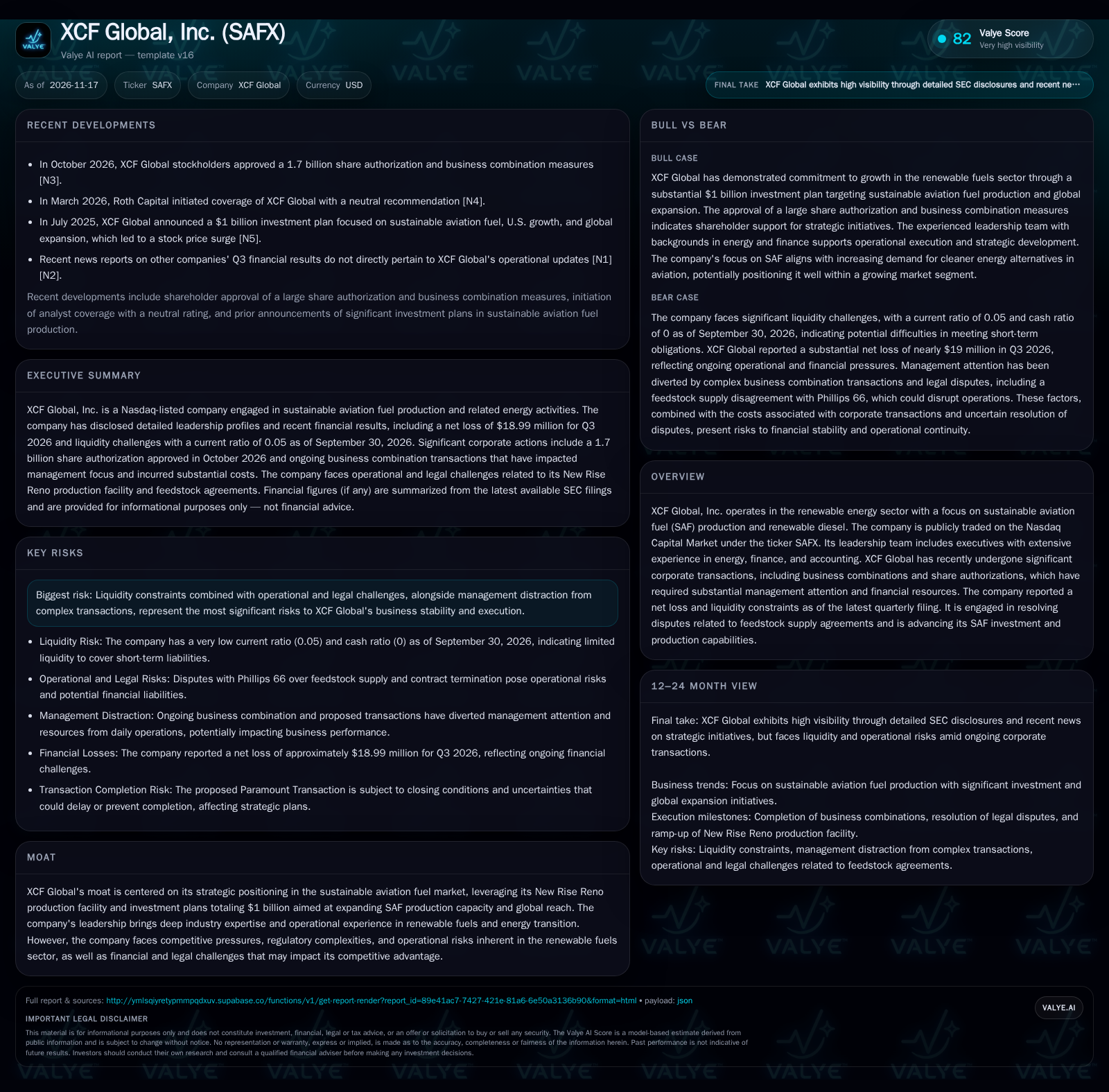
XCF Global’s most pressing fact is its acute liquidity shortfall: as of September 30, 2026, the company reported cash and cash equivalents of just $1.16 million against current liabilities of $258.7 million, translating to a current ratio of 0.05 and a cash ratio of 0 [S2]. This means the company had virtually no liquid resources to cover its short-term obligations at quarter’s end. The New Rise Reno facility, XCF Global’s core asset for SAF and renewable diesel, faces operational disruption due to ongoing legal disputes with Phillips 66 over feedstock supply and contract termination [S2]. These challenges are compounded by the aftereffects of business combination transactions, which have diverted management bandwidth and absorbed significant advisory costs [S2]. Despite these headwinds, the company continues to pursue its $1 billion SAF investment plan, first announced in July 2025 [N5].
Cost Structure and Capital Demands in the SAF Value Chain
The economics of sustainable aviation fuel (SAF) production are fundamentally capital-intensive and margin-challenged, especially in early scaling phases. XCF Global’s business model, as inferred from its focus on the New Rise Reno facility, likely relies on high upfront investment for plant buildout and feedstock procurement, with operating leverage contingent on ramping production volumes and securing stable supply contracts. The company’s reported revenue for the March 2026 period was just $348,688, dwarfed by a quarterly net loss approaching $19 million as of September 2026 [S2]. This suggests either early-stage production, operational bottlenecks, or weak pricing power. Fixed costs (depreciation, plant staffing, regulatory compliance) and large working capital requirements for feedstock acquisition dominate the cost structure, while variable costs hinge on feedstock pricing and processing yields. Without established long-term offtake agreements or subsidies, cash flow volatility is likely high. The company reported cash and liquidity metrics for the period; these figures do not by themselves establish operating runway, investment capacity, financial flexibility, or financing capacity.
In addition to high capital intensity, the SAF value chain is characterized by significant feedstock price volatility, which directly impacts gross margins. Feedstock inputs such as waste oils or agricultural residues are often subject to seasonal availability and competition from other biofuel producers or industrial users. This price uncertainty complicates budgeting and forecasting, especially for a company like XCF Global that lacks long-term supply contracts. Furthermore, the conversion technologies employed in SAF production typically have variable yields and energy consumption rates, meaning operational efficiency gains are critical to improving unit economics. Without scale, fixed overheads and regulatory compliance costs create a structural cost disadvantage relative to larger, integrated competitors. A useful metric would be the company’s feedstock cost as a percentage of total production cost, which would help test the thesis around cost competitiveness and scalability.
Strategic Positioning and the Realities of the SAF Competitive Landscape
XCF Global aims to carve out a position in the SAF market—a segment attracting major oil refiners, integrated energy companies, and specialized renewables players. The company’s leadership team brings deep industry expertise, which could help in navigating regulatory hurdles and structuring feedstock or offtake agreements. However, the sector is marked by intense competition for feedstock (such as waste oils and agricultural byproducts), technological complexity, and regulatory uncertainty. XCF Global’s legal dispute with Phillips 66 over feedstock underscores the competitive tension for critical inputs [S2]. Larger incumbents may benefit from integrated supply chains, stronger balance sheets, and established customer relationships with airlines and logistics firms. For XCF Global to build durable advantages, it will need to secure reliable feedstock sources, achieve cost-competitive production, and lock in long-term offtake agreements—none of which are currently established as facts. Regulatory support (mandates, credits) could help, but is subject to policy risk and political cycles.
The competitive dynamics in the SAF sector also hinge on the ability to integrate vertically or establish strategic partnerships that mitigate supply chain risks. For XCF Global, securing feedstock is not only about volume but also about feedstock quality and consistency, which affect processing efficiency and final fuel specifications. Larger incumbents often leverage their upstream assets or long-standing supplier relationships to lock in feedstock at favorable terms, creating barriers to entry. Additionally, airline customers increasingly demand sustainability certifications and lifecycle emissions transparency, which require investments in traceability and quality assurance systems. XCF Global’s capacity to meet these evolving customer expectations will influence its market acceptance and pricing power. The company’s competitive positioning would be strengthened by demonstrating progress in these areas, which are prerequisites for durable contracts and premium pricing.
If Capital Is Secured and Operations Stabilize, Scale and Partnerships Could Unlock Value
A favorable scenario for XCF Global hinges on successful recapitalization—via equity, debt, or strategic investment—to address its liquidity crisis and fund working capital needs. Resolution of the Phillips 66 dispute, or the securing of alternative feedstock agreements, would allow the New Rise Reno facility to ramp production. With increased output, the company could pursue long-term offtake contracts with airlines or logistics partners, providing revenue visibility and better negotiating leverage. If regulatory frameworks (such as SAF blending mandates or tax credits) remain supportive, XCF Global could benefit from premium pricing and improved margins. Evidence that would confirm this scenario includes: successful debt or equity raises, public announcements of major feedstock or offtake agreements, and a meaningful increase in production volumes and recognized revenue. Conversely, if the company fails to resolve its liquidity or feedstock issues, this upside becomes implausible.
Operational stabilization at the New Rise Reno facility would also enable XCF Global to explore incremental margin improvement opportunities through process optimization and feedstock diversification. For instance, integrating multiple feedstock streams can reduce dependency on any single supply source and potentially lower average feedstock costs. Additionally, advances in catalytic conversion technologies or co-processing methods could enhance yields or reduce energy consumption, improving profitability. If the company can demonstrate operational learning curves and cost reductions over time, it may attract further investment and strategic partners. Moreover, successful scale-up could position XCF Global to participate in emerging carbon credit markets or sustainability-linked financing arrangements, further enhancing potential financial flexibility and valuation. These mechanisms depend on the company’s ability to execute and document operational improvements transparently.
Business Model Remains Constrained by Funding and Execution Risks
The most plausible near-term outlook is that XCF Global continues to struggle with liquidity and operational bottlenecks. Legal disputes may drag on, limiting feedstock availability and stalling production at the New Rise Reno facility. Management, distracted by the aftermath of business combinations, may find it difficult to execute on core operational priorities. Revenue remains modest, and unless substantial new funding or strategic partnerships are secured, the company could face further dilution or even insolvency risk. Evidence supporting this scenario would include continued low or declining cash balances, lack of new contract announcements, and persistent legal disclosures without resolution.
Unresolved Liquidity and Legal Issues Could Lead to Distressed Outcomes
If XCF Global fails to secure new capital or resolve its legal dispute with Phillips 66, it risks extended production shutdowns, creditor actions, or forced asset sales. The company’s current liabilities vastly exceed liquid resources, and ongoing net losses suggest a limited operational runway [S2]. In this scenario, management’s attention remains divided, and the burden of past business combinations further weakens execution. Delays in regulatory support or changes in SAF market dynamics (such as falling credit prices or increased feedstock costs) would exacerbate financial stress. Confirmation would come from default notices, further legal escalations, or SEC filings indicating going-concern warnings or asset impairment.
Concrete Milestones That Will Determine XCF Global’s Trajectory in SAF
Resolution status of the Phillips 66 feedstock dispute, as this directly affects production continuity and input costs.
Evidence of new debt or equity financing, strategic investments, or asset sales to address the liquidity shortfall.
Disclosure of new long-term feedstock supply contracts or offtake agreements with airlines or other major buyers.
Quarterly production volumes and capacity utilization rates at the New Rise Reno facility, if disclosed.
Trends in cash and current assets versus current liabilities in future SEC filings.
Progress on execution of the $1 billion SAF investment plan, including specific project milestones or expansions.
Any evidence of management restructuring, cost-cutting, or strategic realignment following business combination distractions.
Regulatory developments affecting SAF credits, mandates, or subsidies relevant to the company’s economics.
Disclaimer: This is research-only, informational analysis and not investment advice. It may include AI-generated interpretation and general industry context. Always verify important details using primary sources.

Comments