
TAO Synergies: Decentralized AI Ambition Meets Token Volatility, Governance Centralization, and Regulatory Uncertainty
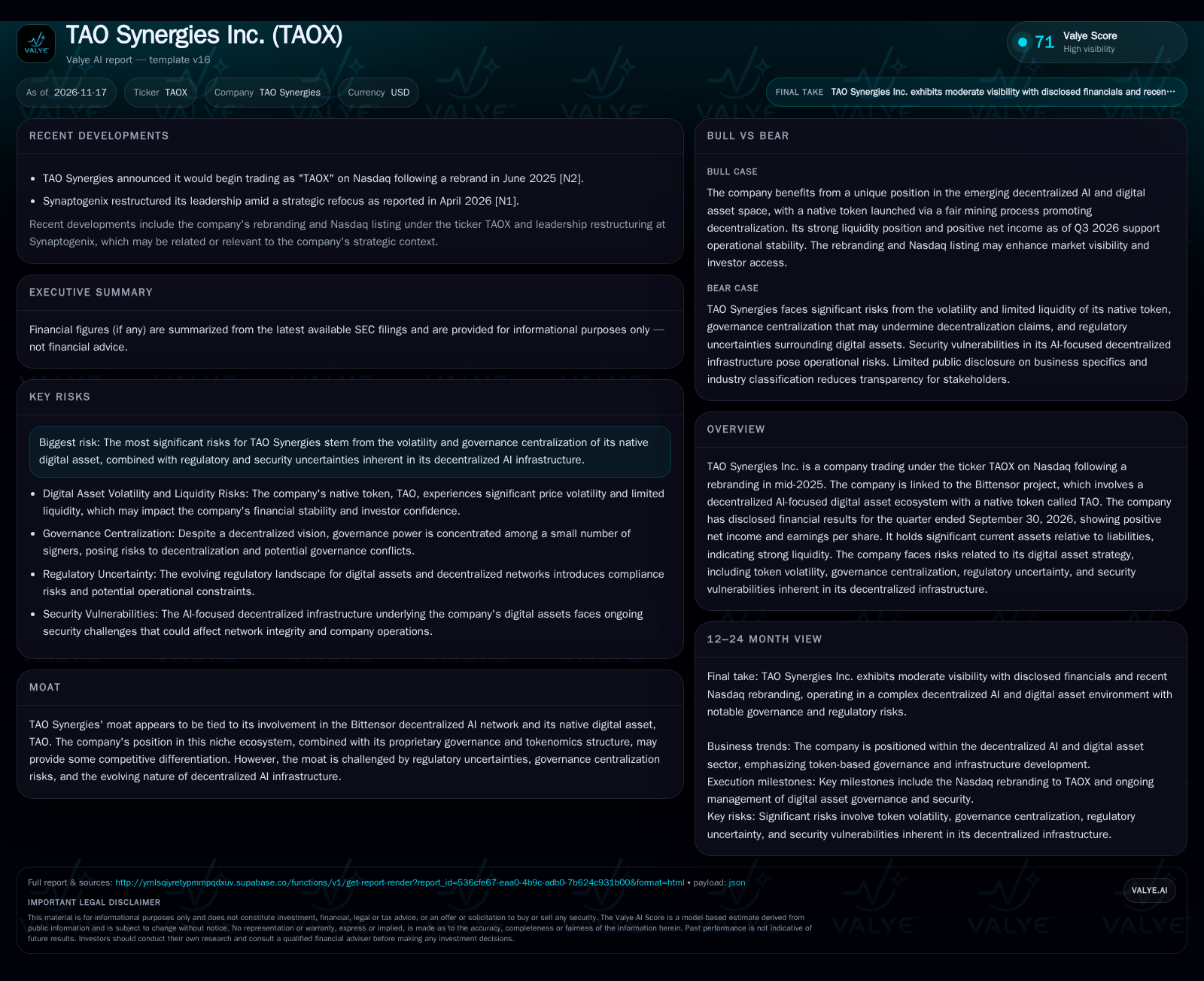
TAO Synergies Inc. (Nasdaq: TAOX) operates at the intersection of decentralized AI and digital assets, reporting reported liquidity position and positive net income as of Q3 2026. Yet its business model is exposed to the risks of TAO token volatility, concentrated governance, and evolving regulatory scrutiny, raising questions about the durability of its competitive positioning.
TAO Synergies shows positive net income and reported liquidity position as of September 2026, backed by current assets far exceeding liabilities. However, its exposure to the Bittensor digital asset ecosystem, governance centralization, and regulatory uncertainty create material risks. The company's decentralized AI infrastructure strategy could yield upside if token adoption and network effects materialize, but execution and external factors remain critical.
TAO Synergies Inc. (Nasdaq: TAOX) stands at a complex crossroads of decentralized AI and digital asset innovation, backed by a reported liquidity position and positive earnings as of Q3 2026. With its rebranding and Nasdaq listing, the company seeks greater market legitimacy, but its fate remains deeply intertwined with the volatile TAO token, concentrated governance structures, and unresolved regulatory questions. The challenge for TAO Synergies is to harness the promise of decentralized AI while navigating persistent risks that could swiftly alter its trajectory.
Financial Health and Strategic Positioning Enter a New Phase
TAO Synergies reported net income of $6,458,553 for the quarter ended September 30, 2026, with basic and diluted earnings per share of $0.38 [S2]. On the balance sheet, the company listed $1,281,239 in cash and cash equivalents, $27,563,343 in current assets, and $1,136,436 in current liabilities, yielding a current ratio of 24.25 and a cash ratio of 1.13 [S2]. These metrics suggest reported liquidity position relative to obligations, though the durability of this position depends on future cash flows and asset volatility. The June 2025 rebranding and commencement of trading as TAOX on Nasdaq signal a strategic effort to enhance visibility and tap public market capital [N2]. The company’s association with the Bittensor project and its native TAO token places its business model at the heart of the decentralized AI and digital asset ecosystem—a niche with high upside potential but significant risks tied to governance and external regulation.
Decentralized Infrastructure and Tokenomics: Economic Model Mechanics
TAO Synergies’ economics are closely linked to the Bittensor decentralized AI ecosystem and the TAO token. The business may monetize by holding, deploying, or transacting in digital assets, potentially earning rewards or fees from participation in the network. This model can generate high-margin, capital-light revenue streams if network adoption and token demand grow, but exposes the company to severe earnings volatility due to token price swings and reported liquidity position. The company’s ability to fund operations, meet preferred stock redemptions, and support executive compensation is currently supported by cash on hand and, if needed, potential sales of TAO tokens, though such sales have not yet occurred and could be at unfavorable prices [S2]. Operating leverage may be high if fixed costs are covered and token-related income scales with network growth, but the lack of recurring, contract-based revenue introduces cyclicality and unpredictability. Capital needs for ongoing R&D, clinical trials, and infrastructure investment could require further financing, with the risk of dilution or restrictive debt covenants if digital asset sales are insufficient or untimely.
Positioning in the Decentralized AI Landscape: Differentiation and Pressures
TAO Synergies’ core differentiation stems from its early involvement in the Bittensor decentralized AI network and proprietary TAO tokenomics. The fair-launch mining process and public network architecture are intended to foster a broad, engaged ecosystem. However, the centralization of governance among a small group of signers undermines claims of full decentralization and exposes the company to governance risks and potential community backlash [S2]. Competitively, TAO Synergies operates in a landscape that includes other decentralized AI protocols, digital asset platforms, and, increasingly, traditional AI companies exploring blockchain integration. The company’s moat depends on network effects, developer adoption, and token utility, but is counterbalanced by rapid technological shifts, regulatory scrutiny, and the risk of forks or rival protocols. If competitors deliver more robust, truly decentralized, or regulatory-compliant solutions, TAO Synergies’ position could erode.
Network Effects and Regulatory Clarity Unlock Value
A favorable trajectory for TAO Synergies would see accelerating adoption of the Bittensor network, with increasing utility and demand for the TAO token driving up both token value and network activity. If regulatory authorities provide clearer frameworks that legitimize digital asset operations, and the company demonstrates improvements in decentralized governance—such as distributing control beyond the current set of signers—investor confidence could rise sharply. Evidence confirming this scenario would include transparent growth in active network participants, third-party adoption of TAO for AI-related tasks, a diversified governance structure, and positive regulatory developments. Sustained positive net income and the ability to fund operations without dilutive equity or distressed token sales would further validate the upside case.
Maintaining a Delicate Balance Between Innovation and Risk
The most plausible medium-term outcome is TAO Synergies maintaining operational stability while navigating persistent token volatility and regulatory ambiguity. The company may continue reporting positive net income, but earnings could fluctuate with TAO token prices and digital asset market sentiment. Governance centralization is likely to persist for some time, limiting the company’s ability to claim full decentralization but not immediately triggering a loss of network participation. Regulatory developments may remain mixed, with ongoing compliance costs and uncertainty. Confirmation of this scenario would be continued Nasdaq listing, steady (if volatile) financial performance, incremental network growth, and no major adverse regulatory or security events. Signs that would falsify this scenario include a sudden loss of network confidence, major regulatory intervention, or a collapse in token value leading to financial distress.
Token Price Collapse and Regulatory Clampdown Threaten Sustainability
A negative scenario would unfold if the TAO token experiences a sharp and sustained price decline, severely eroding the value of the company’s digital asset holdings and undermining its ability to fund operations or meet obligations. Simultaneously, a regulatory crackdown on digital assets or decentralized AI platforms could force costly compliance, restrict core activities, or even delist the company from Nasdaq. If governance disputes or security vulnerabilities lead to network fragmentation or loss of key developers, the ecosystem’s value proposition could quickly unravel. Evidence to watch for would include steep declines in token liquidity and price, regulatory investigations or enforcement actions targeting Bittensor or TAO Synergies, governance breakdowns, or public disclosure of material security breaches.
Milestones and External Factors That Will Shape TAO Synergies’ Trajectory
Trends in TAO token price, liquidity, and trading volume—if disclosed—would directly affect the company’s balance sheet and ability to fund operations.
Progress toward a more decentralized and transparent governance structure for the Bittensor network would help test the long-term sustainability of the ecosystem.
Regulatory developments in the U.S. and other jurisdictions regarding digital assets and decentralized AI infrastructure could materially impact business operations.
Evidence of growing adoption of the Bittensor network by third-party developers, enterprise users, or AI projects would validate the platform’s utility.
The company’s ability to redeem or refinance its Series D and E Convertible Preferred Stock without distressed asset sales or equity dilution.
Disclosure of any significant security incidents, network attacks, or protocol vulnerabilities that could compromise the integrity of the Bittensor infrastructure.
Ongoing Nasdaq compliance and the ability to maintain listing amid evolving business and regulatory conditions.
Material changes in executive compensation, related-party transactions, or partnership commitments that could affect cash requirements or governance.
Disclaimer: This is research-only, informational analysis and not investment advice. It may include AI-generated interpretation and general industry context. Always verify important details using primary sources.

Comments