
iPower Inc.: Crypto Treasury Ambition Meets Operational Restructuring and Execution Risk
iPower’s pivot to digital asset treasury and blockchain infrastructure services, layered on a legacy supply chain platform, brings new volatility, regulatory exposure, and capital constraints. With digital assets pledged as collateral and core operations in transition, the company must prove its ability to generate sustainable returns amid ongoing losses, liquidity limitations, and a shifting competitive landscape.
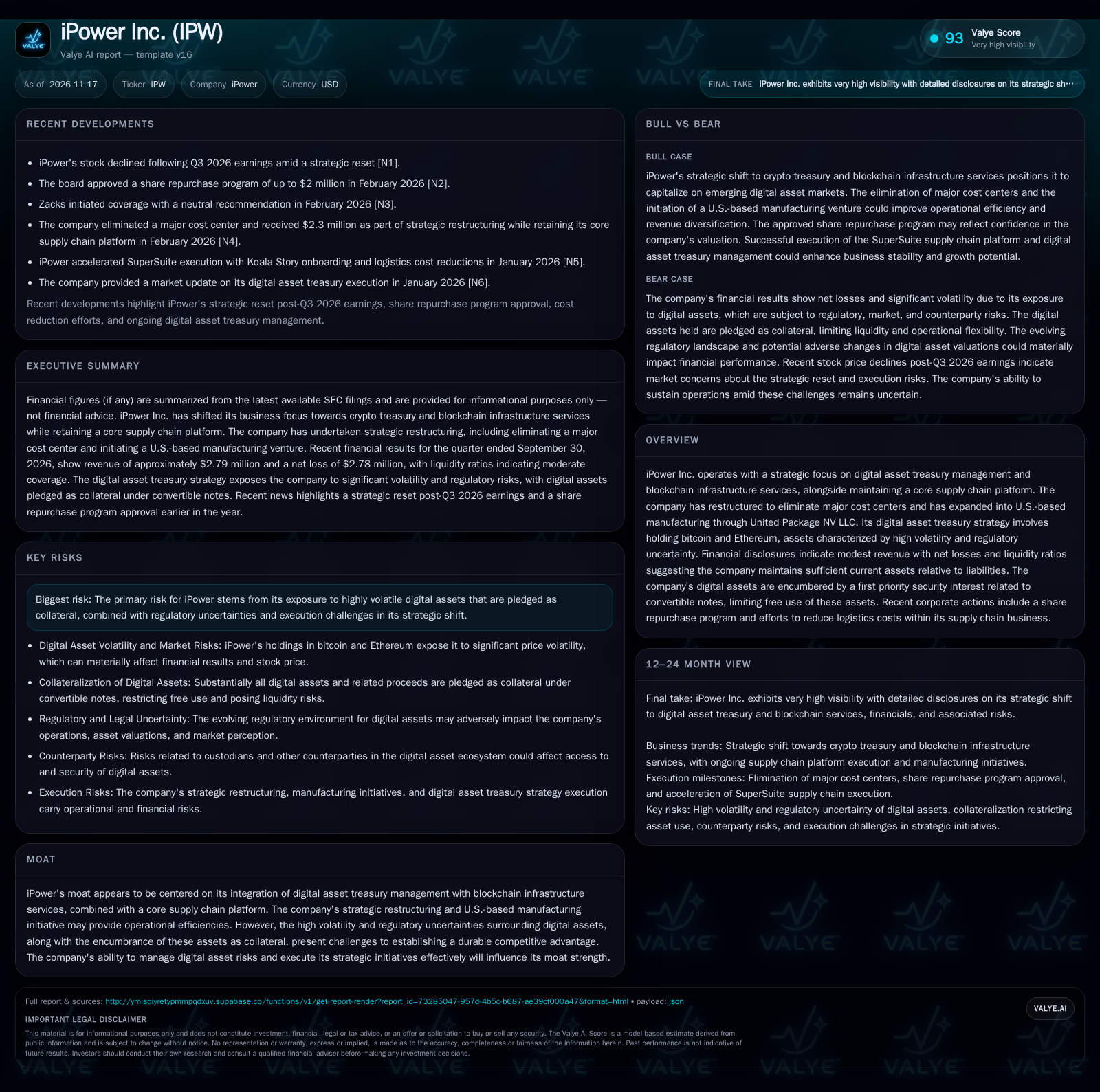
iPower Inc. combines digital asset treasury management with blockchain infrastructure and supply chain services, but its financials reflect ongoing losses and operational restructuring. The company’s digital assets are pledged as collateral, constraining flexibility, while volatility and regulatory uncertainty remain major risks. Near-term outcomes hinge on execution of both the digital asset and supply chain strategies, cost control, and the evolving regulatory environment for crypto holdings. [S2] [S1] [N4] [N7]
iPower Inc.’s strategic reinvention—centered on digital asset treasury management and blockchain infrastructure, while retaining a supply chain platform—marks a bold shift from traditional operations. Recent restructuring, including the elimination of a major cost center and a move into U.S.-based manufacturing, aims to streamline costs and diversify revenue. The company’s fate now rests on its ability to navigate crypto market volatility, regulatory flux, and operational execution, all while proving the viability of its new business model.
Strategic Reset, Losses, and Collateral Constraints Define iPower’s Present
iPower Inc. stands at a strategic crossroad after pivoting to digital asset treasury and blockchain infrastructure services in mid-2025, while maintaining its legacy supply chain platform. The company reported $2.79 million in revenue and a net loss of $2.78 million for the quarter ended September 30, 2026. reported liquidity position: cash and equivalents totaled $1.59 million, with a current ratio of 2.45 and a cash ratio of 0.29, indicating that while current assets cover liabilities, immediate cash availability is thin. A major cost center was eliminated in early 2026, generating $2.3 million in consideration as part of a strategic restructuring. Most notably, iPower’s digital assets—including bitcoin and Ethereum—are pledged as collateral for convertible notes, restricting their use and exposing the company to both market and regulatory risk. [S2] [S1] [N4] [N7]
How iPower’s Hybrid Model Could Create—or Destroy—Shareholder Value
iPower’s revenue streams now blend digital asset treasury (DAT) management, blockchain infrastructure services, and a core supply chain platform. The DAT strategy relies on holding and potentially trading bitcoin and Ethereum, which can generate value through price appreciation or, if actively managed, realized gains—yet introduces significant earnings volatility and capital risk. Unlike recurring SaaS revenues, digital asset gains are inherently unpredictable and subject to sharp swings.
The supply chain business, including the SuperSuite platform, may generate more stable, transaction-based or subscription-like revenue if successful, but its scale remains modest relative to the company’s losses. The elimination of a major cost center aims to reduce fixed costs, but with a net loss nearly equal to revenue, breakeven remains distant. U.S.-based manufacturing via United Package NV LLC could improve gross margins if it enables higher-value or differentiated offerings, but such ventures typically require upfront capital and carry execution risk.
The company reported cash and liquidity metrics for the period; these figures do not by themselves establish operating runway, investment capacity, financial flexibility, or financing capacity. The pledged crypto assets cannot be freely liquidated to cover expenses or invest in growth initiatives, limiting financial agility. This structure also introduces counterparty risk if the value of collateral falls below loan covenants. Operating leverage could improve if the supply chain platform scales, but absent revenue growth, cost discipline alone may not suffice to reach profitability.
Competing on Two Fronts: Digital Asset Infrastructure and Supply Chain Services
iPower faces competition from both established digital asset treasury operators and blockchain infrastructure service providers, as well as traditional supply chain and logistics technology companies. In the crypto treasury space, scale and access to low-cost capital are critical, as are robust risk management and regulatory compliance frameworks. Larger crypto-native firms may enjoy superior trading infrastructure, custody arrangements, and regulatory relationships.
In the supply chain sector, iPower’s SuperSuite platform competes with a crowded field of logistics software, supply chain management, and e-commerce integration providers. Switching costs for enterprise customers can be high if integrations run deep, but the market is highly competitive, and product differentiation is essential to win share. The company’s recent onboarding of customers like Koala Story suggests some traction, but the ultimate economic impact will depend on retention, pricing, and the ability to scale the platform.
The hybrid model—melding digital asset management with traditional supply chain services—is unusual. If iPower can create unique synergies, such as blockchain-enabled supply chain transparency or payment integration, it could carve out a niche. However, the risk is that the company becomes stretched across two challenging domains, lacking scale or a clear competitive advantage in either.
A Path to Upside: Digital Asset Appreciation and Supply Chain Platform Scaling
If digital asset prices rise materially, iPower’s treasury holdings could deliver significant mark-to-market gains, improving the balance sheet and creating optionality for growth investments or debt reduction—provided the collateral structure allows for partial monetization. Successful active management of the digital asset portfolio (if permitted) could further boost returns.
On the operational side, if the SuperSuite supply chain platform gains traction with new enterprise customers and achieves meaningful revenue growth, operating leverage could improve as fixed costs are spread over a larger base. The U.S.-based manufacturing initiative could enhance gross margins if it results in proprietary products or logistics advantages.
Upside would be confirmed by (a) sequential revenue growth in both the supply chain and blockchain infrastructure segments, (b) narrowing operating losses, (c) increased customer adoption and retention metrics for SuperSuite, and (d) a reduction in net debt or improvement in liquidity as digital asset values rise. Regulatory clarity on digital assets would further de-risk the business.
Most Likely Trajectory: Margin Pressure and Execution Strain Amid Volatility
The most plausible course for iPower is continued operational and financial strain as it juggles the volatility of its digital asset holdings, the limitations imposed by collateralization, and the challenges of scaling its supply chain platform. Modest revenue growth may occur if SuperSuite expands its customer base, but losses will likely persist unless there is a dramatic improvement in margin structure or a sustained rally in digital asset prices.
The company will likely remain sensitive to crypto market swings, with quarterly results fluctuating based on bitcoin and Ethereum valuations. The encumbrance of digital assets as collateral will continue to limit flexibility, potentially forcing asset sales or restructuring if values decline. Confirmation of this scenario would include continued net losses, flat or slowly rising revenue, and no material change in liquidity or debt structure.
Adverse Outcomes: Crypto Drawdown and Execution Missteps Intensify Pressure
In a negative scenario, a sharp decline in bitcoin or Ethereum prices would erode the value of iPower’s collateralized assets, potentially triggering debt covenants, margin calls, or forced liquidations. This could further restrict liquidity, impair the balance sheet, and undermine confidence among customers, partners, and creditors.
Simultaneously, if the supply chain platform fails to scale—due to competitive pressures, customer churn, or inability to deliver cost reductions—revenue stagnation would leave the company unable to cover fixed costs. Additional regulatory headwinds or counterparty failures in the crypto ecosystem could exacerbate losses and threaten operational continuity.
Downside confirmation would come from (a) declining digital asset values and related impairment charges, (b) breach of debt covenants or emergency financings, (c) worsening operating losses, and (d) customer attrition or negative growth in the supply chain segment.
Upcoming Developments That Could Shift the iPower Thesis
Quarterly revenue growth or contraction in both supply chain and blockchain infrastructure segments would help test the scalability of each business line.
Gross margin trends and operating expense reductions, if disclosed, would indicate whether cost restructuring is translating into improved economics.
Net change in digital asset holdings (bitcoin and Ethereum), including realized and unrealized gains/losses, would reveal the impact of treasury management.
Status of the digital asset collateral structure: any changes in covenants, collateral release, or refinancing could materially affect liquidity and flexibility.
Customer onboarding, retention, and churn rates for the SuperSuite platform—if disclosed—would clarify the platform’s competitive position and stickiness.
Updates on the U.S.-based manufacturing initiative: production milestones, partnerships, or early revenue contributions would help assess its impact.
Regulatory developments impacting digital asset custody, collateralization, or operational use could either de-risk or amplify current exposures.
Disclaimer: This is research-only, informational analysis and not investment advice. It may include AI-generated interpretation and general industry context. Always verify important details using primary sources.

Comments