
Israel Acquisitions Corp: Financial Structure, Disclosure Gaps, and the Unanswered Question of Strategy
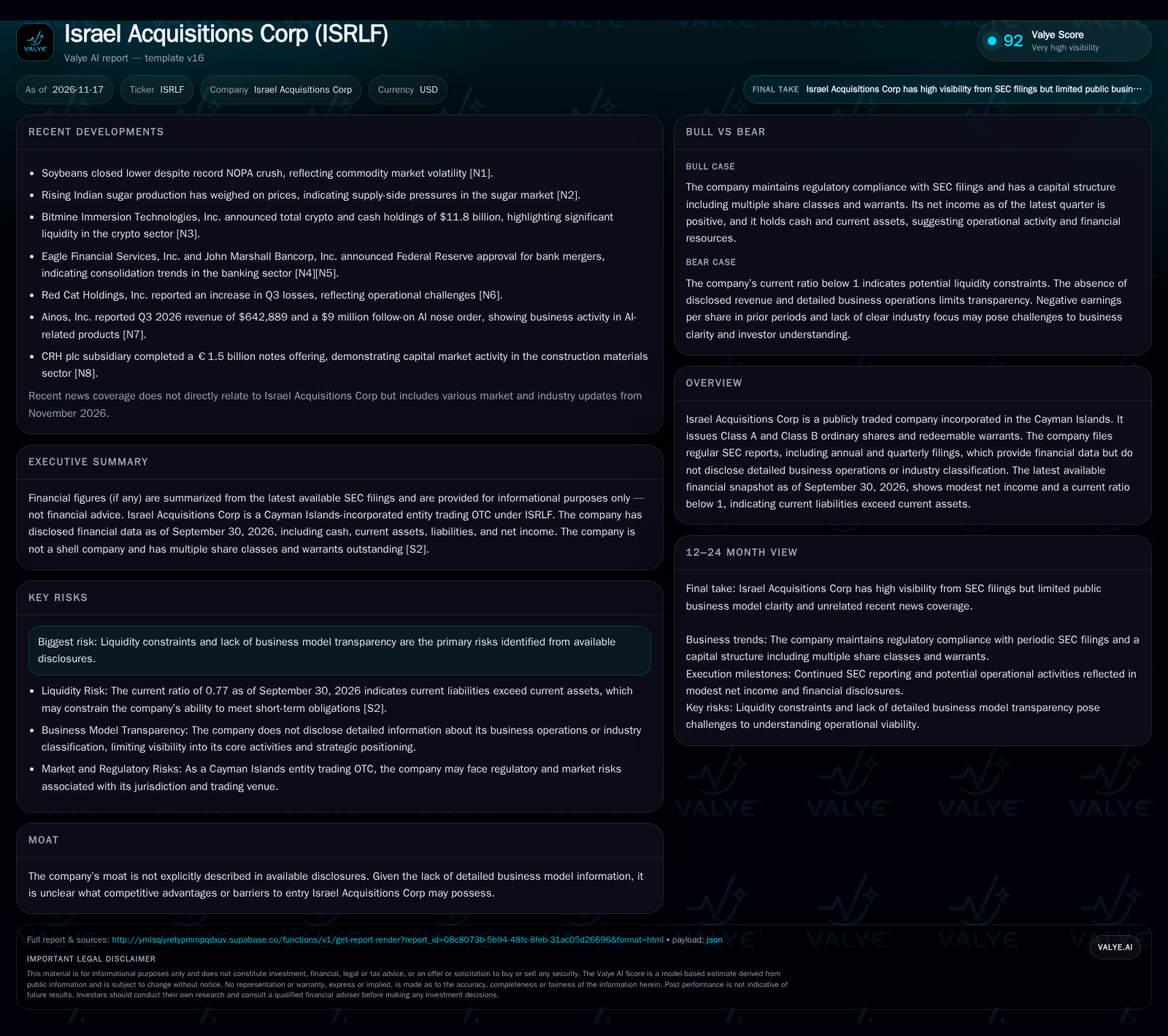
Israel Acquisitions Corp offers a rare case of regulatory transparency without operational clarity. With a positive quarter of net income but a current ratio below 1, the company’s actual business activities remain opaque, leaving investors to weigh the implications of its capital structure, liquidity status, and lack of disclosed strategic direction.
Israel Acquisitions Corp, a Cayman Islands entity trading OTC, reports modest net income but faces a current ratio of 0.77, suggesting more liabilities than current assets. Investors must focus on capital deployment, future disclosures, and the company’s ability to articulate a strategy.
Israel Acquisitions Corp stands as an enigma: a publicly traded Cayman Islands entity with full SEC reporting and a complex capital structure, yet no disclosed business model or industry focus. Without clarity on how it generates earnings or manages its obligations, the core question is whether this is a transition-stage company on the verge of a disclosed strategy, or a persistently opaque entity where financial results lack context. Investors and observers alike must focus on the mechanisms behind its profitability, the implications of its liquidity gap, and the signals that could reveal a genuine operating business—or the lack thereof.
Current Financial Position and Transparency—A Paradox
The most material current facts are: (1) Israel Acquisitions Corp is not classified as a shell company, according to its latest SEC filings; (2) as of September 30, 2026, it reported $14,011 in cash, total current assets of approximately $6.5 million, and current liabilities of about $8.4 million, yielding a current ratio of 0.77 and a cash ratio of 0 [S2]; (3) it posted net income of $79,276 for the quarter, but with no operational or industry details disclosed [S2]; and (4) the company’s capital structure includes 1,264,572 Class A and 4,791,667 Class B ordinary shares, plus redeemable warrants at $11.50 per share [S2].
These facts matter because the company’s apparent profitability is presented without any explanation of revenue sources, business activities, or industry context. The liquidity gap implied by the current ratio below 1 means short-term obligations exceed liquid assets, raising questions about the company’s ability to meet near-term commitments if operational cash flows are not robust or recurring. The multi-class share structure and outstanding warrants create additional uncertainty about future dilution and governance.
Untangling the Economic Engine: What Could Drive Value Creation?
With no disclosed business model, the economics of Israel Acquisitions Corp remain speculative. The presence of net income suggests some form of revenue-generating activity, but without detail, it is impossible to assess the durability, margin profile, or scalability of those earnings. If the company operates as an acquisition platform or holding company—a plausible scenario given its name—it could generate returns through investment gains, fee income, or asset appreciation. In such structures, income may be episodic rather than recurring, and fixed costs may be low relative to deal-driven revenue.
The capital structure, with multiple share classes and warrants, implies the potential for future capital raising or acquisition-driven dilution. If the company deploys capital into high-return investments or acquisitions, the model could provide operating leverage, but the current liquidity shortfall (current ratio 0.77) means any new opportunity may require external funding, which could be dilutive or costly. The absence of disclosed capital expenditures, R&D, or operating segments prevents further granularity on cost structure or required investment cycles.
If Israel Acquisitions Corp functions as an acquisition platform, the timing and nature of capital deployment become critical to value creation. The company’s ability to identify targets at favorable valuations and integrate or manage acquired assets efficiently would determine whether episodic gains translate into sustainable earnings. Moreover, without disclosed operating segments or cost breakdowns, it is challenging to assess leverage points or margin improvement potential. If the company relies heavily on financial engineering or one-time gains, the reported net income may not reflect operational health, underscoring the importance of future disclosures to distinguish between recurring business economics and transient accounting outcomes.
Competitive Landscape: Structural Ambiguity and the Challenge of Differentiation
Without a declared industry or business focus, Israel Acquisitions Corp’s competitive set is undefined. If the company is a special purpose acquisition company (SPAC) or investment vehicle, it competes with other blank-check firms and holding companies for deal flow, capital, and investor attention. Such entities typically rely on sponsor reputation, deal-sourcing networks, and the ability to identify value-accretive transactions.
The lack of disclosed differentiation—such as sector focus, operational expertise, or proprietary sourcing—means the company risks being undifferentiated in a crowded field. Counterforces could include investor skepticism due to opacity, competition from more transparent or sector-specialized vehicles, and possible regulatory scrutiny if disclosures remain limited. Substitutes for investors include direct investment in operating companies, sector-specific funds, or alternative SPACs with clearer mandates.
In an environment where investor appetite for opaque vehicles has diminished, Israel Acquisitions Corp’s lack of strategic clarity could impair its ability to attract capital relative to peers with defined sector expertise or operational track records. The competitive disadvantage may manifest in higher capital costs or difficulties in sourcing proprietary deals. Furthermore, regulatory expectations for transparency have increased, and entities that fail to meet evolving disclosure norms risk reputational damage or investor withdrawal. Consequently, the company’s strategic ambiguity not only challenges differentiation but also raises the prospect of structural disadvantages in capital markets and deal execution.
Catalyst for Value: What If Israel Acquisitions Corp Reveals a High-Quality Operating Business?
A favorable outcome could unfold if the company discloses a credible business model or announces a significant acquisition, providing clarity on revenue sources, industry exposure, and growth potential. If future filings detail recurring revenues, strong gross margins, or a differentiated asset base, investor confidence could rise, potentially closing the valuation and liquidity gap.
Evidence that would confirm this scenario includes: (a) new SEC filings with segment-level financials and operational KPIs; (b) announcements of material acquisitions or partnerships; (c) disclosure of customer or contract wins; and (d) a revised capital plan that addresses liquidity constraints through non-dilutive means. The falsification would be continued opacity, lack of substantive operational updates, or reliance on episodic, non-repeatable income.
Opaque Operations and Incremental Disclosures: The Most Likely Trajectory
The most plausible scenario is that Israel Acquisitions Corp continues to file SEC reports with minimal operational detail, maintaining regulatory compliance but offering little insight into business fundamentals. The company may generate sporadic net income from undisclosed activities, with financial performance remaining unpredictable and disconnected from transparent business drivers.
Confirmation of this trajectory would come from future filings that remain high-level, with no segment reporting, operating metrics, or industry identification. Dilution could materialize if warrants are exercised or new shares are issued to address liquidity needs. The scenario would be falsified if the company suddenly shifts to detailed operational disclosure or provides a clear strategic update.
Liquidity Strain and Persistent Opacity Could Erode Value
A negative chain of events could occur if liquidity pressures intensify and the company cannot generate or access new capital. If the company’s earnings prove to be one-off or non-recurring, and if further dilution or unfavorable financing becomes necessary, shareholder value could erode.
This scenario would be confirmed by deteriorating balance sheet metrics (e.g., rising current liabilities, declining cash), missed payments, or qualified audit opinions. Investor confidence could be further undermined by continued lack of operational transparency, absence of strategic updates, or regulatory scrutiny due to persistent disclosure gaps.
What Will Reveal Israel Acquisitions Corp’s True Business and Trajectory?
Disclosure of revenue sources, customer concentration, or industry classification—if provided—would help clarify the company’s business model and sustainability.
Quarterly trends in net income, cash flow from operations, and the persistence or volatility of earnings would provide insight into whether profitability is recurring or episodic.
Announcements of material acquisitions, investments, or divestitures would reveal strategic direction and capital allocation priorities.
Details on warrant exercises, share issuances, or capital raises would clarify dilution risk and funding strategy.
Any segment reporting, operational KPIs, or management commentary in future SEC filings would provide key information on scalability and execution.
Regulatory or audit commentary on going concern status or disclosure adequacy could signal heightened risk or prompt more transparency.
Disclaimer: This is research-only, informational analysis and not investment advice. It may include AI-generated interpretation and general industry context. Always verify important details using primary sources.

Comments