
Toppoint Holdings: Logistics Growth, Capital Strategy, and Market Confidence Dynamics
Toppoint Holdings has grown its logistics footprint through fleet modernization, refrigeration logistics, and international partnerships, while facing pressure from internal control weaknesses and a trading halt. The company’s next phase will hinge on aligning capital investments with demand, managing operational risks, and restoring market credibility.
Toppoint Holdings has modernized its fleet, expanded into refrigeration logistics, and established international partnerships to drive growth. Market confidence and execution on capital deployment will be central to future outcomes. [S2] [N4] [N8]
Toppoint Holdings Inc. has sought to carve out a differentiated position in the transportation and logistics industry by modernizing its fleet, expanding into refrigeration and waste management, and forging international partnerships. The recent trading halt and persistent internal control issues underscore a critical juncture: can Toppoint translate operational momentum into reliable profitability and restore market confidence, or will execution missteps and risk exposures derail its progress?
Recent Expansion and Financial Position Define the Strategic Crossroads
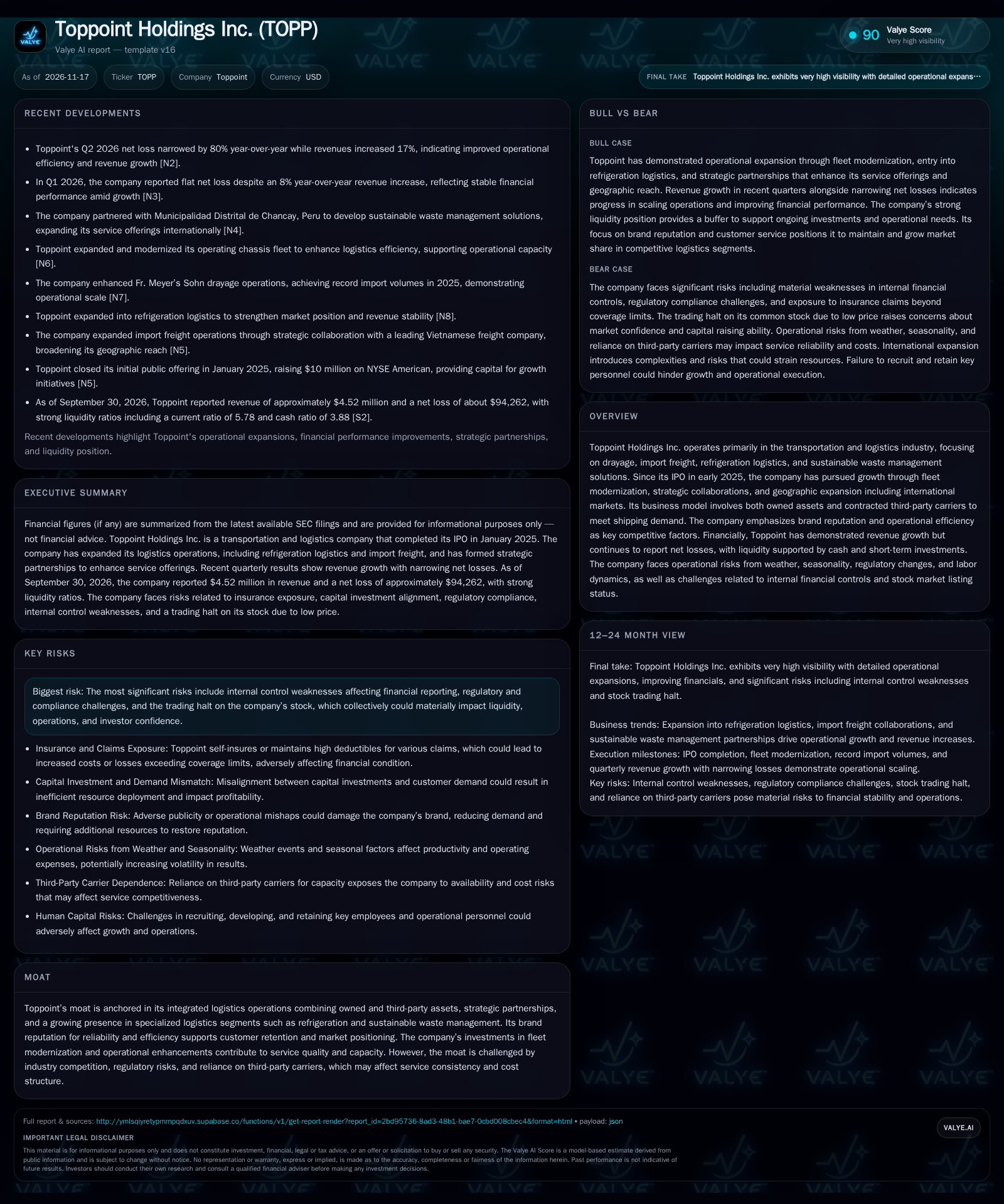
As of September 30, 2026, Toppoint Holdings reported revenue of approximately $4.52 million and a net loss of about $94,262, supported by a reported current ratio of 5.78 and cash ratio of 3.88 [S2]. The company reported cash and liquidity metrics for the period; these figures do not by themselves establish operating runway, investment capacity, financial flexibility, or financing capacity. [N3]
Operationally, Toppoint has expanded and modernized its chassis fleet, entered refrigeration logistics to improve revenue stability, and secured international partnerships in Vietnam and Peru, including a memorandum with the Municipalidad Distrital de Chancay for sustainable waste management [N4] [N5] [N6] [N8].
However, the company’s stock was halted from trading on NYSE American in November 2026 due to low share price, with a planned reverse split aimed at regaining compliance. Material weaknesses in internal financial controls have also been disclosed, raising questions about financial reporting reliability [S2].
How Toppoint’s Revenue Mix and Asset Model Shape Operating Leverage
Toppoint’s business model combines owned fleet assets with contracted third-party carriers to provide drayage, import freight, refrigeration logistics, and waste management solutions. Revenue is generated through a mix of direct transportation services, value-added logistics (such as refrigeration and integrated port drayage), and emerging waste management offerings. The expansion into specialized services, like refrigeration logistics, may support higher-margin, more resilient revenue streams compared to commoditized freight.
Fleet modernization and international partnerships require significant upfront capital deployment, with returns highly dependent on utilization rates and alignment with customer demand. If the company can match investments to growing import/export volumes—such as those anticipated at the developing Port of Chancay—it could unlock operating leverage as fixed costs are spread over greater throughput.
However, exposure to variable costs through third-party carriers, and self-insurance with high deductibles, means that both cost structure and profitability can swing with fuel, labor, and claims volatility. Seasonality, weather, and macroeconomic cycles further complicate forecasting and margin management, especially for asset-intensive logistics providers.
Service Breadth, Brand, and Partnerships: Competitive Levers and Vulnerabilities
Toppoint competes in a fragmented logistics sector where scale, service reliability, and the ability to deliver specialized solutions (such as refrigeration and integrated waste management) differentiate providers. Its strategy of combining owned assets with third-party capacity offers flexibility, but also limits control over service consistency and cost predictability.
Strategic collaborations—such as with a leading Vietnamese freight company and the Chancay municipality—may open doors to higher-growth international trade lanes and specialized waste management contracts. If successfully executed, these partnerships could provide a pipeline of volume and recurring business that is less vulnerable to domestic cyclicality.
However, the company’s reliance on brand reputation for ‘white glove’ service means that operational failures, accidents, or regulatory missteps could quickly erode customer trust. The presence of material internal control weaknesses and the trading halt may also weaken its standing with large enterprise clients and partners who value stability and compliance. Competition from larger integrated logistics firms, niche specialists, and digital freight platforms remains intense, especially in the high-throughput, time-sensitive segments Toppoint targets.
Unlocking Operating Leverage Through Demand-Driven Expansion
A favorable trajectory for Toppoint would see its investments in fleet modernization, refrigeration logistics, and international partnerships translating into sustained volume growth and higher-margin service mix. If the Port of Chancay development proceeds as projected and Toppoint secures a significant share of resulting container flow, the company could achieve scale economies and revenue diversification beyond its legacy U.S. markets.
Successful remediation of internal control weaknesses and a return to active exchange trading would likely restore some market confidence, potentially lowering the company’s cost of capital and enabling further investment.
Confirmation of this scenario would be visible in accelerating revenue growth outpacing cost increases, rising gross and operating margins, reduction in claims or insurance expense as a percent of revenue, and new customer wins or contract extensions tied to the international expansion. A resumption of trading and improved share liquidity would further validate recovery.
Managing Through Volatility as Expansion and Risk Counterbalance Each Other
The most probable path for Toppoint is a period of operational and financial volatility as it works to align capital deployment with actual demand in both domestic and international markets. While the expanded fleet and refrigeration logistics business offer growth potential, utilization rates may lag investments if market demand softens or execution in new geographies proves slower than planned.
The company is likely to remain profitable at the operational level for core U.S. drayage and waste management services but may continue to report modest net losses as new ventures scale and internal control remediation costs persist. The trading halt and reverse split may resolve listing compliance, but investor skepticism could linger until several clean quarters of financial reporting and margin improvement are demonstrated.
This scenario would be supported by steady or modestly rising revenue, flat to slightly improving margins, and incremental progress in resolving internal control issues. Ongoing reliance on third-party carriers and insurance self-retention would continue to expose the company to cost variability.
Execution Missteps and External Shocks Could Derail Momentum
The adverse scenario for Toppoint involves a combination of execution failures, external shocks, and persistent market distrust. If capital investments in fleet and international partnerships outpace actual customer demand, underutilization could erode margins and drain liquidity. Unresolved internal control weaknesses may result in financial reporting errors, regulatory penalties, or further erosion of customer and partner trust.
Continued trading suspension or delisting could impair access to capital, limit strategic options, and trigger loss of confidence among key clients or counterparties. Operational setbacks—such as major claims, labor disputes, or regulatory actions—would further pressure profitability and reputation.
Evidence for this scenario would include declining or stagnant revenue, widening net losses, negative operating cash flow, ongoing or new material weaknesses in financial controls, and continued illiquidity or suspension of the company’s shares.
What Will Determine Whether Toppoint Can Translate Growth Into Lasting Value
Revenue growth and segment mix, especially the contribution from refrigeration logistics and international operations, would help test whether expansion efforts are translating into higher-margin, more resilient revenue streams.
Utilization rates for owned fleet assets and capacity contracted with third-party carriers, if disclosed, would clarify whether capital investments are aligned with realized demand.
Gross and operating margin trends over the next several quarters will indicate whether operational leverage is being achieved or cost pressures are eroding profitability.
Progress updates on remediation of internal control weaknesses, including auditor commentary or removal of material weakness disclosures, would signal improved financial reporting reliability.
Resolution of the trading halt and restoration of active, liquid trading on a major exchange would serve as a barometer of regained market confidence.
Updates on the scale and profitability of the Port of Chancay partnership and other international ventures would help validate the upside scenario.
Claims expense as a percent of revenue and any changes in insurance self-retention structure would provide insight into risk management and cost volatility.
Retention and recruitment of key operational personnel, if disclosed, would test the company’s ability to sustain growth and service quality in a tight labor market.
Disclaimer: This is research-only, informational analysis and not investment advice. It may include AI-generated interpretation and general industry context. Always verify important details using primary sources.

Comments