
Comscore’s Measurement Ambition: Innovation, Losses, and the Credibility-Scale Dilemma
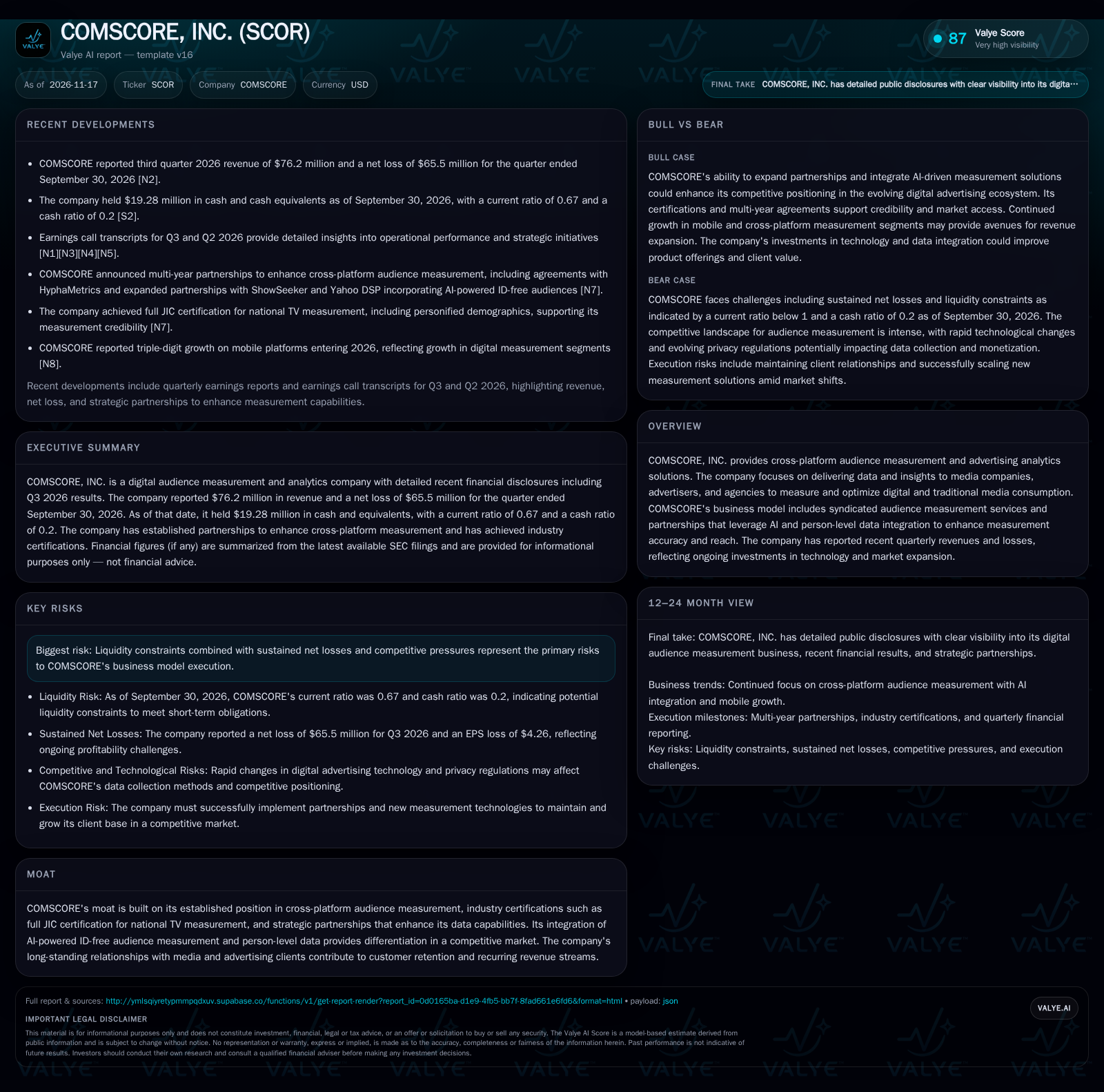
Comscore reported Q3 2026 revenue of $76.2 million and a net loss of $65.5 million, with cash and equivalents of $19.28 million and a current ratio of 0.67.
Comscore reported Q3 2026 revenue of $76.2 million and a net loss of $65.5 million, with cash and equivalents of $19.28 million and a current ratio of 0.67. The company is investing heavily in AI-powered, cross-platform measurement, achieving full JIC certification and signing multi-year partnerships with HyphaMetrics, ShowSeeker, and Yahoo DSP. [N2] [S2] [N7] [N8]
Comscore, once synonymous with digital audience measurement, finds itself at a crossroads: aggressively expanding its cross-platform and AI-powered analytics through high-profile partnerships and industry certifications, while contending with persistent net losses and a shrinking liquidity cushion. The company’s Q3 2026 results highlight a business model under pressure to prove that technological innovation, credibility in measurement, and mobile growth can be converted into sustainable, profitable scale before its potential financial flexibility evaporates. The core question for investors and industry partners alike is whether Comscore’s strategic advances will meaningfully shift its economic trajectory—or if competitive and capital constraints will force a reset.
Recent Results Spotlight Liquidity and Strategic Initiatives
Comscore reported Q3 2026 revenue of $76.2 million and a net loss of $65.5 million, a stark indicator of ongoing unprofitability despite topline stability. The company reported a current ratio of 0.67 for the period. [N2] [S2]
Operationally, Comscore has doubled down on cross-platform measurement, securing multi-year partnerships with HyphaMetrics, ShowSeeker, and Yahoo DSP to enhance AI-powered, ID-free audience analytics. The company’s full JIC certification for national TV measurement, including personified demographics, is a notable industry credential. Triple-digit growth in mobile measurement segments entering 2026 further signals that Comscore is gaining traction in digital-first analytics. [N7] [N8]
These facts matter because they frame a company balancing ambitious product and partnership moves against a backdrop of deteriorating balance sheet flexibility, raising the stakes for near-term execution and commercial validation.
Revenue Streams, Cost Structure, and the Path to Scale
Comscore’s core business model is built on syndicated audience measurement and analytics for media companies, advertisers, and agencies. Revenue is driven by data subscriptions, platform access fees, and custom analytics projects. The company’s recent focus on cross-platform measurement—spanning TV, digital, and mobile—reflects an attempt to capture a broader share of advertiser and publisher budgets as viewing fragments across devices.
The economics of syndicated measurement are attractive at scale: high fixed costs for data infrastructure, panel maintenance, and R&D, but low marginal costs for serving incremental clients. This dynamic creates potential for operating leverage if Comscore can expand its client base or wallet share. However, persistent net losses suggest that either scale has not yet been achieved, pricing remains pressured, or cost discipline is lacking.
AI-powered, privacy-compliant analytics (such as ID-free audience measurement) could command premium pricing if they become table stakes in the post-cookie, privacy-regulated environment. The question is whether Comscore can achieve enough volume and differentiation to offset its heavy investment in technology and data partnerships before liquidity constraints force cutbacks.
Capital needs remain acute. The company reported cash and liquidity metrics for the period; these figures do not by themselves establish operating runway, investment capacity, financial flexibility, or financing capacity.
Defensibility in a Crowded, Evolving Measurement Landscape
Comscore operates in a fiercely competitive market, contending with legacy incumbents in TV and digital measurement, specialized analytics firms, and a growing set of privacy-centric technology providers. The company’s recent industry certifications (notably full JIC approval for national TV measurement with personified demographics) and partnerships with HyphaMetrics, ShowSeeker, and Yahoo DSP are intended to bolster its credibility and data breadth. [N7]
AI-driven, cross-platform measurement is a differentiator, especially as advertisers demand unified reach and frequency analytics across TV, streaming, and digital. However, barriers to switching between measurement providers are not insurmountable—clients often test multiple vendors, and contracts can be project-based or annual rather than truly recurring and multi-year. The durability of Comscore’s revenue thus depends on both technical superiority and the stickiness of its integrations within client workflows.
Substitution risk is rising as privacy regulation limits third-party data access, and as large platforms (e.g., walled gardens or streaming giants) develop proprietary measurement tools. Comscore’s challenge is to remain indispensable by offering cross-platform, privacy-compliant analytics that smaller or single-channel players cannot match. If the company cannot maintain this edge or monetize it effectively, market share could erode rapidly.
If AI-Powered Partnerships Drive Adoption and Margin Expansion
A favorable scenario for Comscore involves rapid client uptake of its AI-driven, cross-platform measurement solutions, underpinned by recent partnerships with HyphaMetrics, ShowSeeker, and Yahoo DSP. If these relationships translate into expanded market access and recurring contract wins—particularly with large agencies or media groups—Comscore could accelerate revenue growth and begin to realize operating leverage as fixed data and tech costs are spread over a larger base.
Full JIC certification and demonstrated triple-digit mobile growth suggest that Comscore’s offerings are resonating as advertisers seek credible, privacy-forward alternatives to legacy measurement. If the company can convert pilot programs and certifications into long-term, high-value customer agreements, it may achieve the scale required to approach or reach profitability.
Evidence confirming this scenario would include sustained double-digit revenue growth, clear disclosure of multi-year recurring contract wins, expanding gross margins, and a reversal of cash burn in quarterly filings. Conversely, if revenue growth stalls, or if gross margins remain compressed due to heavy incentives or client churn, the upside thesis would be challenged.
Most Likely Trajectory: Measured Progress Amid Persistent Strain
The most plausible outlook is that Comscore continues to grow its digital and cross-platform measurement segments—particularly in mobile—thanks to product innovation and industry recognition, but faces ongoing pressure from high fixed costs, competitive pricing, and the need for continual investment in data and technology.
Revenue may expand modestly, but net losses are likely to persist in the absence of significant margin improvement or a step-change in client scale. The company could be forced to seek additional capital—via debt, equity, or strategic partnerships—to support operations, particularly if cash burn continues at current rates.
This scenario would be confirmed by quarterly results showing mid-single-digit to low double-digit revenue growth, limited improvement in operating margins, and recurring references to liquidity management or capital-raising efforts in management commentary. Falsification would require clear evidence of either a return to profitability or a major strategic transaction that fundamentally alters the company’s cost or revenue base.
Liquidity Pressures Force Retrenchment or Strategic Alternatives
In an adverse scenario, Comscore’s liquidity position deteriorates further as net losses persist and cash reserves are depleted. With a current ratio well below 1 and a cash ratio of just 0.2 as of September 2026, the company is vulnerable to any revenue shortfall, delayed collections, or unexpected expense spikes. [S2]
If Comscore is unable to secure new financing or accelerate revenue growth, it may be forced to reduce investment in product development, delay partnership rollouts, or consider asset sales and strategic alternatives (including acquisition or merger with a larger player).
Confirmation of this scenario would include further erosion of the cash balance, disclosure of covenant breaches or going concern warnings, layoffs or R&D cutbacks, and a slowdown in partnership or product launch activity. Conversely, if the company secures a sizable capital infusion or demonstrates a clear path to cash flow break-even, the worst-case outcome could be averted.
What Will Reveal If Comscore’s Strategy Can Outrun Its Financial Constraints?
Quarterly cash burn and cash balance trends—especially any acceleration or deceleration in net cash outflows relative to revenue. [S2]
Client retention rates and average contract duration, if disclosed, to gauge the stickiness and quality of Comscore’s revenue base.
The mix of recurring versus project-based or one-time analytics revenue, which would clarify the predictability of future cash flows.
Gross margin progression as new AI-powered and cross-platform offerings scale—an improvement would indicate operating leverage.
Disclosure of new, multi-year contract wins or expansions, particularly with top-tier agencies or media conglomerates.
Any announcements regarding new capital raises, credit facility amendments, or strategic transactions aimed at shoring up liquidity.
Industry adoption of JIC-certified measurement standards and evidence that Comscore’s solutions are preferred versus major competitors.
Shifts in regulatory or privacy landscapes that could materially impact data access or measurement methodologies across platforms.
Disclaimer: This is research-only, informational analysis and not investment advice. It may include AI-generated interpretation and general industry context. Always verify important details using primary sources.

Comments