
Lakewood-Amedex Biotherapeutics Advances Nu-3 with Early-Stage Antimicrobial Innovation
Lakewood-Amedex Biotherapeutics is progressing its lead candidate, Nu-3, for infected diabetic foot ulcers, leveraging regulatory momentum and reported liquidity position. The company’s future hinges on clinical outcomes, regulatory approval, and the broader market’s appetite for next-generation antimicrobials.
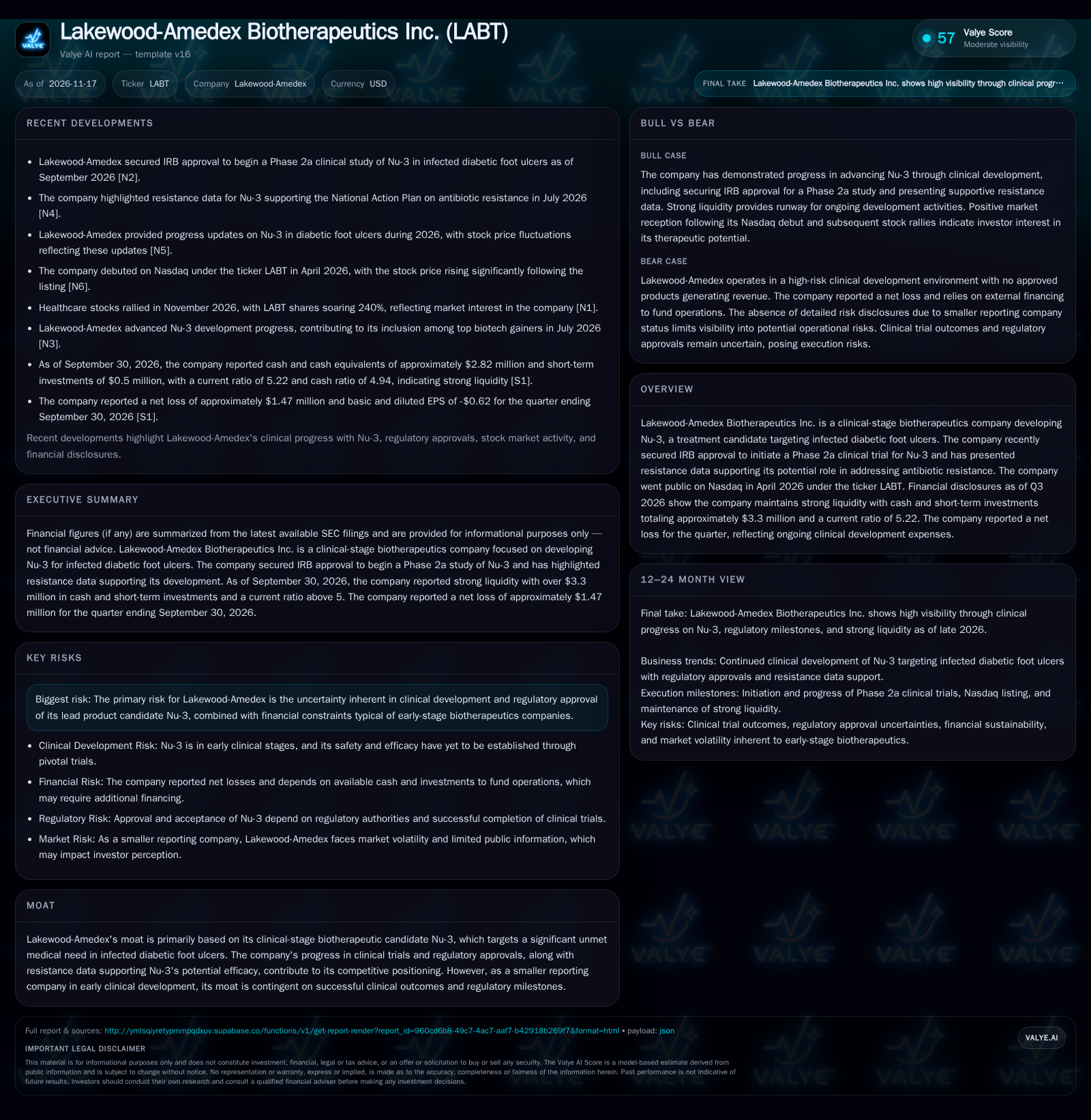
Lakewood-Amedex has initiated a Phase 2a trial for Nu-3 in infected diabetic foot ulcers, backed by IRB approval and supportive resistance data. [S1] [N2] [N4]
Lakewood-Amedex Biotherapeutics is at a pivotal juncture as it advances Nu-3, a novel candidate for infected diabetic foot ulcers, into Phase 2a clinical trials. With antibiotic resistance a mounting global concern and few novel antimicrobials reaching market, Lakewood-Amedex’s resistance data and regulatory momentum have caught investor attention, evidenced by recent stock surges. However, as a pre-commercial company with limited cash and no revenue, the path forward will be dictated by clinical outcomes, financing options, and the ability to differentiate Nu-3 in a crowded and risk-laden sector.
Nu-3 Progresses to Phase 2a: Regulatory Achievements and Financial Health
Lakewood-Amedex secured Institutional Review Board (IRB) approval in September 2026 to initiate a Phase 2a clinical study for its lead asset, Nu-3, in infected diabetic foot ulcers—a key regulatory milestone that enables the company to gather critical safety and efficacy data in a targeted patient population. This step is significant because it transitions Nu-3 from exploratory human studies toward more rigorous clinical evaluation, a prerequisite for advancing to pivotal trials and eventual commercialization. [N2]
In parallel, the company highlighted resistance data for Nu-3, positioning it as a potential tool in the fight against antibiotic resistance—a strategic alignment with global and national health priorities. [N4]
Financially, Lakewood-Amedex reported approximately $3.32 million in cash and short-term investments as of September 30, 2026, with a current ratio of 5.22. While this indicates reported liquidity position for the near term, the company also reported a net loss of $1.47 million for the quarter, reflecting the capital-intensive nature of clinical development and the absence of commercial revenue. [S1]
Examining Cost Dynamics and Value in Early Biotherapeutic Development
Lakewood-Amedex’s business model is typical of early-stage biotherapeutics: high upfront R&D outlays, prolonged periods without revenue, and value inflection tied to clinical and regulatory milestones. The economics are fundamentally binary—either Nu-3 delivers compelling clinical data and secures regulatory approval, creating a pathway to monetization, or it fails at a key hurdle, rendering sunk costs unrecoverable.
The company’s reported net loss of $1.47 million for the quarter illustrates the ongoing cash burn tied to clinical operations, regulatory preparation, and pipeline advancement. [S1] With only $3.32 million in liquid assets, the current funding likely supports operations through a limited set of clinical milestones but may not be sufficient for full Phase 2 or subsequent pivotal studies, let alone an eventual commercial launch.
If Nu-3 advances successfully, Lakewood-Amedex could pursue several commercial models: out-licensing to a larger pharmaceutical partner, co-development arrangements, or direct commercialization in niche markets. Each path would require different capital commitments and could impact the company’s future margin structure, with licensing deals offering upfront payments and royalties but reduced long-term capture, and direct commercialization offering higher margins but greater risk and capital requirements.
Standing Out in the Competitive Antimicrobial Market
Lakewood-Amedex’s competitive position is predicated on Nu-3’s clinical profile and its ability to address the urgent need for new treatments for infected diabetic foot ulcers—a complication with limited effective therapies and high rates of chronic infection. The company’s resistance data could differentiate Nu-3 from legacy antibiotics, especially if it demonstrates efficacy against multidrug-resistant pathogens.
However, the antimicrobial therapeutics market is crowded and dominated by established players with greater resources, robust sales forces, and extensive regulatory experience. Numerous small and mid-sized biotech firms are also pursuing next-generation antibiotics, often targeting similar infection types and leveraging novel mechanisms to combat resistance. The key to differentiation will be not just clinical efficacy, but also safety, dosing convenience, and the ability to fit into existing care protocols.
Barriers to entry in this space include the complexity and expense of clinical trials, regulatory uncertainty, and the historical challenge of commercializing new antibiotics—where reimbursement, stewardship policies, and hospital purchasing dynamics often limit pricing power and uptake. Unless Nu-3 can clearly demonstrate clinical superiority or unique resistance-breaking properties, Lakewood-Amedex may face significant adoption and market access hurdles.
Potential for Strategic Gains from Promising Clinical Outcomes
The most favorable scenario for Lakewood-Amedex is a successful Phase 2a trial demonstrating Nu-3’s safety and robust efficacy in treating infected diabetic foot ulcers, particularly in cases resistant to standard antibiotics. This outcome would materially de-risk the asset, attract potential licensing or partnership interest from larger pharmaceutical companies, and support follow-on financing at more attractive terms.
Positive clinical results could also enable the company to accelerate Phase 2b and potentially negotiate non-dilutive funding through grants or government partnerships, especially given the alignment with antibiotic resistance priorities. Strong clinical and resistance data would position Nu-3 as a differentiated entrant in the market and could support premium pricing or favorable formulary inclusion.
Evidence confirming this scenario would include statistically significant efficacy outcomes, a favorable safety profile, and public disclosures of partnership interest or term sheets from established pharma players. Conversely, a lack of improvement over standard of care or safety signals in the Phase 2a trial would quickly challenge this thesis.
Projected Steady Advancement Amid Funding and Operational Challenges
The most plausible pathway for Lakewood-Amedex is incremental clinical progress with Nu-3, with the Phase 2a study generating mixed or modestly positive results that warrant further investigation but do not immediately unlock transformative value or partnerships. In this scenario, the company continues to burn cash at historical rates and is compelled to pursue additional financing—likely through equity offerings or partnerships with less favorable terms.
This base case assumes that while Nu-3 remains clinically viable, Lakewood-Amedex faces persistent execution risks: extended trial timelines, potential protocol amendments, and the ongoing challenge of differentiating Nu-3 in a field crowded with similar early-stage assets.
Evidence supporting this scenario would include continued trial enrollment, steady but unspectacular clinical updates, and periodic capital raises. Confirmation of this trajectory would come from disclosures of additional financing, modest clinical progress, and lack of major partnership announcements.
Risks from Clinical and Capital Hurdles May Prompt Strategic Shifts
In an adverse scenario, Nu-3 fails to demonstrate sufficient safety or efficacy in Phase 2a, or encounters unexpected adverse events that halt development. Such an outcome would not only undermine the asset’s value but also imperil Lakewood-Amedex’s ability to raise additional capital, given the company’s pre-commercial status and lack of alternative near-term revenue streams.
The company could be forced to suspend or wind down Nu-3 development, pursue asset sales, or seek a merger with a better-capitalized peer. Historical precedent in the antibiotic space suggests that failed mid-stage trials often result in sharp declines in share price, loss of investor confidence, and, in some cases, bankruptcy or liquidation.
Confirmation of this scenario would include negative clinical data, trial discontinuation announcements, or failure to secure financing within the next reporting periods. Early warning signs would be slow enrollment, clinical holds, or adverse regulatory feedback.
Upcoming Events Influencing Lakewood-Amedex’s Investment Outlook
Phase 2a enrollment progress and timeline updates—delays or rapid recruitment would be early signals of trial execution and investor sentiment.
Top-line safety and efficacy results from the Phase 2a Nu-3 trial, as these will directly inform the likelihood of advancing to Phase 2b and beyond.
Public disclosures or filings regarding new funding, equity raises, or non-dilutive grant awards—a useful metric would be cash runway projections if disclosed.
Announcements of strategic partnerships, licensing deals, or inbound interest from larger pharmaceutical companies.
Pipeline updates on earlier-stage assets, which could provide diversification and optionality beyond Nu-3.
Regulatory feedback or designations (such as Fast Track or Breakthrough Therapy) that could accelerate development or enhance market access.
Market or competitive developments among other diabetic foot ulcer or antibiotic-resistance therapeutics, which could shift the landscape for Nu-3.
Disclaimer: This is research-only, informational analysis and not investment advice. It may include AI-generated interpretation and general industry context. Always verify important details using primary sources.

Comments