
Blue Water Acquisition Corp. IV: Assessing Strategic Ambiguity with Limited Disclosure
Blue Water Acquisition Corp.IV’s latest filings reveal positive net income and a reported current ratio, yet zero cash on hand and a lack of revenue disclosure leave major questions about its business model and operational trajectory. The company’s status as a smaller reporting entity underscores both regulatory flexibility and persistent opacity.
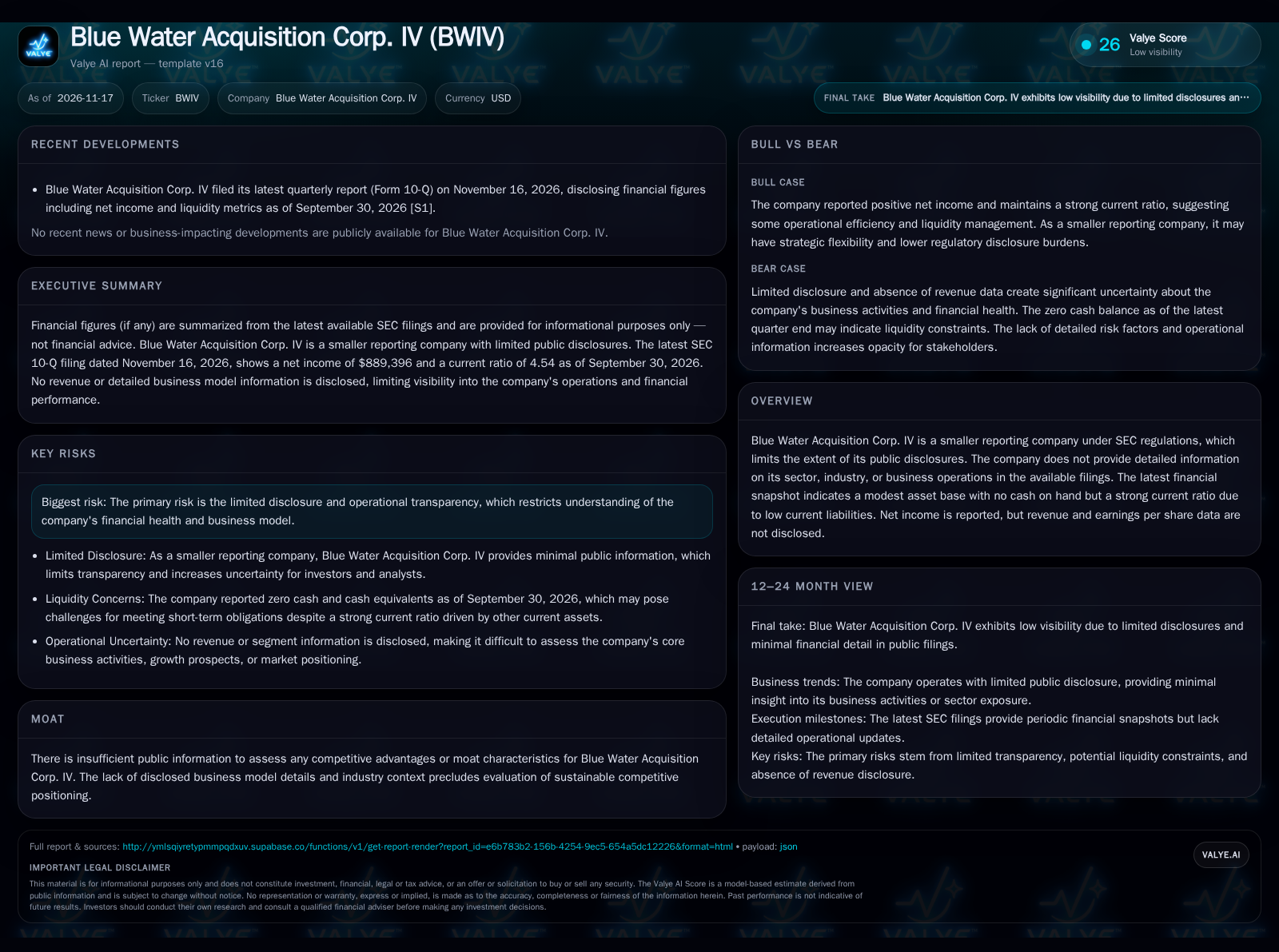
Blue Water Acquisition Corp. IV reported net income of $889,396 and a current ratio of 4.54 as of September 30, 2026, but disclosed no cash on hand or revenue. The key issue is whether the company’s positive income reflects a sustainable business or short-term financial maneuvering in a shell or SPAC-like structure. [S1]
Blue Water Acquisition Corp.IV offers a paradox for investors: its latest SEC filings show a positive net income and a notably reported current ratio, but also a complete absence of cash on hand and zero revenue disclosure. As a smaller reporting company, Blue Water enjoys regulatory leeway in limiting its public disclosures, leaving a wide gap in understanding its true business activities, sector exposure, and future prospects. This analysis explores the implications of these sparse disclosures, the plausible business models at play, and what would need to change for Blue Water to become more than a financial cipher.
Financial Overview: Insights and Gaps in the Latest Filing
As of September 30, 2026, Blue Water Acquisition Corp. IV reported net income of $889,396 for the quarter, a current asset base of $308,355, and current liabilities totaling $67,953, yielding a current ratio of 4.54. However, cash and cash equivalents stood at zero, and no revenue or segment information was provided in the latest SEC filings. The company’s status as a smaller reporting company under SEC rules allows it to minimize public disclosures, further limiting insight into its operations, sector, or business model. These facts suggest the company has generated accounting profits but provides no clarity on the underlying activity or sustainability. [S1]
The discrepancy between reported net income and the absence of cash or revenue highlights the importance of scrutinizing the quality and nature of earnings in entities with limited operational disclosure. In such cases, net income may be influenced by non-cash accounting entries, such as unrealized gains or revaluations, which do not contribute to liquidity or operational sustainability. This raises the question of whether traditional financial ratios and profitability metrics are meaningful without accompanying cash flow or revenue data. Investors and analysts must therefore consider supplementary metrics, such as cash flow from operations or changes in working capital, if disclosed, to better understand the company’s financial health beyond headline income figures.
Unpacking the Business Model Behind the Financial Figures
Without disclosed revenue or operational detail, Blue Water Acquisition Corp. IV’s net income figure could plausibly stem from non-operating sources such as investment gains, interest income on trust assets, or the reversal of prior accruals—common for blank-check companies, SPACs, or shell entities. If the company is structured as a SPAC, as its name suggests, income may come from interest earned on funds held in trust pending an acquisition, with minimal operating expenses. The absence of cash on hand may reflect a recent transaction, a transfer to a trust account, or the timing of financial statement cut-offs. The company reported cash and liquidity metrics for the period; these figures do not by themselves establish operating runway, investment capacity, financial flexibility, or financing capacity. The company’s capital requirements and operating leverage are thus opaque, but likely low unless and until a business combination is executed.
The structural economics of a blank-check or SPAC-like entity often revolve around a defined lifecycle, where initial capital is raised and held in trust until deployment in a target acquisition. The reported income in such entities may be largely passive, derived from interest on trust funds or short-term investments, rather than from active business operations. This creates a unique economic dynamic where profitability does not correlate with operational performance but rather with financial engineering and timing of transactions. The absence of cash on hand might reflect the timing of fund transfers or capital deployment, emphasizing the need to analyze the timing and nature of cash flows alongside balance sheet snapshots to assess liquidity and runway effectively.
Competitive Positioning: Opportunity or Structural Challenge?
Blue Water Acquisition Corp. IV’s lack of disclosed operations or sector focus means its competitive positioning cannot be assessed in conventional terms. If acting as a SPAC or shell company, its only differentiators would be sponsor reputation, deal pipeline, and the capacity to attract a compelling merger target. In the SPAC universe, competition revolves around sourcing attractive acquisition targets, negotiating favorable terms, and minimizing dilution for existing shareholders. The absence of operational or sector specificity could allow strategic flexibility, but also places Blue Water at a disadvantage relative to more transparent or sector-focused peers—especially if the market is saturated with competing blank-check vehicles. If the company instead has a dormant or legacy operating business, the absence of public disclosure may signal minimal scale or competitive relevance.
From a competitive standpoint, a blank-check vehicle’s success hinges on its ability to leverage sponsor expertise, network, and reputation to identify and consummate attractive acquisitions. The absence of sector focus may provide strategic flexibility but can also dilute investor confidence, as sector specialization often signals deeper industry knowledge and clearer value creation pathways. In competitive markets saturated with similar vehicles, differentiation through transparent communication and demonstrated deal execution capability becomes critical. Without operational disclosures or a clear strategic narrative, the company risks being perceived as a generic financial vehicle vulnerable to market sentiment shifts and competitive pressures from more focused or transparent peers.
Potential Upside from a Major Transaction
The most favorable scenario is that Blue Water Acquisition Corp. IV successfully consummates a merger or acquisition with a high-quality operating business, leveraging its public listing to create value for existing shareholders. Confirmation of this scenario would come through public announcements of a definitive merger agreement, detailed proxy filings, and disclosure of the target’s financials, sector, and growth prospects. In such a case, Blue Water’s net income could transition from trust income or accounting gains to genuine business profitability, and the company could see expanded disclosures, sector positioning, and potentially a re-rating by the market. The test for this scenario is the announcement of a business combination and subsequent transparent reporting.
Baseline Outlook: Ongoing Opacity and Financial Inertia
Absent new disclosures or a merger transaction, Blue Water Acquisition Corp. IV is likely to continue reporting minimal financial activity, with net income driven by residual trust interest or accounting adjustments. The company’s asset base may erode over time due to administrative expenses, and the lack of revenue or cash flow generation would persist. The most plausible middle path is ongoing stasis, with periodic filings showing little change, until a trigger event such as a business combination or liquidation occurs. Confirmation of this scenario would be the continued absence of material news, operational updates, or transaction filings over subsequent quarters.
Downside Risks from Expense Drain or Unsuccessful Deals
The adverse scenario is that Blue Water Acquisition Corp. IV either fails to secure a viable business combination or incurs administrative and professional expenses that erode its asset base. With zero cash reported, the company could face short-term liquidity challenges if obligations arise that cannot be met through other current assets. If the company is unable to consummate a transaction within regulatory deadlines, forced liquidation or redemption at less than book value could occur, leading to value loss for shareholders. Evidence supporting this scenario would include rising administrative expenses, a shrinking current asset base, or disclosures of failed transaction attempts or liquidation proceedings.
Key Developments That May Clarify Blue Water’s Future
Disclosure of a definitive merger or acquisition agreement, including details on the target’s business and financials, would be a major thesis inflection point.
Announcement of liquidation or redemption proceedings, particularly if trust assets are insufficient to cover obligations, would signal downside realization.
Trends in current asset composition—especially movements in restricted versus unrestricted cash, if disclosed—would clarify liquidity risk.
Administrative and professional fee trends, if detailed in future filings, would help assess the rate of value erosion in the absence of a transaction.
Evidence of sponsor capital injections, extensions of transaction deadlines, or shareholder votes on business combinations would indicate active deal pursuit.
Changes in reporting cadence or expansion of operational disclosures would suggest a shift from shell status to active business operations.
Any disclosure of revenue sources, customer relationships, or segment data would help validate the transition to a true operating company.
Disclaimer: This is research-only, informational analysis and not investment advice. It may include AI-generated interpretation and general industry context. Always verify important details using primary sources.

Comments